波动率税

Search documents
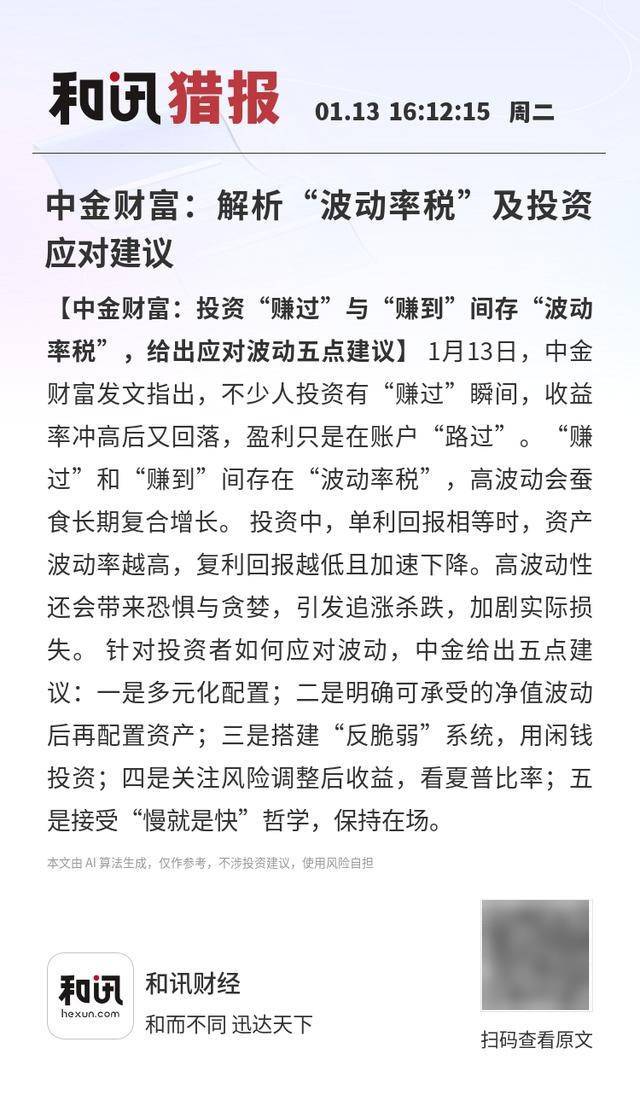
中金财富:解析“波动率税”及投资应对建议
Sou Hu Cai Jing· 2026-01-13 09:18
Core Insights - The article emphasizes the concept of "volatility tax" that exists between "earning" and "realizing" profits, highlighting that high volatility can erode long-term compound growth [1] Group 1: Volatility Tax - Many investors experience moments of "earning" but fail to "realize" those profits due to market fluctuations, which can lead to losses [1] - High volatility can lead to fear and greed, causing investors to chase trends and ultimately incur greater losses [1] Group 2: Recommendations for Investors - The company provides five strategies to manage volatility: 1. Diversify asset allocation 2. Define acceptable net asset value fluctuations before investing 3. Build a "anti-fragile" system using spare funds for investment 4. Focus on risk-adjusted returns, such as the Sharpe ratio 5. Embrace the philosophy that "slow is fast" and maintain presence in the market [1]

中金:“赚过”,是波动送给我们的一场幻觉
Ge Long Hui· 2026-01-13 08:47
Core Viewpoint - High volatility in investments can significantly erode long-term compound growth, creating a "volatility tax" that impacts returns despite short-term gains [1] Group 1: Impact of Volatility - Investors often experience fleeting moments of profit, but high volatility can lead to actual losses due to emotional trading behaviors like "buy high, sell low" [1] - Under equal simple return conditions, higher asset volatility results in lower compound returns, with a trend of accelerated decline [1] Group 2: Recommendations for Investors - Diversification is the most fundamental and effective method to manage volatility [1] - Investors should assess their tolerance for net value fluctuations when allocating assets [1] - Building a "anti-fragile" system is essential, emphasizing the use of idle funds for investment [1] - Focus on risk-adjusted returns rather than just yield rankings, learning to evaluate metrics like the Sharpe ratio [1] - Embrace the philosophy that "slow is fast" in investing, as remaining invested allows time to work in favor of the investor [1]
基金收益保卫战:如何不被市场波动「征税」?
天天基金网· 2025-07-14 11:18
Core Viewpoint - The article discusses the phenomenon of "return gap" in the Chinese public fund market, highlighting that despite the net asset value of funds increasing, investors are not achieving corresponding returns due to various behavioral biases and market volatility, referred to as "volatility tax" [4][7][20]. Summary by Sections Investment Returns Analysis - According to a recent report by Morningstar China, the annualized returns for non-industry and industry equity funds over the past five years were 6.67% and 3.68% respectively, while investors' returns were significantly lower, indicating a return gap of -2.65% and -5.05% [4]. - The report notes that despite the Shanghai and Shenzhen 300 Index declining by 3.95% from 2020 to May 2024, the overall fund net values have increased, yet investors are not benefiting from this growth [4]. Understanding Volatility Tax - "Volatility tax" is described as the erosion of investor returns due to behavioral biases caused by market fluctuations, affecting both retail and professional investors [7]. - The impact of volatility tax can be divided into two parts: "compound tax," which is the difference between arithmetic returns and actual returns due to volatility losses, and "behavioral tax," which arises from investors' emotional responses to market changes [8][9]. Strategies to Mitigate Volatility Tax 1. **Choosing Low-Volatility Products**: Selecting products with moderate volatility is the most effective way to avoid volatility tax. Typically, funds with high equity ratios or concentrated in single industries exhibit higher volatility [10]. 2. **Regular Investment in Stable Assets**: Investing in low-volatility strategies or indices through systematic investment plans can enhance the likelihood of achieving positive returns [11]. 3. **Constructing a Barbell Portfolio**: A balanced approach using opposing strategies, such as dividend and growth strategies, allows for rebalancing opportunities that can capitalize on market fluctuations [16]. Market Trends and Investor Behavior - The article notes that in developed markets, the average return gap for investors is around 1%, while in China it exceeds 2%, primarily due to the higher volatility of funds in the Chinese market [20]. - As economic growth slows, there is a growing preference for medium-volatility products, which are seen as more stable and capable of providing better returns with lower risk [20]. Recommendations for Investors - Investors are advised to diversify across various asset classes based on their risk tolerance and focus on undervalued or overlooked opportunities, particularly in dividend and value stocks, which may offer higher potential returns [21].