流动性缓冲设计

Search documents
ETO Markets:摩根大通3500亿美元大挪移,会否再次触发危机?
Sou Hu Cai Jing· 2025-12-18 08:07
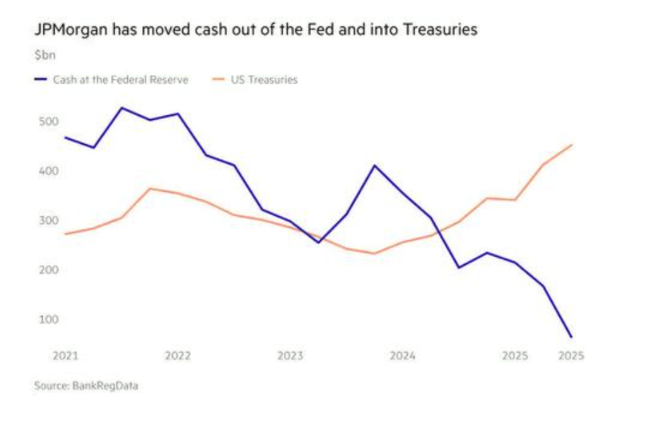
Core Insights - The liquidity in the U.S. financial system is being significantly impacted by JPMorgan Chase's strategic shift of $350 billion from reserves at the Federal Reserve to U.S. Treasury securities, leading to a contraction in overall system reserves [3] - JPMorgan's holdings of U.S. Treasuries surged from $231 billion to $450 billion, nearly doubling, as the bank aims to lock in future yields before anticipated interest rate cuts by the Federal Reserve [3][4] - The actions of a single institution, such as JPMorgan, can have substantial effects on overall market liquidity, raising concerns among regulators about financial stability [4][5] Group 1 - JPMorgan Chase has moved $350 billion from Federal Reserve reserves to U.S. Treasury securities, causing total bank deposits at the Fed to drop from $1.9 trillion to $1.6 trillion [3] - Excluding JPMorgan, the remaining 4,000 banks have seen a net increase in reserves, indicating that JPMorgan's actions are counteracting the overall banking sector's liquidity [3] - The bank's strategy is driven by the declining interest on reserves (IORB), which has decreased from a peak of 5.4% [3] Group 2 - JPMorgan's Treasury holdings increased significantly, with market speculation suggesting the bank is extending asset duration and using interest rate swaps to prepare for a low-rate environment [3][4] - The bank received $15 billion in interest from the Federal Reserve in 2024, which constitutes about 25% of its projected annual profit of $58.5 billion [4] - The ongoing debate regarding the Federal Reserve's interest on reserves and its impact on credit availability for the real economy has been reignited, highlighting potential conflicts between individual bank strategies and macroeconomic stability [4][5]