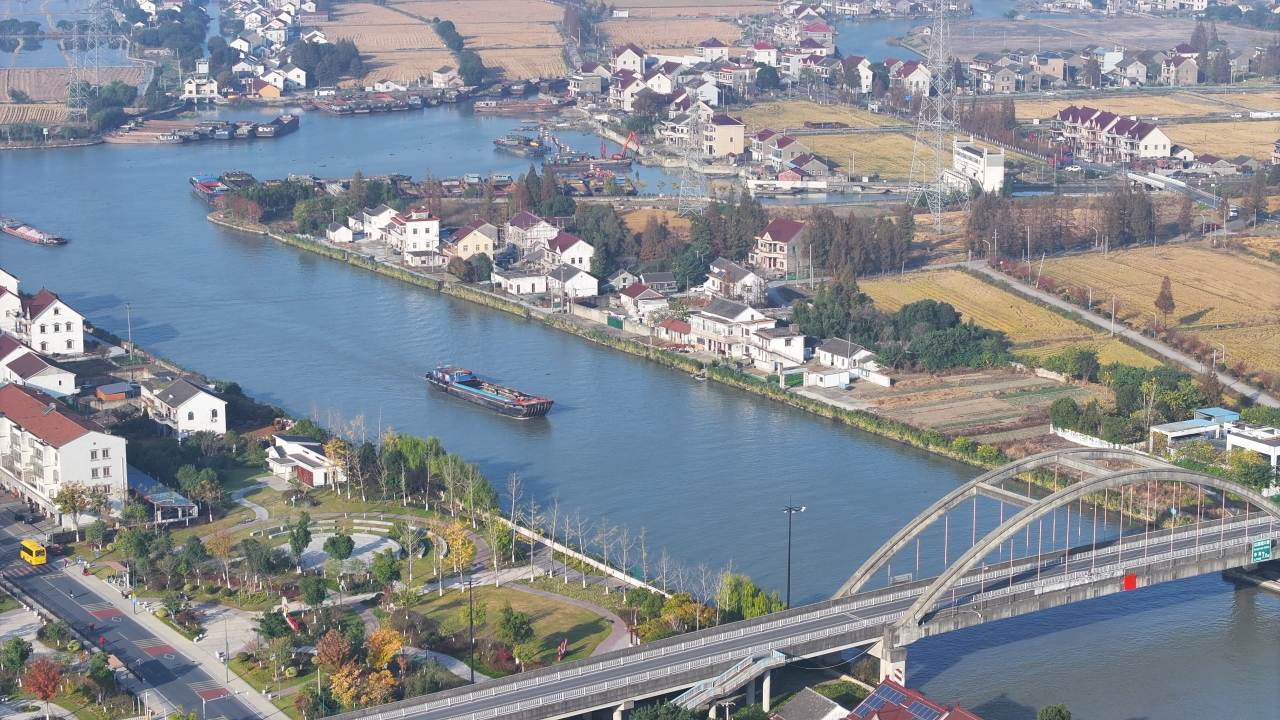
海河联运

Search documents
嘉兴港区持续放大海河联运新优势
Xin Lang Cai Jing· 2026-01-25 23:27
Core Viewpoint - The logistics model at Jiaxing Port is transforming its geographical advantages into competitive advantages for enterprises in the Yangtze River Delta, significantly reducing logistics costs and enhancing efficiency [1][3]. Group 1: Logistics Model and Cost Savings - The "sea-river" logistics model at Jiaxing Port can save related photovoltaic companies approximately 20% in comprehensive logistics costs [1]. - The logistics park's collaboration with Zhejiang Haigang Group on "overseas lithium ore direct unloading" has reduced costs for new energy companies by nearly 30% [3]. - By 2025, the logistics park is expected to achieve a cargo throughput of 170,000 tons, with a cost reduction of nearly 20 million yuan and a carbon reduction of nearly 10,000 tons [3]. Group 2: Infrastructure and Capacity - The Sixli Bridge Sea-River Combined Transport Logistics Park, with a total investment exceeding 1 billion yuan, is a key platform for enhancing the sea-river combined transport advantages [2]. - The logistics park is designed to handle an annual throughput of 3.5 million tons, including 100,000 TEUs (Twenty-foot Equivalent Units) [2]. - The park features eight berths and various supporting facilities, emphasizing multi-modal transport, strong supply chain support, and cost reduction [2]. Group 3: Regional Impact and Development - Jiaxing Port has expanded its sea-river combined transport network, covering northern and western Zhejiang, as well as provinces like Jiangxi, Jiangsu, Anhui, and Henan [4]. - In 2025, Jiaxing Port is projected to complete a container throughput of 1.3716 million TEUs, marking a year-on-year increase of 21.82% [5]. - The port has established 44 inland sea-river combined transport routes, enhancing its regional influence and operational stability [5]. Group 4: Future Plans and Strategic Development - Jiaxing Port is planning to construct a modern shipping service industry system and has been designated as a provincial pilot for the construction of a sea-river combined transport shipping service cluster [5][6]. - The logistics park's second phase is expected to be completed in the first half of 2026, aiming for an annual cost reduction exceeding 50 million yuan and a carbon reduction of nearly 20,000 tons [3]. - The port area is focused on optimizing spatial layout and multi-modal transport networks, with ongoing upgrades to supporting facilities and equipment [6].
“烟台港-寿光港-高青港”海河联运集装箱新航线开通
Feng Huang Wang Cai Jing· 2025-12-08 06:34
Core Viewpoint - The opening of the new "Yantai Port - Shouguang Port - Gaoqing Port" sea-river combined transport container route marks a significant development in the comprehensive logistics system of the sea-river transport supply chain in Shandong Province [1] Group 1: New Route Development - The new route is a result of the benefits from the Xiaoqing River rehabilitation project, which has restored a 169.2-kilometer waterway capable of accommodating 2,000-ton vessels [1] - The route connects Yantai Port as the coastal hub, Shouguang Port as the transfer node, and Gaoqing Port as the inland terminal, creating a transportation network that aligns with sea-river transport planning requirements [1] Group 2: Economic Impact - The new route significantly reduces the comprehensive logistics costs in the region and supports the transformation of bulk commodity transportation from road to water [1] - It injects new momentum into the high-quality economic development of the region by leveraging the efficient connectivity of the Shandong Port Express and the inland reach of the Xiaoqing River [1] Group 3: Operational Efficiency - To ensure a smooth inaugural voyage, multiple departments at Shouguang Port coordinated in advance to customize a full-process logistics plan for "unloading + transshipment" [1] - The seamless connection of various stages, including vessel berthing, container loading and unloading, and inland vessel transshipment, allows for immediate operations upon arrival at the port [1]
“河海接力”链接全球!嘉兴“海河联运”助力经济发展开启新篇章
Sou Hu Cai Jing· 2025-11-25 04:11
Core Insights - The article highlights the significant progress in the development of the "sea-river intermodal transport" system in Jiaxing, which is expected to enhance the city's economic growth and connectivity to global markets [1][10][12]. Group 1: Infrastructure Development - The Hangshen Line (Jiaxing section) waterway renovation project is the largest water transport construction project in Jiaxing's history, with an investment of 7.799 billion yuan and a total length of 91.6 kilometers [5]. - As of now, approximately 45% of the construction for the Hangshen Line has been completed, with significant milestones achieved, including the installation of key bridge components [3][5]. - The project aims to improve the connectivity of Jiaxing's waterways, facilitating the movement of goods between the northern Zhejiang region and Shanghai [5][9]. Group 2: Economic Impact - The Jiaxing Port has opened 44 "sea-river intermodal transport" routes, with container throughput exceeding 3.61 million TEUs from January to October, marking a year-on-year increase of 16.37% [10]. - The shift from road transport to water transport is expected to reduce costs and carbon emissions, making "sea-river intermodal transport" a preferred choice for many foreign trade enterprises [10][12]. - By 2030, Jiaxing aims to have its main waterways reach over 85% of provincial and above industrial platforms, supporting the development of inland port logistics parks [11]. Group 3: Strategic Importance - Jiaxing's geographical advantages, including its location at the intersection of rivers and seas, position it well for developing a robust "sea-river intermodal transport" network [7][9]. - The ongoing construction of the "three horizontal and three vertical" high-grade waterway network is crucial for enhancing Jiaxing's logistics capabilities and economic vitality [9][10]. - The successful implementation of the "sea-river intermodal transport" strategy is expected to transform Jiaxing into a leading city in water transport by 2035 [11][12].