混合模型

Search documents
Arista Networks (NYSE:ANET) Conference Transcript
2025-12-09 16:02
Summary of Arista Networks Conference Call (December 09, 2025) Company Overview - **Company**: Arista Networks (NYSE: ANET) - **Industry**: Networking and Data Infrastructure - **Growth**: Expected to reach $10 billion in revenue with a 20% growth estimate for the upcoming year [8][9][13] Key Points Market Opportunity - **Total Addressable Market (TAM)**: Increased from $70 billion to $105 billion year-over-year, encompassing AI, data centers, cloud, enterprise, and campus networking [9][11] - **Market Leadership**: Arista is a market share leader in front-end data center networking and is the only vendor outside of China with significant AI networking capabilities [11][12] Customer Concentration and Diversification - **Customer Base**: Historically, 40% of revenue came from two customers; however, Arista aims to diversify its revenue streams as it approaches the $10 billion mark [12][13] - **Enterprise Growth**: Targeting $800 million in revenue from the enterprise segment in 2025, increasing to $1.25 billion in 2026, representing only 5% market share [13][14] AI Market Dynamics - **AI Spending**: Estimated $2.3 trillion in AI-related spending from 2022 to 2035, with significant opportunities in agentic AI and autonomous robotics [15][16] - **Demand Drivers**: Industries such as education, finance, and healthcare are increasingly adopting AI, leading to a surge in data demand [18][20] Customer Segmentation - **NeoCloud and Sovereign Customers**: NeoCloud customers appreciate Arista's hyperscaler experience, while sovereign customers face longer decision-making cycles due to organizational complexities [22][50] - **Enterprise Adoption**: Enterprises are shifting from cloud-based AI training to on-premise solutions, indicating a trend towards localized data processing [24][27] Technology and Product Strategy - **Scale-Up Opportunities**: Arista is exploring scale-up architectures, which are not currently included in the TAM but are expected to be significant as the market matures [55][56] - **Campus Networking**: Arista plans to leverage its existing portfolio and go-to-market strategy to capture a larger share of the campus networking market, which has a refresh cycle of five to nine years [61][62] Channel Strategy - **Channel Engagement**: Arista is enhancing its channel strategy, focusing on a mix of channel-led and channel-fulfilled approaches to improve market penetration [66][69] Future Outlook - **Growth Indicators**: Key indicators for future growth include guidance, deferred revenue growth, and purchase commitments, with optimism for the next five to ten years [71] Additional Insights - **Customer Decision-Making**: The ownership of AI initiatives within enterprises can influence whether they opt for on-premise or cloud solutions, highlighting the importance of understanding customer dynamics [30][31] - **Blurring of Front-End and Back-End**: The distinction between front-end and back-end networking solutions is becoming less clear as customers seek flexible, integrated solutions [34][36] This summary encapsulates the essential insights from the Arista Networks conference call, highlighting the company's strategic direction, market opportunities, and evolving customer dynamics in the networking industry.

上海AI Lab发布混合扩散语言模型SDAR:首个突破6600 tgs的开源扩散语言模型
机器之心· 2025-11-01 04:22
Core Insights - The article introduces a new paradigm called SDAR (Synergistic Diffusion-AutoRegression) that addresses the slow inference speed and high costs associated with large model applications, which are primarily due to the serial nature of autoregressive (AR) models [2][3][4]. Group 1: SDAR Paradigm - SDAR effectively decouples training and inference, combining the high performance of AR models with the parallel inference advantages of diffusion models, allowing for low-cost transformation of any AR model into a parallel decoding model [4][11]. - Experimental results show that SDAR not only matches but often surpasses the performance of original AR models across multiple benchmarks, achieving up to a 12.3 percentage point advantage in complex scientific reasoning tasks [6][28]. Group 2: Performance and Efficiency - SDAR maintains the performance of AR models while significantly improving inference speed and reducing costs, demonstrating that larger models benefit more from parallelization without sacrificing performance [17][19]. - The research indicates that SDAR can be adapted to any mainstream AR model at a low cost, achieving comparable or superior performance in downstream tasks [19][29]. Group 3: Experimental Validation - The study conducted rigorous experiments to compare SDAR's performance with AR models, confirming that SDAR can achieve substantial speed improvements in real-world applications, with SDAR-8B-chat showing a 2.3 times acceleration over its AR counterpart [23][20]. - The results highlight that SDAR's unique generation mechanism does not compromise its complex reasoning capabilities, retaining long-chain reasoning abilities and excelling in tasks requiring understanding of structured information [28][29]. Group 4: Future Implications - SDAR represents a significant advancement in the field of large models, providing a powerful and flexible tool that lowers application barriers and opens new avenues for exploring higher performance and efficiency in AI reasoning paradigms [29][31].


实测低调上线的DeepSeek新模型:编程比Claude 4还能打,写作...还是算了吧
3 6 Ke· 2025-08-20 12:14
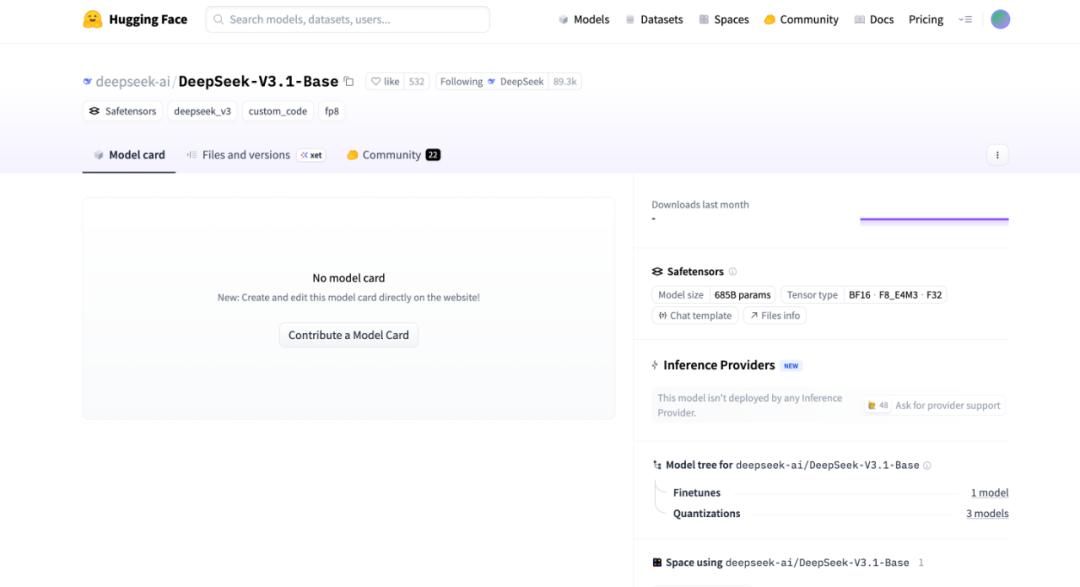
Core Insights - DeepSeek has officially launched and open-sourced its new model, DeepSeek-V3.1-Base, following the release of GPT-5, despite not having released R2 yet [1] - The new model features 685 billion parameters and supports multiple tensor types, with significant optimizations in inference efficiency and an expanded context window of 128k [1] Model Performance - Initial tests show that DeepSeek V3.1 achieved a score of 71.6% on the Aider Polyglot programming benchmark, outperforming other open-source models, including Claude 4 Opus [5] - The model successfully processed a long text and provided relevant literary recommendations, demonstrating its capability in handling complex queries [4] - In programming tasks, DeepSeek V3.1 generated code that effectively handled collision detection and included realistic physical properties, showcasing its advanced programming capabilities [8] Community and Market Response - Hugging Face CEO Clément Delangue noted that DeepSeek V3.1 quickly climbed to the fourth position on the trends chart, later reaching second place, indicating strong market interest [79] - The update removed the "R1" label from the deep thinking mode and introduced native "search token" support, enhancing the search functionality [79][80] Future Developments - The company plans to discontinue the mixed thinking mode in favor of training separate Instruct and Thinking models to ensure higher quality outputs [80] - As of the latest update, the model card for DeepSeek-V3.1-Base has not yet been released, but further technical details are anticipated [81]