清朗系列专项行动

Search documents
热点追踪丨抵挡“数字泔水”的三道防线
Xin Hua She· 2026-01-21 03:20
Core Viewpoint - The term "digital slop" has gained significant attention, representing low-quality digital content that poses risks, especially to minors, and highlights the need for governance in the digital ecosystem [1][3]. Group 1: Impact on Minors - "Digital slop" is a product of the combination of technological benefits and the greed for traffic, leading to the spread of low-quality content that targets minors' curiosity and trends [3]. - It diminishes cognitive abilities and causes mental dullness, as the instant gratification from "digital slop" can lead to a loss of interest in quality content and degrade critical thinking skills [3]. - It distorts value recognition, creating psychological hazards for minors by blurring the lines between right and wrong, and promoting unhealthy behaviors as trends [3]. Group 2: Strategies for Resistance - To combat "digital slop," it is essential to establish three defensive lines, starting with a technological defense that involves optimizing algorithms to promote quality content and reduce the spread of low-quality material [4][5]. - Regulatory measures must be strengthened, including the development of a legal framework for AI-generated content and clear guidelines to address issues like vulgar modifications and false scripts [5]. - Encouraging community involvement, particularly through educational institutions and families, is crucial for fostering critical thinking and helping minors navigate digital content effectively [5][6].


“广l州l日l报”是假的!广州网信出手了,又一批账号被查处
Xin Lang Cai Jing· 2026-01-04 13:52
Core Viewpoint - Guangzhou's internet information department has been actively implementing the "Clear and Bright" series of special actions since 2025 to combat various online irregularities, resulting in the legal handling of numerous illegal accounts and websites based on public reports [1]. Group 1: Case Summaries - Case 1: A self-media account imitated the name "Guangzhou Daily" to mislead the public, and has been rectified following guidance from the Guangzhou internet information department [1]. - Case 2: A website imitated the official visual identity of the Guangzhou Medical Insurance Bureau, spreading false information and illegally collecting data, leading to its closure by the internet information department [2]. - Case 3: An imitation page of the Guangzhou Quality Inspection Research Institute's official website provided forged inspection reports and misused official seals, resulting in its deletion after legal action [3]. - Case 4: Several websites imitated the official sites of educational institutions and research organizations, lacking proper registration and posing risks of misinformation and potential fraud, which led to their closure by the internet information department [4].
中国多方共治构建文明网络空间 “清朗”行动一个月处置2.4万违规账号
Chang Jiang Shang Bao· 2025-12-07 23:43
Core Viewpoint - The article emphasizes the importance of maintaining network security and order, highlighting recent actions taken against tax evasion and other violations in the internet industry, which contribute to a healthier online environment [1][2]. Group 1: Tax Evasion Case - Influential car reviewer Chen Zhen was found to have evaded taxes amounting to 1.1867 million yuan, leading to a total penalty of 2.4748 million yuan, including back taxes and fines [2]. - Chen Zhen's reported income was significantly lower than his actual earnings, raising concerns about the accuracy of income declarations among internet celebrities [2]. - The tax authorities have taken a firm stance against tax evasion in the internet sector, indicating that the online space cannot be a refuge for avoiding tax obligations [2]. Group 2: Regulatory Actions - The Central Cyberspace Administration of China reported that over 73,000 illegal live streaming rooms and 24,000 accounts have been dealt with as part of the "Clear and Bright" campaign [3]. - The campaign aims to address issues such as vulgar content and tax evasion, with a focus on improving the overall online ecosystem [3][4]. - The "Clear and Bright" series of actions has been ongoing since 2016, demonstrating a commitment to maintaining a clean online environment through coordinated efforts from multiple government departments [6]. Group 3: Network Ecology Improvement - The article notes that the network ecology has shown improvement, with ongoing efforts to strengthen the legal framework and governance mechanisms in the internet space [5][7]. - The Chinese government has enacted over 160 laws related to the internet, establishing a comprehensive legal system to support the development of a robust online environment [7]. - Future initiatives will focus on enhancing content management and establishing long-term governance mechanisms to ensure a positive online atmosphere [7].
网红张雪峰、户晨风账号被处置详情披露
证券时报· 2025-12-07 06:52
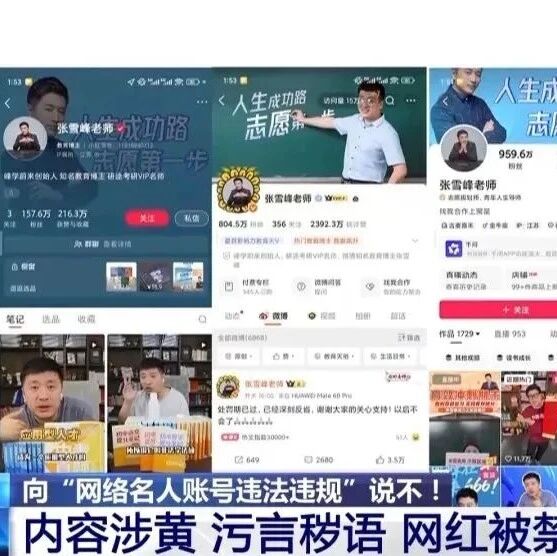
Core Viewpoint - The article discusses the recent crackdown by the Central Cyberspace Administration of China on various online influencers and accounts that have engaged in illegal and harmful activities, highlighting the need for stricter regulation in the digital space [2][17]. Group 1: Inciting Division Among Groups - The account "Huchengfeng" has been reported for creating divisive narratives, labeling groups as "Android people" and "Apple people," which has led to heightened social tensions. This account has been banned across multiple platforms for violating regulations [4][6]. - Experts suggest that the actions of "Huchengfeng" are aimed at generating traffic and monetization by exploiting societal divisions and anxieties [6]. Group 2: Promoting Distorted Values - Several accounts, including "Guo Mei May努力努力" and "Yi Yan LuLu," have been penalized for promoting materialistic and hedonistic values. These accounts have been closed or subjected to long-term bans [7][9]. - "Guo Mei May" was previously imprisoned for serious crimes and attempted to regain attention through flaunting luxury items online, which ultimately led to her account's closure due to continued promotion of negative values [9]. Group 3: Polluting the Online Environment - The account "Lansi" has been found disseminating content related to foreign pornography, while the streamer "Zhang Xuefeng" has been using vulgar language during live broadcasts. Both accounts have faced legal penalties and bans [10][12]. - Experts emphasize that online influencers have a responsibility to maintain decorum and adhere to societal norms, given their significant influence [12]. Group 4: Issues of Account Rebranding - Accounts like "Xiaoying Couple" and "Yibu Wuxin" have been banned for tax evasion and promoting negative values but have been found to have re-registered under new identities [13]. - The regulatory authorities are urging platforms to enhance their monitoring and management systems to prevent the resurgence of problematic accounts [15]. Group 5: Ongoing Regulatory Actions - The Central Cyberspace Administration has been actively conducting the "Qinglang" series of special actions to address various online issues, including malicious marketing and the spread of false information [17]. - The new cybersecurity law, effective from January 1, 2026, aims to strengthen the accountability of platforms and enhance the regulatory framework to combat the spread of harmful content [17].
卖惨、炫富、装罪犯……邪路“起号”必然见光死
Bei Jing Ri Bao Ke Hu Duan· 2025-11-08 10:14
Core Viewpoint - The recent incident involving the streamer "Lao Zhi Shu Dao San" imitating criminal Lao Rong Zhi has sparked public outrage, leading to the indefinite suspension of the account by the platform, highlighting the failure of sensationalism and curiosity-driven content creation [1] Group 1: Industry Trends - The phenomenon of "violent account creation" promotes the idea that success in gaining attention, regardless of morality, can lead to significant profits, thereby harming the overall creative ecosystem of the internet [2] - Content creators and MCN agencies are increasingly resorting to unethical practices, such as fabricating emotional narratives or showcasing extravagant lifestyles, to quickly monetize their content [1][2] Group 2: Regulatory Response - Regulatory bodies and platforms are actively addressing the trend of "violent account creation" through initiatives like the "Qinglang" series of special actions aimed at rectifying issues related to self-media chaos and malicious hype [3] - The rapid response from platforms to penalize violators demonstrates a commitment to maintaining a healthy online environment, with an increasing number of cases showcasing decisive action against rule-breaking streamers [3] Group 3: Public Awareness - There is a growing awareness among internet users regarding the tactics behind "toxic traffic," leading to improved reporting and complaint mechanisms that contribute to the purification of the online environment [3]
“不敢发朋友圈”,清华学霸小红书晒1.67亿元年薪引调查!美国司法部:他处于在逃状态
新浪财经· 2025-09-17 09:13
Core Viewpoint - The article discusses the legal troubles faced by Wu Jian, a high-earning employee at Two Sigma, who is accused of fraud and manipulation of investment models, leading to significant financial losses for clients and the firm [2][7]. Group 1: Background of Wu Jian - Wu Jian, a Chinese citizen residing in New York, has a notable educational background, having graduated from Tsinghua University and Cornell University [2]. - He worked at Citadel before joining Two Sigma in April 2018, where he quickly rose to the position of Senior Vice President by January 2023 [4]. Group 2: Allegations and Consequences - Wu Jian is facing civil and criminal charges from the U.S. Department of Justice for wire fraud, securities fraud, and money laundering [2]. - The SEC's indictment claims that from November 2021 to August 2023, Wu Jian secretly manipulated at least 14 investment models, misleading Two Sigma about their performance and leading to client losses of at least $165 million [7]. - Two Sigma's internal investigation was triggered by Wu Jian's ostentatious display of wealth on social media, which raised red flags within the firm [7]. Group 3: Financial Implications - Wu Jian reportedly earned a salary of $23.5 million in 2022, a significant increase compared to previous years, and used part of his earnings to purchase a multi-million dollar apartment in Manhattan [4][7]. - Two Sigma has canceled Wu Jian's $8 million performance bonuses for 2021 and 2022 but has not yet recovered the $17.8 million in cash bonuses he received during those years [8]. Group 4: Company Response - Two Sigma terminated Wu Jian's employment in 2024 and has taken steps to compensate affected clients for their losses [9].

对付假专家须打出组合拳
Jing Ji Ri Bao· 2025-08-18 21:17
Core Viewpoint - The article emphasizes the need for algorithms and online platforms to genuinely serve farmers by supporting real agricultural experts and punishing fake ones, highlighting the prevalence of fraudulent agricultural advisors targeting farmers' finances [1][2][3]. Group 1: Characteristics of Fake Experts - Fake agricultural experts exhibit three main characteristics: exaggerating promises, ambiguous identities, and identical promotional content across multiple accounts [2]. - These fraudulent practices not only lead to financial losses for farmers but also jeopardize their annual harvests [2]. Group 2: Demand for Genuine Agricultural Services - There is a significant demand among farmers for effective agricultural technology services, which are currently insufficient and disconnected from their actual needs [2]. - The article calls for genuine agricultural experts to engage more actively in providing guidance, both online and in-person, to meet farmers' needs [2]. Group 3: Recommendations for Improvement - The evaluation system for agricultural colleges and institutions should be revised to recognize contributions to real agricultural services [3]. - Agricultural technology promotion systems need to adapt to modern trends, enhancing their effectiveness and reach, especially through mobile platforms [3]. Group 4: Combating Fraud and Ensuring Quality - There is a need to strengthen the crackdown on counterfeit agricultural products and establish a quality traceability system to purify the market environment [4]. - A collaborative effort is essential to ensure that farmers receive genuine assistance and guidance, ultimately contributing to rural revitalization [4].
网信办出手!针对“自媒体”发布不实信息乱象
Zheng Quan Shi Bao· 2025-07-29 09:55
Core Viewpoint - The Central Cyberspace Administration of China has launched a two-month special action to address the issue of false information dissemination by "self-media" starting from July 24, 2023, as part of the "Clear and Bright" series of initiatives aimed at regulating information release behavior [1]. Group 1: Key Issues Addressed - The action focuses on four major issues: maliciously exploiting public sentiment, using AI to distort facts, failing to properly label information sources, and disseminating false information in professional fields [1][2][3][4]. Group 2: Specific Problems Highlighted - Malicious exploitation includes impersonating individuals during significant public events to mislead the public and creating false narratives around critical incidents [1][2]. - The use of AI-generated content to fabricate social issues and manipulate public perception through edited or staged events is a significant concern [2]. - The lack of proper source attribution for news related to public policies and events leads to confusion and misinformation [3]. - In professional domains, the absence of credential verification and the spread of scientifically unverified information by impersonating experts are critical issues [4].
网信办出手!针对“自媒体”发布不实信息乱象
证券时报· 2025-07-29 09:15
Core Viewpoint - The article discusses the launch of a two-month special action by the Central Cyberspace Administration of China to address the issue of misinformation spread by self-media, aiming to regulate information dissemination and enhance public trust [1]. Summary by Categories Key Issues Targeted - The special action focuses on four major issues: 1. Malicious hype and misleading public information, including impersonation of individuals during significant events and fabricating information in critical fields like finance and military [2]. 2. Distortion of facts through various means, such as using AI to create fake identities, manipulating narratives, and spreading false information about policies and events [3]. 3. Lack of proper source attribution, where information is shared without clear or accurate sourcing, leading to confusion and misinformation [4]. 4. Dissemination of false information in professional fields without proper certification, misrepresenting expertise, and creating misleading narratives [5].