清迈倡议

Search documents
环球圆桌对话:“亚洲版IMF”,旧事重提缘于现实需求
Sou Hu Cai Jing· 2025-11-23 23:09
Core Viewpoint - The concept of establishing an "Asian Monetary Fund" (AMF) has resurfaced due to the changing global economic landscape and the increasing need for financial stability and cooperation among Asian countries [1][3][11]. Group 1: Historical Context - The idea of creating an AMF originated during the 1997 Asian financial crisis when Asian countries faced severe currency devaluations and sought a collective response to stabilize their economies [2][9]. - The initial proposal for an AMF was rejected due to U.S. intervention, which imposed stringent conditions through the IMF, exacerbating the financial turmoil in the region [2][10]. Group 2: Current Economic Landscape - Nearly 30 years later, the conditions for establishing an AMF have significantly improved, with Asian economies now being major global players in terms of economic size, trade volume, and population [3][4]. - The U.S. has adopted a protectionist stance, imposing high tariffs on Asian exports, which has increased the urgency for Asian countries to seek reliable financial support [3][11]. - The financial development in Asia has matured, with a solid industrial base and increased financial capacity, allowing for better management of funds and resources [3][4]. Group 3: Regional Cooperation and Mechanisms - The establishment of the AMF is seen as a pragmatic response to the lack of effective regional financial coordination mechanisms, which have historically left Asian countries vulnerable to external shocks [6][10]. - Existing frameworks like the "Chiang Mai Initiative" have laid the groundwork for regional financial cooperation, but further multilateralization is needed to enhance effectiveness [10][11]. - The successful implementation of trade agreements like RCEP has strengthened regional supply chains and economic autonomy, creating a conducive environment for the AMF [4][12]. Group 4: Future Prospects and Implications - The establishment of an AMF could significantly enhance regional economic stability and predictability, positively impacting global economic recovery [12]. - It would facilitate increased use of local currencies in trade, reducing reliance on the U.S. dollar and mitigating the effects of dollar hegemony [12]. - The AMF could amplify the economic "aggregation effect" within the region, improving the utilization of existing trade agreements and fostering a more resilient financial ecosystem [12].
担心“美元互换”被武器化,欧洲官员探讨为"最坏情况"做准备:自建美元储备池
Hua Er Jie Jian Wen· 2025-11-13 20:29
Core Viewpoint - European financial stability officials are discussing the integration of non-U.S. central bank dollar reserves to reduce dependence on the U.S. financial system, particularly under the Trump administration [2][10]. Group 1: Discussion of Dollar Reserve Integration - European officials are considering a plan to consolidate dollar reserves held by central banks outside the U.S. to create an alternative to the Federal Reserve's funding support mechanisms [2]. - Concerns have been raised that these mechanisms could be weaponized by the Trump administration, with fears peaking in April when tariff threats shook the global financial system [2][9]. - Discussions are ongoing at a working level among central banks in and outside the Eurozone, although practical challenges to integrating dollar reserves exist [3][4]. Group 2: Challenges and Limitations - Despite holding thousands of billions in cash, non-U.S. central banks cannot match the Federal Reserve's capacity as the issuer of the world's reserve currency [4]. - Any attempt to pool reserves will face logistical and political challenges, with indications that even a hint of the Fed interrupting swap lines could create significant pressure on the global financial system [5]. - The proposed dollar reserve pool may only address localized liquidity issues and is unlikely to provide decisive support during widespread market turmoil [4]. Group 3: Alternative Measures and Precedents - European officials are looking at other measures to enhance financial resilience, including strengthening scrutiny of lending institutions and requiring them to develop plans for obtaining dollars from markets in Asia and the Middle East [7]. - The experience of other regions, such as the ASEAN and China, which established the Chiang Mai Initiative for multilateral currency swap arrangements, is being considered as a potential model [6]. Group 4: Ongoing Concerns and Future Outlook - The issue of building resilience without relying on the U.S. is consistently raised in central bank meetings, indicating a persistent concern among European officials [8]. - The potential loss of access to the Fed's swap lines is not seen as the primary concern, but discussions about finding alternatives continue among the European Central Bank and various national central banks [9][10]. - European officials are particularly worried about the implications of Jerome Powell's term ending in May 2024 and the potential selection of a new Fed chair by Trump, which could affect future financial stability [10].
中日韩东盟一致发声,美国关税让亚洲“抱团”
Sou Hu Cai Jing· 2025-05-06 08:42
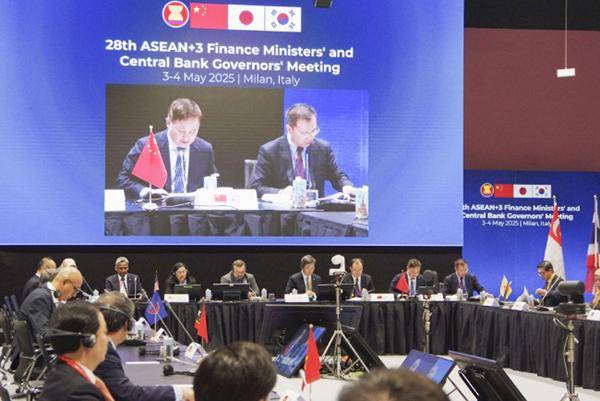
"未来的不确定性正在增加,"联合声明呼吁,"加强区域团结与合作,努力应对日益加剧的不确定 性","我们当前的政策重点是增强长期韧性,同时保持灵活性以应对保护主义抬头和不稳定的全球金融 形势等挑战"。 亚洲财长和央行行长们还声明中重申,他们致力于"以世界贸易组织(WTO)为中心",基于规则、非 歧视、自由、公平、开放、包容、平等和透明的多边贸易体制。 【文/观察者网 王一】当地时间5月4日,第28届东盟与中日韩(10+3)财长和央行行长会议在意大利米 兰举行,主要讨论了全球和区域宏观经济形势、10+3区域财金合作等议题。《日经亚洲评论》5日报道 称,亚洲各国的财政部长和央行行长在该会议后的联合声明中警告称,贸易壁垒可能会给全球经济造成 裂痕。 声明写道,"贸易保护主义加剧将成为全球贸易的重负,导致经济分裂,影响整个地区的贸易、投资和 资本流动"。 《日经亚洲评论》指出,尽管这份声明并未点名美国,但上月初,美国总统特朗普宣布对全球几乎所有 国家征收新关税,其中对柬埔寨、老挝和越南分别征收49%、48%、46%的关税,属于美国所有贸易伙 伴中的最高水平。虽然目前特朗普暂缓90天对大部分国家征收"对等关税",但10% ...