火星城市

Search documents
马斯克的月球城市:技术野心正在重写现实边界
Sou Hu Cai Jing· 2026-02-10 02:44
Core Viewpoint - The discussion surrounding Elon Musk's vision of building cities on the Moon and Mars reflects a serious timeline rather than whimsical fantasy, emphasizing engineering progress and technological maturity over romantic ideals [1][3]. Group 1: Moon City Development - SpaceX is shifting its focus towards constructing a "self-sustaining city" on the Moon within a decade, while acknowledging that a Mars city will take at least twenty years [3]. - The Moon is prioritized due to its proximity to Earth, manageable communication delays, and calculable supply costs, making it a more realistic target compared to Mars [3]. - The concept of a Moon city is not a replica of Earth civilization but a re-engineered system that minimizes human dependency, relying heavily on automation and robotics [4]. Group 2: Technological Integration - The merger of SpaceX and xAI indicates a future where cities are algorithm-driven products, suggesting that systems will be established before human presence is integrated [4]. - The complexity of establishing a city on Mars is significantly higher due to factors like communication delays and environmental challenges, necessitating a nearly autonomous technological system [6]. Group 3: Public and Private Sector Dynamics - The narrative surrounding space exploration is shifting the boundaries between public authority and private capital, with governments becoming major clients and rule-makers while companies handle execution and technological advancements [6]. - The governance of a Moon city raises questions about the definition of "publicness" when infrastructure is controlled by a private entity, highlighting a new form of spatial governance [6]. Group 4: Future Implications - Musk's timeline for the Moon city appears bold yet cautious, reflecting a precise judgment of technological maturity and capital patience, indicating that the future will be gradually engineered and institutionalized [9]. - The first operational Moon city may not resemble grand sci-fi visions but will likely be quiet, closed, and highly automated, marking a significant shift in human activity supported by private technological systems [9].

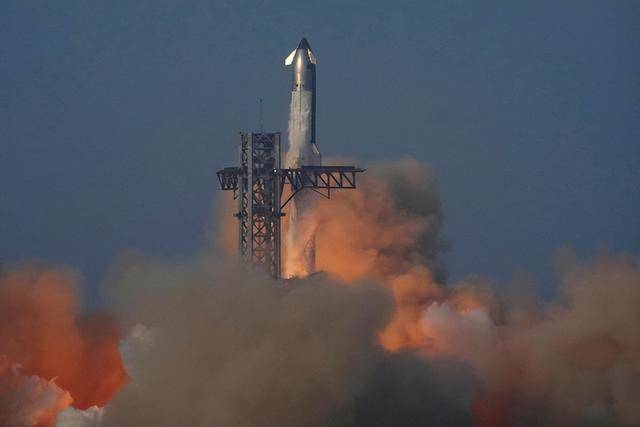
马斯克宣布SpaceX重心转向月球城市,2027年实施载人登月
Sou Hu Cai Jing· 2026-02-09 23:31
Core Viewpoint - SpaceX has shifted its core research and development focus towards building a self-sustaining lunar city within the next decade, while the Mars city project is expected to take over twenty years to complete [1] Group 1: Lunar City Development - The launch frequency for missions to the Moon can occur every ten days, with a one-way flight time of only two days, significantly faster than the Mars missions which have a launch window every twenty-six months and a six-month flight time [1] - This difference in travel time allows for quicker technological validation, system iteration, and scaling for the lunar city project compared to Mars [1] Group 2: Mars City Project - Despite the focus on the lunar city, SpaceX remains committed to the long-term goal of establishing a city on Mars, with preparatory work expected to officially commence within five to seven years [1] Group 3: Manned Lunar Missions - The manned lunar mission is currently in a critical implementation phase, with ground testing and validation of the spacecraft progressing steadily [1] - The first manned lunar landing is scheduled to take place in 2027 as per the established plan [1]
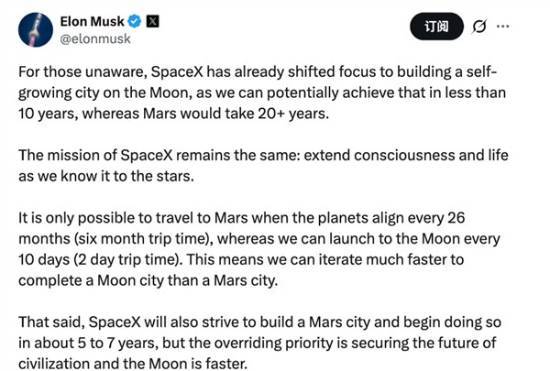
马斯克:10年内建成月球城市
财联社· 2026-02-09 06:13
Core Viewpoint - SpaceX has shifted its focus to building a self-sustaining city on the Moon, with expectations to achieve this within a decade, while still pursuing its long-term vision for Mars, which is projected to take over 20 years [3][4]. Group 1: Strategic Shift - Elon Musk announced that SpaceX's primary focus is now on lunar city construction, which can be achieved faster than Mars colonization due to shorter travel times and more frequent launch opportunities [3][4]. - The company plans to start efforts for Mars city construction within 5 to 7 years, but emphasizes that lunar development is the immediate priority for ensuring the future of civilization [4]. Group 2: NASA's Artemis Program - SpaceX won a $4 billion contract from NASA to develop a lunar lander for the Artemis program, which aims to establish a long-term human presence on the Moon and prepare for future Mars missions [4][5]. - The Artemis 3 mission, originally scheduled for 2024, has been delayed to 2027, while Artemis 2 is now set for April 2026 [5]. Group 3: Self-Sustaining City Concept - Analysts highlight the importance of the "self-expanding" concept for the lunar city, which requires the base to be self-sufficient and capable of continuous expansion through automation and robotics [5]. - SpaceX has already demonstrated concepts for using lunar regolith to create building materials and extract oxygen and water, aligning with the vision of a self-sustaining city [5].

马斯克宣布有望10年内建首座“月球城市”:火星计划“没熄火”,但“月球更快”
Sou Hu Cai Jing· 2026-02-09 04:34
Core Viewpoint - SpaceX is shifting its focus from Mars to the Moon, with the primary goal of building a "self-sustaining lunar city" within the next 10 years [1]. Group 1: Strategic Shift - Elon Musk announced that the priority has changed to lunar missions as they can ensure the future of civilization more quickly than Mars missions [2]. - SpaceX plans to begin lunar landing missions, with a specific target for an unmanned lunar landing in March 2027 [2]. - The decision to prioritize lunar exploration over Mars is influenced by the current geopolitical competition, particularly with China in the aerospace sector [3]. Group 2: Financial Developments - SpaceX's valuation has reached $1 trillion, while its recent acquisition of AI startup xAI is valued at $250 billion [4].
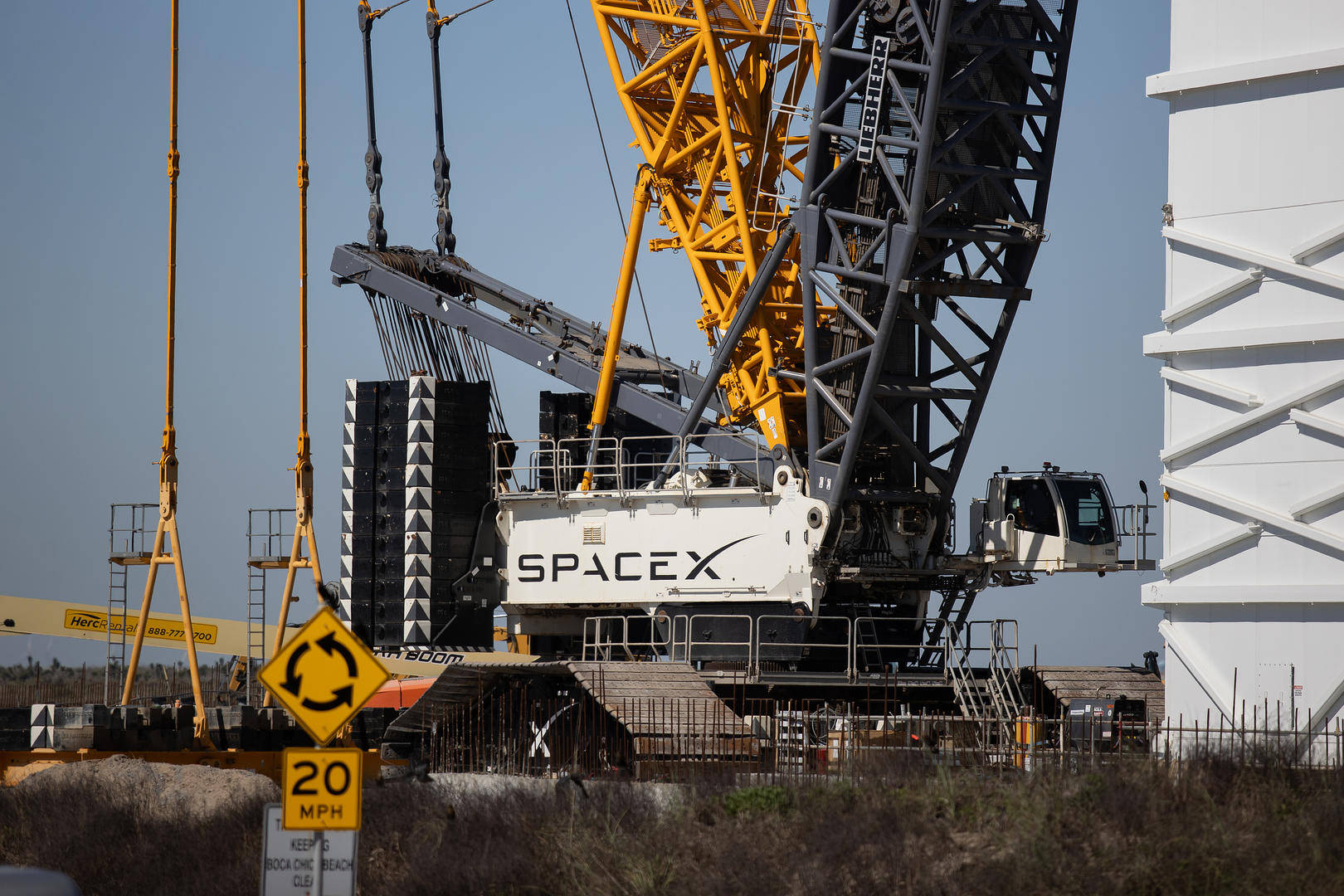
重心转移!马斯克立下新十年之约:引领万亿美元SpaceX建造月球城市
智通财经网· 2026-02-09 03:39
Group 1 - SpaceX is shifting its focus towards building a "self-sustaining city" on the Moon, with a goal to achieve this within the next decade [1] - The plan for a lunar city is seen as a long-term vision for permanent settlement beyond Earth, relying on SpaceX's Starship capabilities to transport necessary modules and resources [1] - The lunar base aims to utilize local resources for expansion and sustainability, contingent on ongoing technological advancements and funding [1] Group 2 - SpaceX has informed investors that the lunar mission will take priority over Mars exploration, with an unmanned lunar landing targeted for March 2027 [2] - The decision to focus on the Moon is influenced by the current policy environment and the resurgence of global interest in lunar exploration, providing potential collaboration opportunities [2] - The competitive landscape includes significant challenges from China, as the U.S. aims to return astronauts to the Moon for the first time since the Apollo program in 1972 [2]
马斯克:有望10年内在月球建造城市
Sou Hu Cai Jing· 2026-02-09 02:46
Group 1 - SpaceX is shifting its focus to building a self-expanding city on the Moon, aiming to achieve this goal within 10 years, while Mars exploration is projected to take over 20 years [1][4] - The launch frequency for lunar missions can be reduced to every 10 days with a travel time of 2 days, compared to Mars missions which are limited to every 26 months with a 6-month travel time [3][4] - Despite the focus on the Moon, SpaceX will still work on Mars city plans, with intentions to start related work within 5 to 7 years [4] Group 2 - SpaceX has postponed its planned Mars mission for this year to prioritize the long-awaited NASA lunar flight, targeting an unmanned lunar landing in March 2027 [4][5] - The company is actively recruiting engineers in Austin and Seattle to develop AI satellites and space data centers, indicating a strategic expansion in technology [4] - SpaceX's recent acquisition of Elon Musk's startup xAI has led to a combined company valuation of $1.25 trillion, and an IPO is anticipated as early as this summer [4]