火锅市场

Search documents
海底捞20260203
2026-02-04 02:27
Summary of Haidilao Conference Call Company Overview - The conference focused on Haidilao, a leading hot pot restaurant chain in China, discussing its recent performance and strategic outlook [1][2]. Key Points and Arguments Financial Performance - Haidilao's overall performance showed a trend of improvement from the first half of 2025, with a recovery in table turnover rates in the third and fourth quarters [1]. - The same-store sales turnover experienced a decline initially but stabilized and turned positive by the fourth quarter of the previous year, indicating a bottoming-out trend [2]. - The average customer spending has stabilized around 100 yuan, showing no further decline [2]. - The total number of restaurants remained stable at approximately 1,370 by year-end, with some closures of underperforming locations [2]. Management Changes - The return of Chairman Zhang Yong to a more active role in management is expected to enhance operational efficiency and cohesion within the company [3][4]. - New promotions within the management team include regional managers with extensive experience in store management, which is anticipated to inject fresh energy into the leadership [4]. Market Position and Competition - The hot pot market in China is substantial, valued at over 600 billion yuan, with Haidilao holding about 7% market share [9]. - The competitive landscape shows a strong concentration, with Haidilao leading in the affordable price segment (below 120 yuan) [9]. - Growth in lower-tier cities is expected to outpace that of first and second-tier cities, providing further expansion opportunities for Haidilao [10]. Expansion Strategy - Haidilao plans to cautiously expand its number of restaurants, potentially reaching 2,000 locations in the future, but will prioritize quality over quantity [11]. - The company is also focusing on the development of sub-brands, which are expected to contribute significantly to revenue growth in the coming years [12]. Financial Projections - Projected net profits for 2025 are expected to show a slight decline, with forecasts of 4.75 billion yuan in 2026 and 5.26 billion yuan in 2027 [15]. - The valuation of Haidilao is currently estimated at around 15-20 times PE, with a target price of 21 yuan based on DCF analysis [15]. Additional Important Information - The company has a stable shareholding structure, with Zhang Yong and his spouse holding a significant portion of shares, ensuring strong control over company decisions [4][5]. - The management's focus on improving operational efficiency and profitability is expected to yield positive results in the long term [8][14]. Conclusion - Overall, the outlook for Haidilao remains optimistic, with expectations of gradual recovery and growth in both revenue and market presence, particularly in lower-tier cities and through the development of sub-brands [15].

巴奴更新招股书:今年前三季净利增近六成,未足额缴纳社保存在风险
Sou Hu Cai Jing· 2025-12-19 23:40
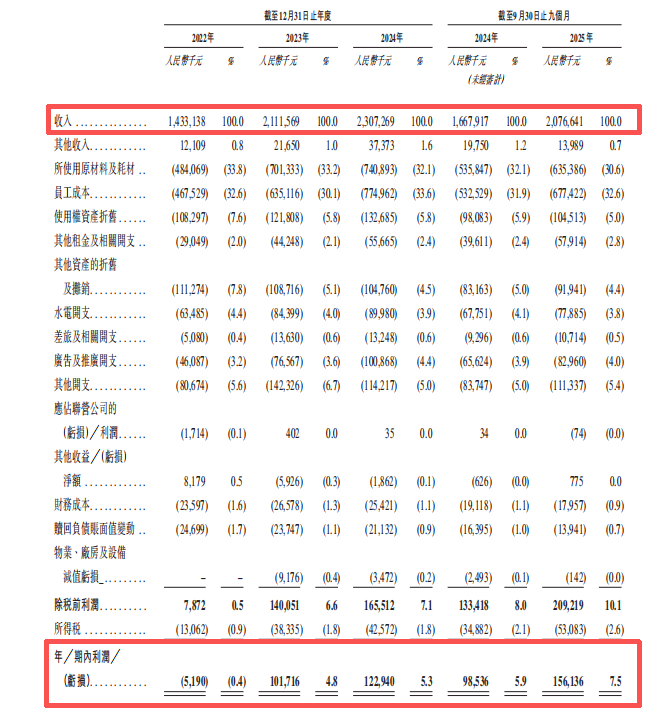
Core Viewpoint - Banu International Holdings Limited, the parent company of Banu Hotpot, has updated its prospectus with business data up to September 30, 2025, indicating a strong growth trajectory and plans for expansion in the Chinese hotpot market [1][2]. Financial Performance - Banu's revenue for the years 2022 to 2024 and the nine months ending September 30, 2025, are reported as 1.433 billion, 2.112 billion, 2.307 billion, and 2.077 billion RMB respectively, with a year-on-year growth of 47.3% in 2023 and 9.3% in 2024 [2][3]. - The net profit has shown significant improvement, moving from a loss of 0.052 billion RMB in 2022 to a profit of 1.02 billion RMB in 2023, and further increasing to 1.23 billion RMB in 2024, marking a 20.8% year-on-year growth [4]. Market Position - Banu is the largest hotpot brand in China's quality hotpot market by revenue, holding a 3.1% market share in 2024, and is the third-largest in the overall hotpot market with a 0.4% share [1]. - The company operates in a segmented market that includes quality hotpot (average spend over 120 RMB), high-quality hotpot, and budget hotpot [1]. Operational Efficiency - The average table turnover rate for Banu has increased from 3.0 times per day in 2022 to 3.6 times in the first three quarters of this year, indicating improved operational efficiency [5][6]. - The average daily customer spending has slightly decreased from 147 RMB in 2022 to 138 RMB in the first three quarters of 2023, attributed to adjustments in product offerings [5][8]. Expansion Plans - Banu plans to open approximately 177 new restaurants from 2026 to 2028, significantly increasing its restaurant count from the current 162, focusing on second and third-tier cities [11]. - The company aims to enhance restaurant density in established markets while cautiously managing the pace of new openings to avoid market saturation [11]. Employee Structure - As of September 30, 2023, Banu employed 1,974 full-time and 3,308 part-time employees, with part-time staff making up over 60% of the workforce [12][13]. - The company has faced challenges in fully complying with social insurance and housing fund contributions, with a shortfall reported for the past years [14][15].