炼焦煤供需平衡

Search documents
电池片-炼焦煤-大宗商品热点解读
2025-12-31 16:02
Summary of Key Points from Conference Call Records Industry: Photovoltaic (PV) Battery Cells Core Insights and Arguments - **Price Decline**: In 2025, the price of photovoltaic battery cells significantly dropped, reaching a low of 0.24 yuan per watt in June, influenced by policies, demand, and costs, leading to an industry downturn with operating rates falling below 50% and severe inventory accumulation [1][3][7] - **Market Share and Technology**: TOPCon batteries dominate the market with nearly 80% share, while PERC technology is gradually phasing out. Future expectations point towards DC batteries becoming the new mainstream technology, with leading companies already building some capacity for this transition [4][11] - **Production Capacity**: China's PV battery cell production is concentrated in the eastern coastal regions and Sichuan province, with Jiangsu province leading at 327.6 GW due to its developed economy and strong industrial base [5][6] - **Global Dominance**: By 2025, China holds a dominant position in the global PV supply chain, accounting for 90%-95% of polysilicon, silicon wafer, and battery production, and 83% of module production. Major export markets include India, Indonesia, and Turkey, with India alone accounting for 50.89% of total exports [8][10] - **Policy Impact**: Policies significantly influenced the market, with the February announcements boosting demand temporarily, leading to a surge in installations. However, demand was overstretched, resulting in a sharp decline in new installations in the latter half of the year [9][12] Challenges and Future Outlook - **Industry Challenges**: The PV industry faces severe challenges, including price crashes, cost inversions, and halted expansion plans. The end of policy stimuli has led to a significant drop in downstream demand, exacerbating supply-demand imbalances [7][13] - **Future Demand Reduction**: Anticipated reductions in battery cell demand due to market pricing shifts and policy changes, with the transition from fixed subsidies to market pricing impacting growth models [13][14] - **Operational Factors**: Future operating rates will be influenced by inventory levels, order situations, production costs, and seasonal factors, with many companies facing increased inventory and reduced orders [15][16] Industry: Coking Coal Market Situation - **Price Trends**: Coking coal prices experienced three phases in 2025: a steady decline from January to mid-July, a rise from mid-July to mid-November, and a subsequent drop due to seasonal demand decline, with an annual average price of 1,216 yuan per ton [17] - **Supply and Demand Dynamics**: China's proven coking coal reserves account for 27% of the national total, primarily in North China. Production increased in the first half of 2025 but declined in the second half due to strict production checks [18] Consumption and Structural Changes - **Consumption Structure**: Coking coal consumption remains largely stable, with over 95% used for coke production, showing little change in recent years [19][20] - **Environmental Impact**: Seasonal air pollution has led to production limits for coking enterprises, affecting output levels [21] Future Predictions - **Demand from Steel Industry**: The steel industry is currently in a seasonal downturn, with limited demand for coke due to maintenance and production adjustments. Overall steel supply is expected to slightly decrease in 2025 [22] - **Supply Policies and Future Outlook**: Policies regarding safety, clean energy, and production capacity will maintain stable coking coal supply. However, resource depletion and quality decline may affect future production rates, with expected output between 490 million to 500 million tons in 2026 [23] - **Price Forecast**: The overall price trend for coking coal in 2026 is expected to be downward, with limited upward pressure due to insufficient domestic demand and ample supply, projected to fluctuate between 1,000 to 1,400 yuan per ton [25]
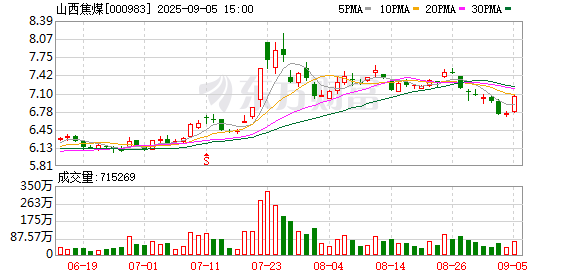
煤矿事故致子公司停产!山西焦煤利润连降后再添压力
Hua Xia Shi Bao· 2025-09-06 14:25
Core Viewpoint - Shanxi Coking Coal Energy Group Co., Ltd. (referred to as "Shanxi Coking Coal") has reported a safety production accident at its subsidiary, Water Yu Coal Industry Co., Ltd. (referred to as "Water Yu Coal"), which has led to its suspension of operations. The incident is currently under investigation by relevant government departments [2][3]. Company Impact - Water Yu Coal, established in 2005, is a significant subsidiary of Shanxi Coking Coal, with over 3,000 employees and a revenue of 1.05 billion yuan (approximately 0.79 billion yuan net profit) in the first half of 2025. The suspension of operations may add pressure to Shanxi Coking Coal's overall performance [3][4]. - Water Yu Coal has an annual approved production capacity of 4 million tons, accounting for 8.18% of the total approved capacity of Shanxi Coking Coal [4]. - The company stated that the specific impact of the suspension on its financial data will be determined based on audited financial reports. Following the accident, Water Yu Coal is cooperating with the investigation and implementing measures to enhance safety awareness and operational skills among employees [5]. Industry Context - Shanxi Coking Coal has faced multiple safety incidents in recent years, particularly involving its subsidiary, Huajin Coking Coal Co., Ltd. (referred to as "Huajin Coking Coal"). Notable incidents include accidents at Shaqu No. 1 Coal Mine and Jining Coal Industry Co., Ltd. [5][6]. - The overall performance of Shanxi Coking Coal has been declining since 2022, with net profits dropping from 10.754 billion yuan in 2022 to 3.108 billion yuan in 2024. In the first half of 2025, the company reported a revenue of 18.053 billion yuan, a 16.3% year-on-year decrease, and a net profit of 1.014 billion yuan, down 48.44% [9]. - The decline in profits is attributed to a decrease in coal prices, influenced by a relaxed supply-demand balance and increased imports. The domestic coal price has been fluctuating, with a downward trend in the price center for coking coal due to increased supply and decreased demand for pig iron [9][10]. Market Dynamics - The coking coal market is currently characterized by a relatively balanced supply-demand situation, with major producers, including Shanxi Coking Coal, holding significant market power. The first half of 2025 saw a wide drop in coking coal prices, leading to reduced production enthusiasm among coal mines [10]. - Despite the challenges, the demand for coking coal remains supported by high operating rates in coking plants, driven by optimistic steel consumption. As of August 28, 2025, coking coal inventories have decreased significantly compared to the previous year [10].