烧钱换用户

Search documents
2026了,大厂们还在用撒钱这招搞AI
Di Yi Cai Jing· 2026-01-26 05:28
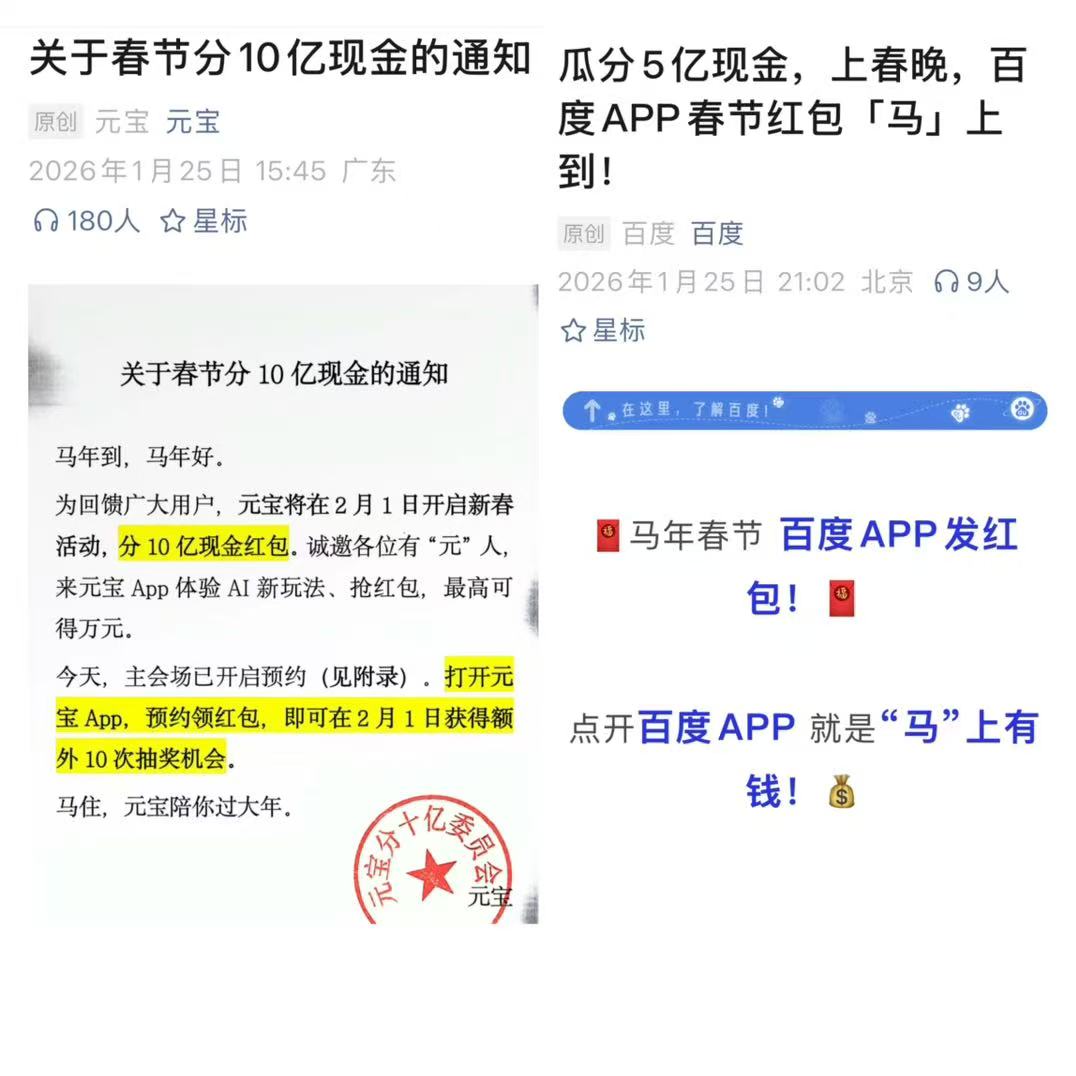
Group 1 - Major companies are investing heavily in AI, with Tencent spending 1 billion and Baidu following with 500 million, indicating a return to familiar tactics of "money burning" to capture market share [1] - The timing of these investments during the Spring Festival is strategic, aiming to integrate AI applications into the daily lives of millions, thus achieving a form of mass AI enlightenment [1] - The competition is intensified by ByteDance's Volcano Engine becoming the exclusive AI cloud partner for the Spring Festival Gala, prompting Tencent and Baidu to defend their positions in the AI space [1] Group 2 - The effectiveness of cash incentives is questioned, as demonstrated by DeepSeek's success without heavy marketing or subsidies, relying instead on strong open-source model capabilities and user experience [2] - The download spikes for AI applications during the Spring Festival are expected to be temporary, with users likely to disengage once the initial excitement fades [2] - The traditional "burning money for users" strategy is less effective in the AI sector, where user trust and long-term performance are critical for retention, contrasting with other sectors where price competition is more prevalent [3] Group 3 - The AI market presents unique challenges, as users require consistent and reliable performance from AI tools, leading to a low tolerance for subpar experiences [3] - The importance of product quality and user experience is emphasized, as companies must innovate and address real user pain points to maintain engagement beyond initial promotional efforts [3] - The conclusion drawn is that in the AI era, product capability is the primary driver of success, overshadowing financial incentives [3]
2026了,大厂们还在用撒钱这招搞AI
第一财经· 2026-01-26 05:24
Core Viewpoint - Major tech companies are heavily investing in AI, with Tencent spending 1 billion and Baidu 500 million, reminiscent of past strategies to capture user engagement during key events like the Spring Festival [3]. Group 1: Investment Strategies - The strategy of "spending money" is being employed again, with a focus on integrating AI into users' daily lives during the Spring Festival, a time when family gatherings can facilitate technology adoption [3]. - The financial outlay during this period is seen as a way to maintain visibility and compete for user attention, especially against rivals like ByteDance, which is also making significant moves in the AI space [3]. Group 2: Market Dynamics - The effectiveness of cash incentives is questioned, as demonstrated by the success of DeepSeek, an AI company that gained traction without heavy marketing or subsidies, relying instead on strong model capabilities and user experience [4]. - The article suggests that while initial downloads and user engagement may spike due to financial incentives, long-term retention is contingent on the quality and reliability of the AI products [4][5]. Group 3: User Behavior and Expectations - Users exhibit a low tolerance for AI tools that do not quickly demonstrate value, contrasting with other sectors where price competition drives user choice [5]. - The article emphasizes that in the AI landscape, product quality and user experience are paramount, and companies must innovate beyond financial incentives to build lasting user loyalty [5].




大厂们还在用撒钱这招搞AI
Di Yi Cai Jing· 2026-01-26 04:01
Core Viewpoint - Major tech companies are heavily investing in AI through cash incentives, reminiscent of past strategies, but this approach may only yield temporary engagement rather than sustainable user retention [1][3][5]. Group 1: Investment Strategies - Tencent has invested 1 billion and Baidu 500 million in AI initiatives, indicating a return to familiar tactics of financial incentives to attract users [1]. - The timing of these investments during the Spring Festival is strategic, aiming to leverage family gatherings to introduce AI applications to a wide audience [3]. Group 2: User Engagement and Retention - While cash incentives can drive initial downloads and engagement, the long-term retention of users is uncertain, as evidenced by the rapid decline in usage of AI applications post-incentive [4][5]. - The experience and trust in AI applications are critical; users are less likely to remain engaged without a proven value proposition, highlighting the importance of product quality over financial incentives [6]. Group 3: Competitive Landscape - The rise of companies like DeepSeek, which gained traction without significant financial backing, demonstrates that superior technology and user experience can outperform cash-driven strategies [3][4]. - The competitive environment in the AI sector is challenging, as users have high expectations for performance and reliability, making it difficult for companies relying solely on financial incentives to succeed [6].