爆款策略

Search documents
壕炸天,吉比特送出千万房产,游戏大厂年会狂撒钱
3 6 Ke· 2026-02-06 03:37
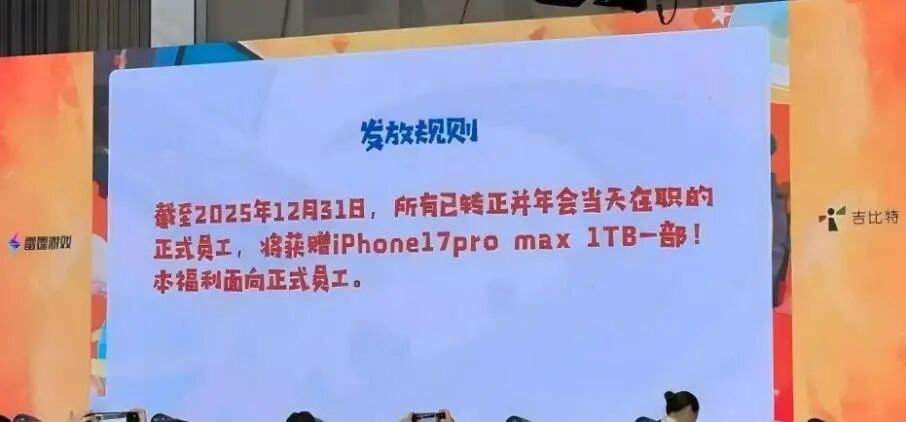
Core Viewpoint - The annual meeting season for gaming companies has showcased extravagant rewards, reflecting their strong financial performance and growth prospects for 2025 [1][3][5]. Group 1: Company Performance - Jibite (吉比特) expects a net profit of 1.69 billion to 1.86 billion yuan for 2025, representing a year-on-year growth of approximately 79% to 97% [5][8]. - Century Huatong (世纪华通) anticipates a consolidated revenue of about 38 billion yuan for 2025, with a net profit forecast of 5.55 billion to 6.98 billion yuan, indicating a staggering growth of 357% to 475% [8][10]. - The gaming industry in China is projected to achieve a total sales revenue of 350.79 billion yuan in 2025, marking a year-on-year increase of 7.68% [7]. Group 2: Employee Incentives - Jibite and Century Huatong have adopted high-reward strategies to motivate talent, with Jibite's average salary expected to rise by 6.34% to 710,700 yuan in 2024, while Century Huatong's average salary is projected to increase by 25.77% to 544,100 yuan [6]. - Jibite's annual meeting featured the distribution of iPhone 17 Pro Max phones to all eligible employees, while Century Huatong's subsidiary, Diandian Interactive, offered cash prizes with a maximum of 18,888 yuan [1][3]. Group 3: Market Trends - The A-share gaming sector has seen a significant upward trend, with the Tonghuashun gaming index rising by 57.58% since the beginning of 2025, and Jibite and Century Huatong's stock prices increasing by 105.94% and 277.82%, respectively [6]. - The trend of domestic gaming companies expanding into overseas markets is gaining momentum, with self-developed games generating 20.455 billion USD in actual sales revenue abroad, a year-on-year increase of 10.23% [9]. Group 4: Product Performance - Jibite's success in 2025 is attributed to the launch of several hit games, including "杖剑传说" and "问剑长生," which have significantly boosted its revenue [11]. - Century Huatong's Diandian Interactive has achieved remarkable success with its game "Whiteout Survival," ranking first in the Chinese mobile game export list [10].


小鹏“瘦身”,蔚来学得会吗?
3 6 Ke· 2025-05-23 10:46
Core Viewpoint - The article discusses the contrasting strategies of Xiaopeng Motors and NIO in the electric vehicle market, highlighting Xiaopeng's successful cost-cutting and management restructuring, while NIO struggles to replicate this success despite attempts to launch competitive products [2][20]. Group 1: Xiaopeng Motors' Performance - Xiaopeng Motors reported a revenue of 15.81 billion RMB in Q1 2025, a year-on-year increase of 141.5%, with a gross margin of 15.6%, up 2.7 percentage points [2][4]. - The company delivered 94,008 vehicles in Q1 2025, a 330.8% increase compared to the same period in 2024, surpassing its delivery guidance [4]. - Xiaopeng's successful models include MONA M03, P7+, X9, G6, and G9, with MONA M03 achieving over 100,000 deliveries in eight months [6][8]. Group 2: Cost Control and Management - Xiaopeng's gross margin improvement is attributed to cost reduction and economies of scale, with a focus on optimizing product mix and supply chain [7]. - The company emphasizes a "technology equality" strategy, aiming to lower the barriers to advanced technology through innovation [8]. - Xiaopeng has undergone significant organizational changes, including the replacement of 10 senior executives and restructuring of 30 key centers to enhance operational efficiency [16]. Group 3: NIO's Challenges - NIO's new model "Firefly" has underperformed, with only 470 units delivered since its launch, compared to Xiaopeng's MONA M03, which sold 3,200 units weekly [10][12]. - NIO's approach involves maintaining brand differentiation across its various models, which complicates cost management and resource allocation [13]. - Despite plans to achieve profitability by Q4 2025, NIO reported a net loss of 22.4 billion RMB in 2024, with a significant increase in losses in Q4 [15][16]. Group 4: Market Dynamics - The domestic market for vehicles priced below 100,000 RMB and between 100,000 to 150,000 RMB accounted for over 60% of total sales, indicating a strong demand in these segments [10]. - The competition in the electric vehicle sector is intensifying, with every cost and revenue decision becoming increasingly critical for manufacturers [20].