牛市抄底

Search documents
牛市抄底陷阱:90%散户都犯了这个错
Sou Hu Cai Jing· 2025-12-08 16:30
Core Insights - The article discusses the recent market activity where institutional investors are adjusting their portfolios, leading to a phenomenon known as "bottom-fishing anxiety" among retail investors [1] Group 1: Institutional Behavior - Recent data shows that stocks like Hotgen Biotech and Xiangyuan Cultural Tourism, which had previously seen significant gains, are being reduced by institutions, while leaders in niche markets like Goodix Technology and Petty Holdings are being increased [3] - The average equity fund position has reached 86.74%, an increase of 0.51 percentage points from the previous month, indicating a shift in institutional strategy towards defensive sectors like non-ferrous metals and coal, while reducing exposure in sectors like pharmaceuticals and computers [3][4] - The article highlights that only about 60% of stocks outperform the index during market rallies, suggesting that a significant portion of stocks may lag behind [3] Group 2: Market Dynamics - The year-end adjustment period sees a preference for stocks with high earnings certainty due to a lack of clear performance guidance [4] - In a tightening liquidity environment, undervalued sectors are more likely to attract risk-averse capital [4] - As the market begins to reprice based on next year's expectations, companies with solid fundamentals are at an advantage [4] Group 3: Investment Strategies - True bottom-fishing should not be based on market trends or index fluctuations; only stocks with sustained institutional participation have the potential for continued price increases [6] - The article emphasizes the importance of understanding institutional trading behavior, which tends to be more consistent than retail investor behavior [9] - A comparison of two stocks shows that one experienced sustained institutional interest while the other did not, leading to a significant difference in price performance [11][13] Group 4: Recommendations for Investors - Investors are advised to focus on behavioral patterns rather than price movements, as large capital flows are more reliable indicators [14] - Utilizing quantitative tools can help differentiate the behaviors of various market participants [14] - It is crucial to engage only in opportunities backed by clear institutional support and to rely on data to mitigate emotional decision-making [14]

六成个股跑输指数的秘密
Sou Hu Cai Jing· 2025-12-01 14:04
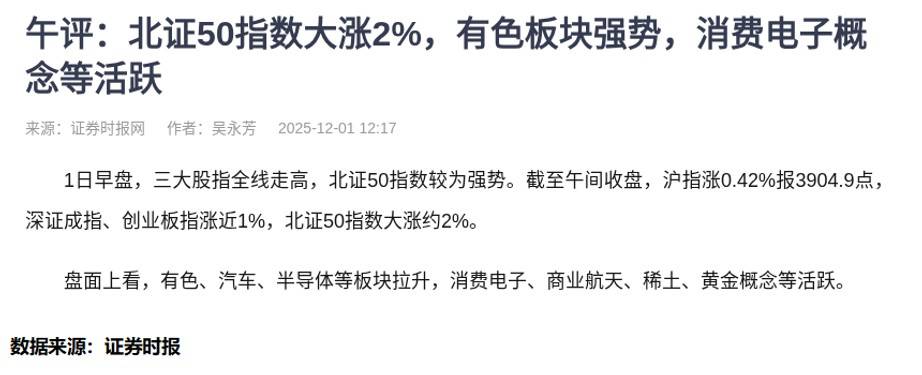
Core Viewpoint - The A-share market is experiencing a broad rally, with the North Securities 50 Index rising approximately 2%, driven by sectors such as non-ferrous metals, automotive manufacturing, and semiconductors, indicating a favorable time for positioning ahead of the spring market [1] Group 1: Market Performance - On December 1, the A-share market showed a strong upward trend, particularly in the North Securities 50 Index, which increased by about 2% [1] - Various sectors, including non-ferrous metals, automotive manufacturing, and semiconductors, exhibited strong performance, contributing to a positive market sentiment [1] Group 2: Investor Behavior and Risks - A reminder of the November 14 trading day highlights the risks of retail investors blindly "bottom-fishing" during market corrections, as many ended up facing significant losses [3][4] - Historical data indicates that only about 60% of stocks outperform the index during bull markets, suggesting that a substantial portion of stocks may lag behind even in favorable conditions [3] Group 3: Investment Strategies - True bottom-fishing should not rely on market trends or index fluctuations; only stocks with sustained institutional participation are likely to see continued price increases [7] - The example of Hualan Vaccine illustrates that while the index may rise, individual stocks can decline, leading to panic selling among retail investors [7] Group 4: Market Dynamics - During market downturns, retail investors often exhibit extreme behaviors, either holding onto their positions or fleeing at the slightest sign of volatility, both driven by emotional responses [10] - Quantitative data reveals that trading behavior, particularly by institutional investors, is more indicative of market trends than price movements alone [13][16] Group 5: Recommendations for Investors - Investors are advised to remain vigilant and not be misled by superficial price increases; focus should be on stocks with ongoing institutional involvement [20][21] - Utilizing quantitative tools to identify the movements of major players and establishing personal trading discipline are essential for successful investing [21]