牛市趋平

Search documents
市场抢跑“降息行情”:零售销售数据公布前,美债收益率持续走低
Zhi Tong Cai Jing· 2026-02-10 11:48
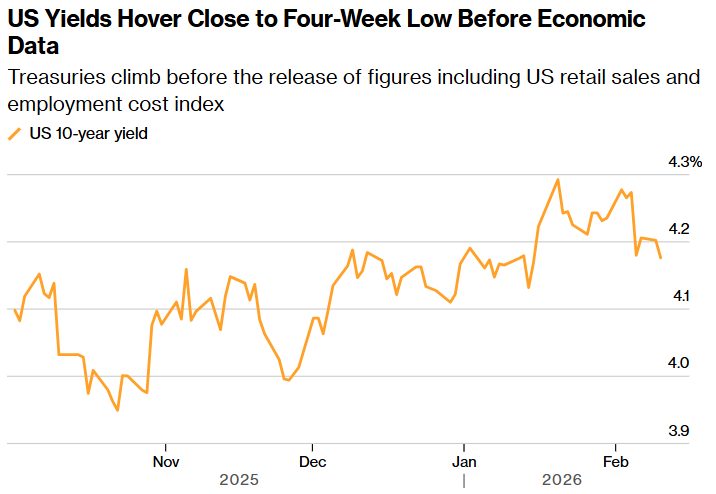
Group 1 - US Treasury bonds are expected to rise for the second consecutive day, with economic data and Federal Reserve officials' speeches potentially reinforcing the case for further rate cuts [1] - The yield on the 10-year US Treasury bond fell by 2 basis points to 4.18%, nearing its lowest level since mid-January, while the 2-year yield dropped by 1 basis point, indicating a "bull-flattening" trend [1] - The market currently estimates a 25% probability of the Federal Reserve cutting rates three times this year, each by 25 basis points, compared to a previous expectation of two cuts [1] Group 2 - Economists predict that US retail sales growth in December will slow from 0.6% to 0.4%, while the employment cost index for the fourth quarter is expected to remain stable at 0.8% [1] - The upcoming non-farm payroll data, delayed due to a government shutdown, is highly anticipated and will be released on Wednesday [1] - Kevin Hassett, Director of the National Economic Council, indicated that US employment data may decline in the coming months [4] Group 3 - The Cleveland Fed President and the Dallas Fed President, both considered hawkish, will participate in interest rate policy voting and are scheduled to speak on Tuesday [4] - The US Treasury will issue $58 billion in three-year new bonds this week, along with new 10-year and 30-year bonds [4] - Market expectations suggest that policymakers will keep interest rates unchanged at the next meeting, maintaining the range between 3.5% and 3.75% [4]

日本参议院选举投票开启,这是一场影响“首相归属、日美谈判”,关于“通胀化债、金融抑制”的公投
Hua Er Jie Jian Wen· 2025-07-20 03:16
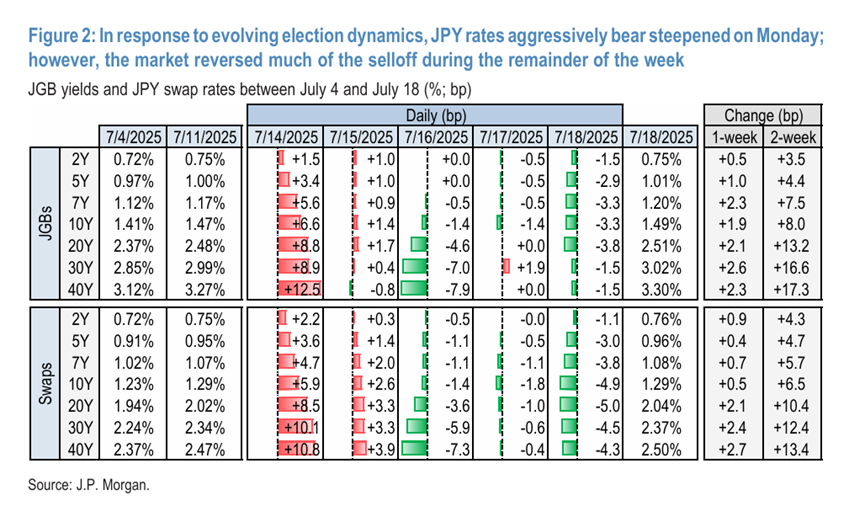
Core Viewpoint - The Japanese Senate election is a critical test for Prime Minister Shigeru Ishiba's administration, impacting future Japan-U.S. trade negotiations and economic policies [1][3] Group 1: Election Context - The election commenced on July 20, with voting ending at 19:00 Beijing time, and results expected by early July 21 [1] - A total of 125 seats are up for grabs, with the ruling coalition needing at least 50 seats to maintain a majority in the Senate [1][3] - Current polls indicate Ishiba's cabinet support has dropped to 20.8%, below the critical 30% threshold [3] Group 2: Political Implications - If the ruling coalition loses its majority, Ishiba's government may resign, potentially halting crucial Japan-U.S. trade talks [2][8] - The rise of the far-right "Reform Party" reflects a shift in political dynamics, with predictions of winning 10 to 15 seats [4][8] - A "twisted parliament" scenario could emerge, complicating legislative processes and leading to a political deadlock [4][7] Group 3: Market Reactions - Morgan Stanley suggests that the market has priced in the likelihood of the ruling coalition losing its majority, anticipating a complex political landscape [5][7] - If the ruling coalition performs better than expected, a "bull flattening" in the market may occur; conversely, a poor performance could lead to a steepening of the yield curve [7][8] Group 4: Economic Policies - Nomura warns that a loss of majority could accelerate tax increases and disrupt ongoing trade negotiations [8][9] - Deutsche Bank views the election as a referendum on "financial repression" policies, with voters demanding tax cuts and cash subsidies [10][11] - The public's growing discontent with negative real interest rates and inflation is becoming a central issue in the election [13][15]