牛顿定律

Search documents
张朝阳2026跨年演讲:解码太阳系奥秘,用数理公式演算宇宙谜题
Jing Ji Wang· 2026-01-04 08:12
Core Viewpoint - The keynote speech by Zhang Chaoyang, founder and CEO of Sohu, focuses on the exploration of the solar system and its implications for human civilization, emphasizing the importance of understanding the laws governing the solar system as a key to understanding humanity's past and future [3][4]. Group 1: Solar System Exploration - The solar system operates under specific laws, and understanding these laws is crucial for humanity [4]. - Zhang Chaoyang describes the solar system as a "home" that is both distant and close, highlighting the need for exploration and understanding [4]. - The speech is characterized as a "archaeology" of the solar system, using Newton's laws as foundational principles to explore celestial mechanics [4][5]. Group 2: Human Advancement in Space - The development of AI and aerospace technology is propelling humanity towards a "multi-planet civilization" [3]. - Zhang outlines three key stages for human exploration beyond Earth: the escape phase dominated by Earth's gravity, the Hohmann transfer phase dominated by the Sun's gravity, and the capture phase dominated by Mars' gravity [6]. - The concept of Lagrange points is introduced as stable locations for deploying scientific instruments, such as the Webb Telescope [6]. Group 3: Educational Impact and Media Strategy - Zhang emphasizes the value of learning physics, which aids in understanding both macro phenomena like global warming and everyday experiences [9]. - The physics course has conducted 270 live sessions over four years, accumulating over 26,000 minutes of online content, contributing significantly to the knowledge base [9]. - The integration of traditional teaching with new media is seen as a meaningful approach to disseminating knowledge in the current digital age [9].

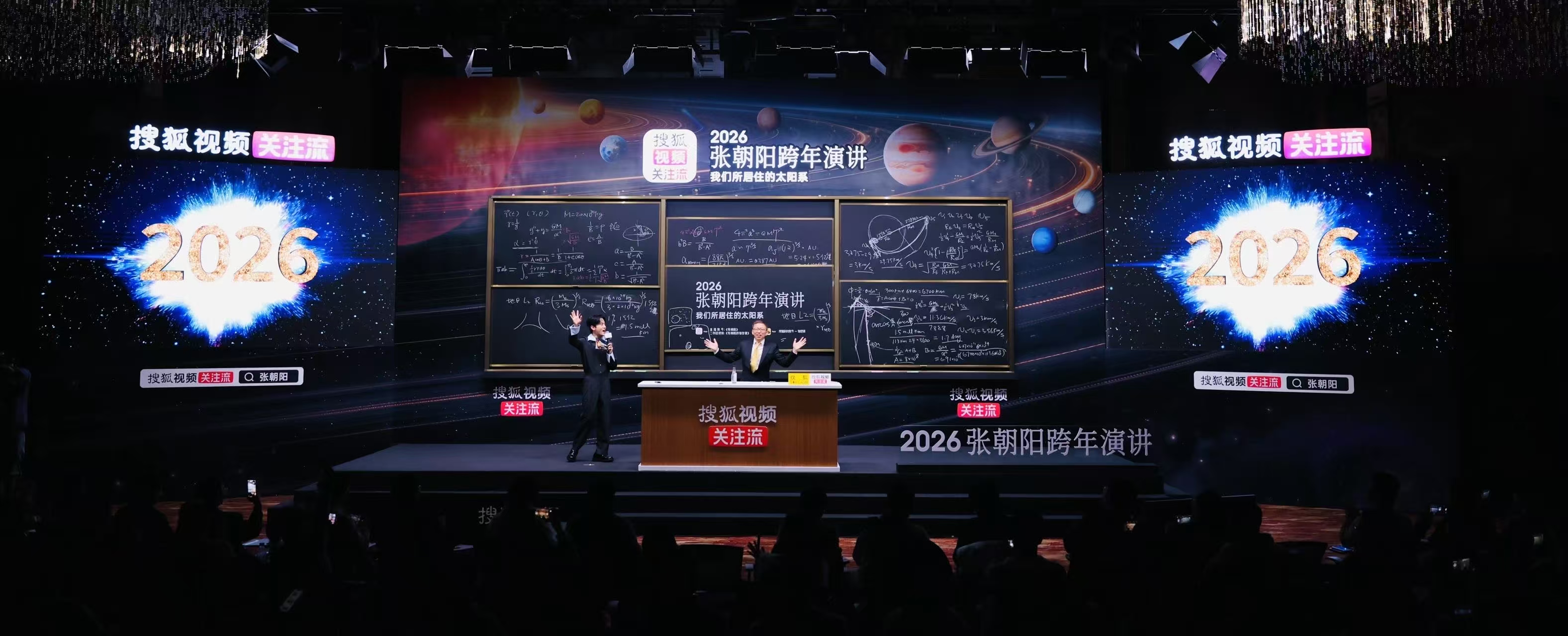
开普勒三定律、潮汐力、轨道方程:张朝阳跨年演讲解析太阳系的内在秩序
Bei Jing Shang Bao· 2026-01-02 06:03
Core Viewpoint - The keynote speech by Zhang Chaoyang focuses on understanding the solar system and its significance for humanity's future, particularly in the context of advancing AI and space technology towards a multi-planetary civilization [1][3]. Group 1: Understanding the Solar System - The solar system operates under specific laws, with Newton's laws providing a framework for understanding planetary motion [3][4]. - Zhang emphasizes that the solar system is not distant and unknown but rather a familiar home that requires understanding [3][6]. - The exploration of celestial bodies has led to significant advancements in physics, with historical figures like Tycho Brahe and Kepler contributing to our understanding of planetary motion [3][4]. Group 2: The Role of Tidal Forces - Tidal forces play a crucial role in the behavior of moons and planets, affecting their orbits and physical characteristics [6][8]. - Zhang explains how tidal forces can lead to phenomena such as the synchronous rotation of the Moon and the volcanic activity on Io, one of Jupiter's moons [8][9]. Group 3: Human Exploration of Space - The speech outlines three key stages for human exploration beyond Earth, starting with Lagrange points, which are stable locations for deploying spacecraft [9][11]. - Mars is highlighted as a potential destination for human exploration due to its similarities to Earth, with a detailed explanation of the Hohmann transfer orbit for efficient travel [9][11]. - The Voyager missions are noted as significant milestones in humanity's exploration of the outer solar system, utilizing gravitational assists to increase speed [11][12]. Group 4: Scientific Foundation for Speculation - Zhang stresses the importance of grounding speculative ideas in solid scientific principles, particularly in discussions about future space colonization [12][14]. - The audience is encouraged to engage with scientific concepts before delving into speculative scenarios, ensuring a robust understanding of physics [14][15]. Group 5: Educational Impact and Engagement - The integration of traditional teaching with new media has proven effective, with Zhang's physics classes reaching a wide audience and contributing to public knowledge [15][17]. - The emphasis on rigorous mathematical foundations in science education is highlighted as essential for fostering a deeper understanding of complex topics [15][17].