
特色化转型

Search documents
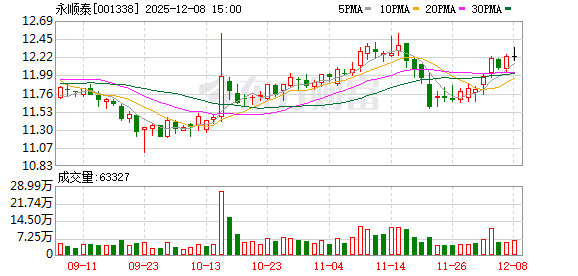
永顺泰:公司在啤酒及延伸消费产业链中扮演原料提供者的角色
Zheng Quan Ri Bao· 2025-12-08 12:41
Core Viewpoint - Yongshuntai is positioned as a leading malt supplier in Asia, playing a crucial role as a raw material provider in the beer and extended consumption industry chain [2] Group 1: Company Positioning - The company actively adapts to the trend of premiumization by offering specialty malts and customized products to meet the demands of emerging markets such as craft beer [2] - Yongshuntai participates in the industry's transformation towards high-end, craft, and specialty products [2]

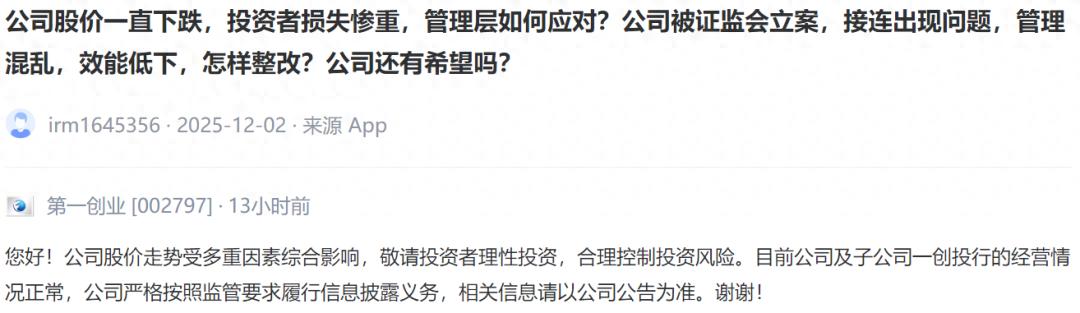
互动易上被问股价持续下跌,第一创业证券回复难解投资者焦虑
Xin Lang Cai Jing· 2025-12-04 06:17
Core Viewpoint - The article highlights the challenges faced by First Capital Securities amid regulatory scrutiny and market volatility, leading to investor anxiety and a significant decline in stock price [1][2]. Group 1: Stock Performance and Investor Sentiment - As of December 3, First Capital's stock price has dropped 18.01% year-to-date, significantly underperforming the market and other listed brokers [2]. - The company's dividend plan for mid-2025 proposes a cash dividend of 0.10 yuan per 10 shares, totaling 42.024 million yuan, which represents only 8.66% of the net profit attributable to shareholders for the first half of the year, failing to meet investor expectations [2]. - Following the announcement of an investigation into its subsidiary, the stock price fell by 5.94% on the next trading day, reflecting heightened investor concerns [2]. Group 2: Regulatory Issues and Compliance Challenges - First Capital's subsidiary, Yi Chuang Investment, is under investigation by the CSRC for alleged negligence in the 2019 Hongda Xingye convertible bond project, which raised 2.427 billion yuan, with 1.691 billion yuan misappropriated [2][3]. - The company has faced scrutiny regarding its private asset management business, with the Shenzhen Securities Regulatory Bureau issuing a warning about inadequate net value management and insufficient information disclosure [3]. Group 3: Corporate Governance and Management Structure - First Capital has undergone significant ownership changes, transitioning from a local state-owned broker to a structure dominated by Beijing state-owned assets, leading to perceptions of "chaotic management" [4][5]. - The company currently lacks a controlling shareholder, with Beijing Guoguang becoming the largest shareholder in May 2023, holding 11.06% of the shares [5]. - The management team has seen instability due to the integration of new personnel with state-owned backgrounds and the retention of long-standing executives, resulting in decision-making challenges and compliance issues [5][6]. Group 4: Financial Performance - For the first three quarters of 2023, First Capital reported revenue of 2.985 billion yuan, a year-on-year increase of 24.32%, and a net profit of 771 million yuan, up 20.21% [6]. - The net income from securities underwriting reached 197 million yuan, a 15.13% increase, with notable achievements in bond issuance for Beijing state-owned enterprises [6]. Group 5: Future Outlook and Strategic Communication - To rebuild investor trust, the company needs to disclose specific rectification plans regarding the investigation and enhance risk management in its investment banking operations [6][7]. - Engaging with investors through performance briefings and communication channels is essential to translate business developments into market confidence [7].

锚定数字生态新定位 银行网点“瘦身强体”在路上
Zheng Quan Shi Bao· 2025-04-16 18:46
Group 1 - The core viewpoint of the articles highlights the ongoing transformation of bank branches in China, where the number of physical outlets is decreasing while their operational quality is improving, driven by digitalization and cost-cutting measures [1][2] - As of the end of 2024, the average net interest margin of Chinese commercial banks is projected to drop to 1.52%, indicating increasing operational pressure on banks [1] - The average annual operating cost of a traditional branch in third-tier cities ranges from 3 million to 5 million yuan, emphasizing the high cost of maintaining physical outlets [1] Group 2 - The transformation of bank branches is not merely a replacement of channels but involves a fundamental reshaping of service concepts and positioning, with over 90% of banking services now conducted online [2] - Digital transformation is pushing banks to innovate, turning physical branches from homogeneous "transaction processing centers" into differentiated "value creation nodes" [2] - Community branches are being relocated and optimized to better serve residents, incorporating advanced technologies like AR and digital currency experiences, thus evolving into "financial education platforms" [2] Group 3 - Unique transformations are injecting new vitality into bank branches, allowing them to shift from "cost centers" to "incremental entry points," as seen in various innovative initiatives across different regions [3] - The balance between efficiency and cost, avoiding the digital divide, and maintaining service warmth are ongoing challenges that banks must navigate during this transformation [3] - The evolution of physical banking channels is a complex process that reflects a continuous improvement in service capabilities rather than a simple increase or decrease in quantity [3]