
现代育种技术

Search documents
小麦变身记(三餐四季)
Ren Min Ri Bao· 2026-02-27 06:07
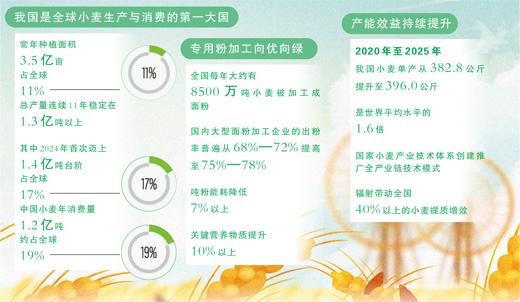
Core Insights - Wheat is a staple food in China, with a planting area of 350 million acres and a production exceeding 130 million tons for 11 consecutive years, accounting for 17% of global production and consumption [1] - The trend of specialized wheat for various food products is growing, with specialized flour now making up 30% of total wheat flour production [3][5] Group 1: Wheat Production and Quality - The quality of wheat is crucial for different types of flour products, leading to the development of specialized wheat varieties such as "Xinmai 26" and "Zhengmai 1860" [2] - The average yield of wheat in China has reached 1.6 times the world average, with ongoing efforts to improve yield through modern breeding techniques [8] Group 2: Technological Innovations in Processing - Advanced processing techniques have increased flour yield from 68%-72% to 75%-78%, with energy consumption reduced by over 7% and key nutritional content improved by 10% [5] - Companies are utilizing smart technology for precise flour blending, achieving consistency in product quality with minimal variability [5] Group 3: Market Trends and Consumer Preferences - The demand for functional wheat products is rising, with examples like "Chuanmai 98" mooncakes achieving significant sales, indicating a shift towards health-oriented food options [10] - The cultural significance of wheat is highlighted through traditional crafts like flower dough art, showcasing its versatility beyond just food [11] Group 4: Economic Impact and Industry Growth - The wheat industry is expanding into various sectors, contributing to a total output value of 15.2 billion yuan in regions like Yan Jin, supporting local farmers and creating job opportunities [12] - The integration of the wheat supply chain is enhancing the overall economic value, with a focus on high-end processing and sustainable practices [12]

深耕中国市场的决心从未改变——德国企业高管看好中国机遇
Xin Hua She· 2026-02-27 03:10
Group 1 - The meeting held in Beijing with representatives from major German companies like Siemens, Volkswagen, and Bayer highlights the strong economic ties between Germany and China, emphasizing the importance of deepening bilateral trade relations in the current challenging global environment [1] - The high-level delegation, consisting of 30 representatives from key sectors such as automotive, chemicals, biopharmaceuticals, and machinery, reflects the significant interest of German companies in the Chinese market and their strong willingness to enhance practical cooperation [1] - The trade volume between China and Germany has consistently exceeded $200 billion, with bilateral investment stock surpassing $65 billion, indicating a robust and complementary economic partnership [1] Group 2 - Mercedes-Benz's involvement in the Chinese automotive market is highlighted as a key element of Sino-German cooperation, with a focus on local innovation networks that are crucial for maintaining competitiveness in the rapidly evolving electric and intelligent vehicle sectors [2] - The visit of the German Chancellor included a stop at Yushu Technology in Hangzhou, showcasing China's innovation capabilities and the potential for future market opportunities driven by technological advancements [3] - Henkel's CEO noted that China has become a global innovation hub, with significant potential in high-quality development and sustainable growth, leading to continued investment and collaboration with Chinese partners [3] Group 3 - German companies are actively investing in China, with Siemens Energy leading the way in Hainan Free Trade Port, and BMW collaborating with Alibaba to advance artificial intelligence technologies [4] - The presence of over 560 German companies in Taicang, known as the "hometown of German enterprises," underscores the strategic importance of this region for high-quality manufacturing and innovation [4] - The efficient supply chain and open innovation ecosystem in China are attracting more German firms, making investment in China a necessity rather than an option [5][6]