
手延面

Search documents
小麦变身记(三餐四季)
Ren Min Ri Bao· 2026-02-27 06:07
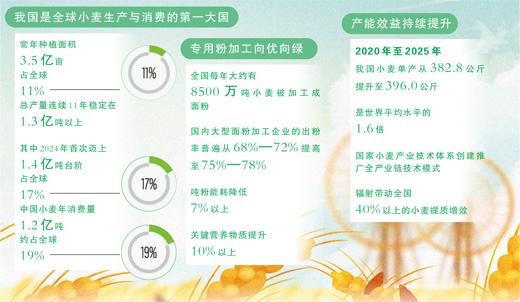
Core Insights - Wheat is a staple food in China, with a planting area of 350 million acres and a production exceeding 130 million tons for 11 consecutive years, accounting for 17% of global production and consumption [1] - The trend of specialized wheat for various food products is growing, with specialized flour now making up 30% of total wheat flour production [3][5] Group 1: Wheat Production and Quality - The quality of wheat is crucial for different types of flour products, leading to the development of specialized wheat varieties such as "Xinmai 26" and "Zhengmai 1860" [2] - The average yield of wheat in China has reached 1.6 times the world average, with ongoing efforts to improve yield through modern breeding techniques [8] Group 2: Technological Innovations in Processing - Advanced processing techniques have increased flour yield from 68%-72% to 75%-78%, with energy consumption reduced by over 7% and key nutritional content improved by 10% [5] - Companies are utilizing smart technology for precise flour blending, achieving consistency in product quality with minimal variability [5] Group 3: Market Trends and Consumer Preferences - The demand for functional wheat products is rising, with examples like "Chuanmai 98" mooncakes achieving significant sales, indicating a shift towards health-oriented food options [10] - The cultural significance of wheat is highlighted through traditional crafts like flower dough art, showcasing its versatility beyond just food [11] Group 4: Economic Impact and Industry Growth - The wheat industry is expanding into various sectors, contributing to a total output value of 15.2 billion yuan in regions like Yan Jin, supporting local farmers and creating job opportunities [12] - The integration of the wheat supply chain is enhancing the overall economic value, with a focus on high-end processing and sustainable practices [12]

小麦变身记
Ren Min Ri Bao· 2026-02-27 05:57
Core Insights - Wheat is a staple food in China, with a planting area of 350 million acres and an annual production exceeding 130 million tons, accounting for 17% of global production and consumption, making China the largest producer and consumer of wheat [1][2] Group 1: Wheat Production and Quality - The quality of wheat is crucial for various food products, with specialized wheat varieties being developed to meet specific needs, such as "烟农1212" which has high flour yield and strong flavor [4] - Specialized flour now accounts for 30% of total wheat flour production, indicating a trend towards more refined product categorization [4] - Technological innovations have improved flour yield from 68%-72% to 75%-78%, with energy consumption reduced by over 7% and key nutrients increased by 10% [5] Group 2: Agricultural Practices and Challenges - Wheat cultivation faces challenges from weather variability, with significant efforts required for successful harvests, particularly in major production areas like the Yellow River and Huai River regions [6][7] - The average wheat yield in China is 1.6 times the global average, with ongoing efforts to enhance production through modern breeding techniques [8] Group 3: Economic Impact and Value Chain - The wheat economy is expanding across food, culture, and industrial sectors, with innovative products like "川麦98" series mooncakes achieving significant sales [10] - By integrating various agricultural and processing techniques, the wheat industry is creating diverse economic opportunities, with total output value in regions like 延津 reaching 15.2 billion yuan [11]

陈克明面馆全国直营首店开业,锅气热炒定义新牌桌规则
Cai Jing Wang· 2025-12-31 11:19
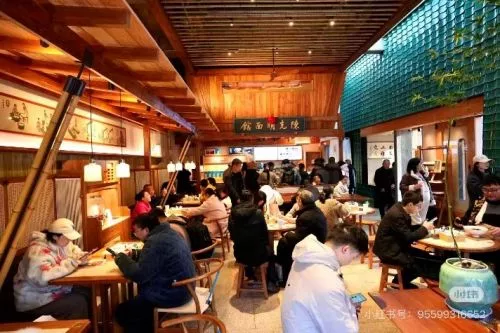
Core Insights - Kemin Food has expanded its business model by launching a noodle restaurant, Chen Kemin Noodle House, which emphasizes brand promotion and consumer engagement through a unique dining experience [1][2][4]. Group 1: Business Strategy - The new restaurant features a traditional Chinese courtyard design and offers a range of noodle dishes priced between 9.9 yuan and 39 yuan, showcasing the live noodle-making process to enhance customer experience [4][5]. - The company aims to address supply chain issues for small B-end clients while also focusing on expanding its market presence in various channels, including wholesale and catering [5][6]. - Kemin Food's strategic move into the restaurant sector is seen as a way to revitalize its brand and counteract declining sales in its core noodle products, which have seen revenue drops of 12.7% in 2023 and 6.37% in 2024 [6][8]. Group 2: Market Trends - The noodle restaurant market in China is becoming increasingly competitive, with a projected 785,000 noodle restaurants by Q1 2025, representing 9.7% of the overall restaurant industry [10][11]. - High-line cities are becoming hotspots for new noodle brands, with consumer preferences shifting towards unique dining experiences that emphasize freshness and cooking methods like "stir-frying" and "pot aroma" [10][11][14]. - The trend towards experiential dining is supported by a growing consumer willingness to pay for emotional value and scene experiences, particularly among younger generations [13][14]. Group 3: Future Outlook - The company plans to evaluate the performance of the new restaurant before considering further expansion beyond Changsha, indicating a cautious approach to growth [15][16]. - Experts suggest that establishing a sustainable customer repurchase habit and maintaining operational efficiency will be crucial for long-term success in the noodle restaurant sector [8][14].

从“面条大王”到构建主食生态 克明食品向“新消费”突围
Shang Hai Zheng Quan Bao· 2025-12-29 19:06
Core Viewpoint - The company is transforming from a traditional noodle manufacturer to a provider of staple food solutions aimed at younger consumers, utilizing mobile food trucks to enhance consumer engagement and feedback [1][2]. Group 1: Company Strategy - The company plans to launch mobile food trucks in multiple cities by 2025 to shorten the connection between products and consumers, adapting to the preferences of the younger generation [1][2]. - The strategy is based on the observation that the number of noodle shops in China is expected to exceed 660,000 by March 2025, with a market size projected to surpass 160 billion yuan, growing at 8% year-on-year [2]. - The company aims to transform traditional noodle products into experiential and shareable items, aligning with the emotional and social consumption trends of younger consumers [2][3]. Group 2: Cultural and Emotional Connection - The company emphasizes the cultural attributes of its products, aiming to balance industrial efficiency with human touch, and leveraging cultural narratives such as traditional noodle-making techniques and seasonal eating habits [3]. - The competition in the food industry is shifting towards the ability to connect values and emotions with consumers, highlighting the importance of cultural storytelling in product offerings [3]. Group 3: Product Innovation and Quality - The company processes 3,000 tons of wheat daily in its factories, maintaining high production efficiency while also exploring traditional methods for new product lines [4][5]. - The introduction of AI in production aims to enhance quality control and product consistency, reflecting the company's commitment to innovation and adaptation to market demands [5]. - The company is expanding its product range to include healthier options and is focusing on B2B markets by providing customized semi-finished products and solutions [5][6]. Group 4: Market Positioning - The company is transitioning from being a "noodle supplier" to a "staple food solution provider," aligning with the current trends in the food industry towards integration of dining and retail [6]. - The transformation reflects a proactive response to new consumer trends and serves as a model for traditional manufacturers seeking growth in a saturated market [6].
克明食品:将持续深耕高端挂面,保障软弹面、手延面品质稳定且逐渐降本增效
Cai Jing Wang· 2025-09-04 09:41
Core Insights - The company is facing challenges with declining revenue and sales due to decreased market demand [1] - The company is actively responding to health trends by expanding the use of buckwheat and whole wheat flour in its products [1] - The company aims to strengthen its high-end noodle product line while ensuring quality and reducing costs [1] - The company is exploring new distribution channels, including C-class small stores, wholesale markets, and catering services [1] - The company is implementing measures to reduce costs in its pig farming segment, focusing on health management and feed optimization [1] Revenue and Sales - The company reported a decline in sales primarily attributed to a decrease in market demand [1] Product Development - The company is expanding the application of buckwheat and whole wheat flour in response to health dietary trends [1] - The company is committed to enhancing the quality and cost-effectiveness of its high-end noodle products [1] Competitive Strategy - The company is conducting in-depth research on factors affecting the taste of its soft and elastic noodles to establish competitive barriers [1] Distribution Channels - The company is consolidating its existing advantageous channels while actively expanding into new markets such as wholesale and catering [1] Cost Management - The company is implementing several key measures to lower costs in its pig farming operations, including health management and feed optimization [1]