理性重新定价

Search documents
AI巨头暴跌背后的真相
Ge Long Hui· 2025-12-14 10:12
Core Viewpoint - The recent sell-off in the AI sector is not due to a sudden contraction in AI demand, but rather a rational re-evaluation of the industry's pricing and profitability dynamics following disappointing earnings reports from major companies like Oracle and Broadcom [6][8][17]. Group 1: Market Reactions - Oracle's stock price plummeted after its earnings report, contributing to a broader decline in the AI sector, with Broadcom's shares falling 11.43% in a single day [1][3]. - The sell-off extended to various AI-related stocks, with notable declines in companies like Astera Labs and Core Weave, which saw drops exceeding 10% [3]. - Concerns about an "AI bubble burst" have spread throughout the market, reflecting heightened anxiety among investors [4]. Group 2: Earnings Insights - Broadcom reported that AI-related orders have surpassed $73 billion for the next 18 months, indicating strong ongoing demand [6]. - Oracle's RPO (Remaining Performance Obligations) reached $523 billion for Q2 of fiscal year 2026, a 15% quarter-over-quarter increase, driven by significant contracts from major players like Meta and NVIDIA [6]. - Oracle's current remaining performance obligations (cRPO) stood at approximately $53.1 billion, a 40% year-over-year increase, suggesting a robust short-term order flow [6]. Group 3: Market Dynamics - The market is shifting from a focus on growth scale to a more critical assessment of profitability quality, investment return cycles, and order fulfillment certainty [8][9]. - Broadcom's transition from high-margin chip sales to system-level sales has raised concerns about future profit margins, as the company indicated a potential decline in gross margins [9]. - The sell-off reflects a broader trend of capital moving away from crowded AI midstream sectors towards more stable assets with clearer cash flows [11]. Group 4: Future Outlook - The AI sector is transitioning from a "compute breakthrough phase" to a "system delivery phase," where efficient delivery of reliable AI systems becomes paramount [12][13]. - Companies with diverse customer bases and clear order fulfillment paths are likely to attract more investment, while those relying on large orders from single clients may face increased valuation pressure [13]. - The differentiation within the AI sector will become more pronounced, with companies that possess core technologies and stable profitability likely to thrive [17].


AI巨头暴跌背后的真相
格隆汇APP· 2025-12-14 10:06
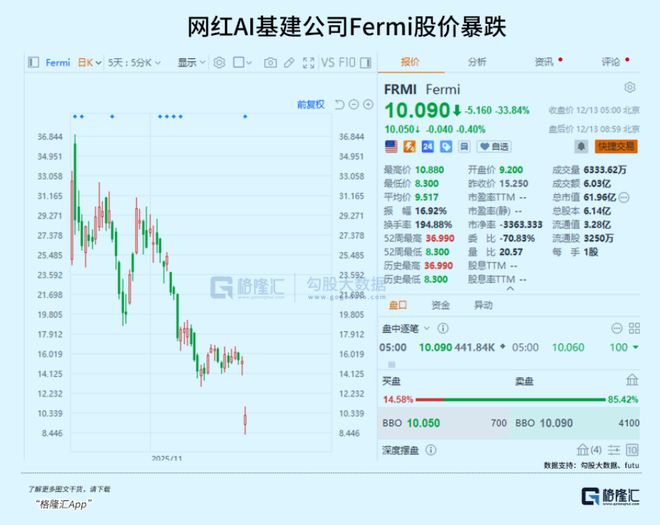
Core Viewpoint - The recent sell-off in the AI sector is not due to a sudden contraction in AI demand, but rather a rational re-evaluation of the industry's growth quality and profitability [9][12][29] Group 1: Market Reactions and Performance - Oracle's stock plummeted after disappointing earnings, contributing to a broader decline in the AI sector [3] - Broadcom's stock fell by 11.43% following its earnings report, further shaking market confidence [3] - Fermi, an AI infrastructure company, saw its stock crash by 46% due to a major client canceling a lease, exacerbating market fears [4] - The NASDAQ index dropped by 1.91%, reflecting widespread panic across the AI supply chain [6] Group 2: Financial Insights - Broadcom reported that AI-related orders exceeded $73 billion for the next 18 months, indicating strong ongoing demand [10] - Oracle's RPO reached $523 billion for Q2 FY2026, a 15% quarter-over-quarter increase, with new contracts adding approximately $67.7 billion [10] - Oracle's cRPO balance was about $53.1 billion, a 40% year-over-year increase, suggesting a faster order fulfillment pace [10] Group 3: Market Dynamics and Trends - The market is shifting from a focus on growth scale to evaluating profitability quality and investment return cycles [13][21] - Companies that relied on large orders from single clients may face increased valuation pressure, while those with diverse customer bases will attract more investment [23] - The transition reflects a broader market maturation process, with a focus on stable profits and clear growth paths [29] Group 4: Sector Impacts - Midstream companies in the AI supply chain may experience increased valuation sensitivity and stock price volatility [25] - Core suppliers like NVIDIA and TSMC, which hold pricing power, are likely to remain resilient amid uncertainty [25] - Downstream cloud providers like Amazon and Meta, with strong ecosystems, are expected to benefit from AI technology deployment and maintain stable valuations [26][28]