
XPU芯片

Search documents
迈威尔科技(MRVL):FY26Q4 业绩点评及业绩说明会纪要:单季与财年收入双创记录,需求强劲上调 FY27-28 指引
Huachuang Securities· 2026-03-08 11:59
Investment Rating - The report assigns a strong buy rating for Marvell Technology, expecting it to outperform the benchmark index by over 20% in the next six months [57]. Core Insights - Marvell Technology reported record revenue for FY26Q4, with a total revenue of $2.219 billion, reflecting a quarter-over-quarter increase of 7% and a year-over-year increase of 22% [3][8]. - The strong demand from the data center market significantly contributed to the revenue growth, with data center revenue reaching $1.651 billion in FY26Q4, up 9% quarter-over-quarter and 21% year-over-year [3][15]. - The company expects FY27Q1 revenue to be approximately $2.4 billion, with a projected quarter-over-quarter growth of about 8% and a year-over-year growth exceeding 30% [4][24]. Revenue Performance - FY26Q4 revenue breakdown shows data center market revenue at $1.651 billion and communications and other markets at $567 million, with the latter expected to grow at a low single-digit rate quarter-over-quarter and approximately 30% year-over-year [22][23]. - Non-GAAP gross margin for FY26Q4 was reported at 59.0%, while GAAP gross margin was 51.7%, both exceeding the guidance midpoint [9][10]. Guidance for FY27Q1 - The company anticipates FY27Q1 Non-GAAP gross margin to be between 58.25% and 59.25%, with GAAP gross margin expected between 51.4% and 52.4% [4][25]. - Operating expenses for FY27Q1 are projected to be around $872 million for GAAP and approximately $575 million for Non-GAAP [24][25]. Market Segmentation - The data center market is expected to see a quarter-over-quarter revenue growth of about 10% in FY27Q1, despite a seasonal decline in local deployment data center revenue [4][15]. - The communications and other markets are projected to maintain low single-digit quarter-over-quarter growth with a year-over-year increase of around 30% [4][22]. Strategic Developments - Marvell is focusing on expanding its product offerings in the data center segment, including advancements in custom chips and interconnect products, which are expected to drive significant revenue growth [20][21]. - The company has established strong partnerships with major data center operators, enhancing its market position and diversifying its customer base [26][27].

AI巨头暴跌背后的真相
Ge Long Hui· 2025-12-14 10:12
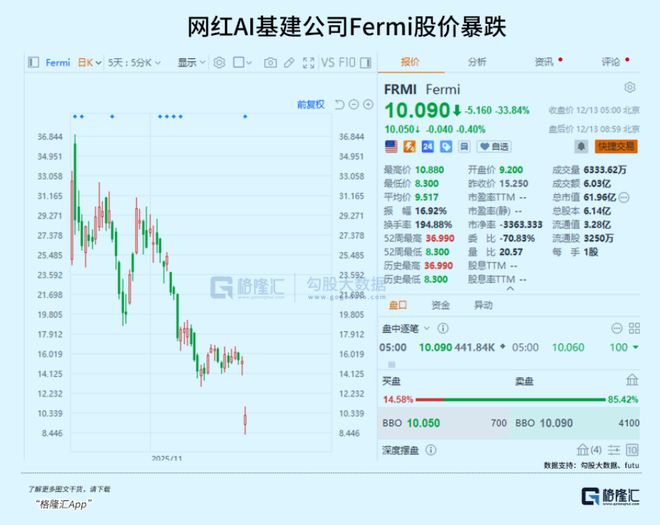
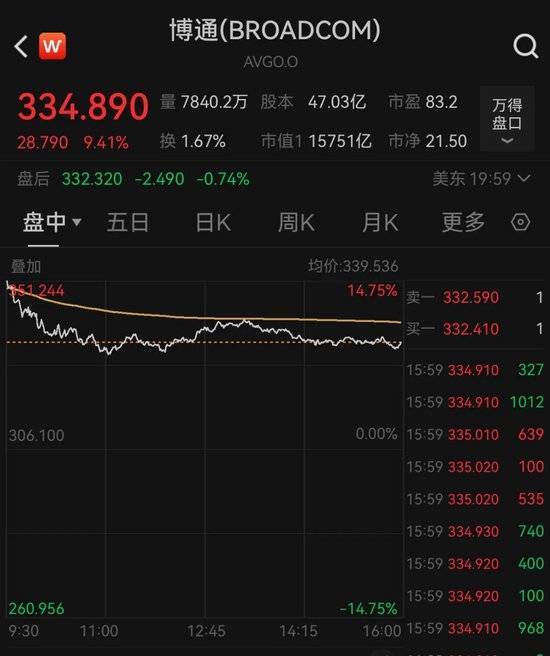
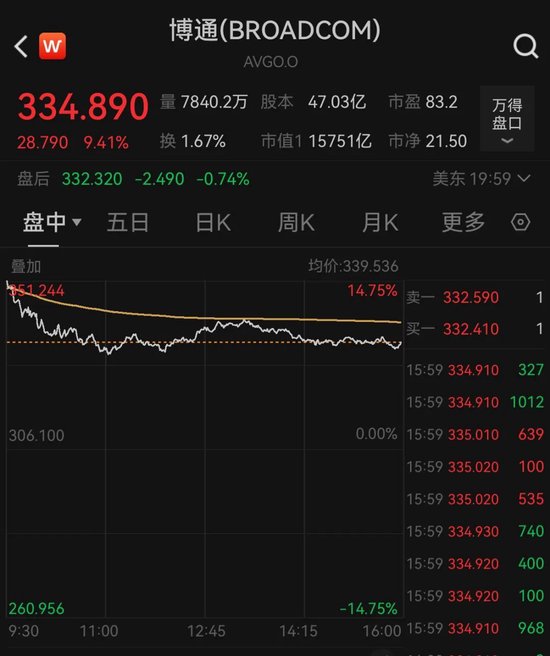
Core Viewpoint - The recent sell-off in the AI sector is not due to a sudden contraction in AI demand, but rather a rational re-evaluation of the industry's pricing and profitability dynamics following disappointing earnings reports from major companies like Oracle and Broadcom [6][8][17]. Group 1: Market Reactions - Oracle's stock price plummeted after its earnings report, contributing to a broader decline in the AI sector, with Broadcom's shares falling 11.43% in a single day [1][3]. - The sell-off extended to various AI-related stocks, with notable declines in companies like Astera Labs and Core Weave, which saw drops exceeding 10% [3]. - Concerns about an "AI bubble burst" have spread throughout the market, reflecting heightened anxiety among investors [4]. Group 2: Earnings Insights - Broadcom reported that AI-related orders have surpassed $73 billion for the next 18 months, indicating strong ongoing demand [6]. - Oracle's RPO (Remaining Performance Obligations) reached $523 billion for Q2 of fiscal year 2026, a 15% quarter-over-quarter increase, driven by significant contracts from major players like Meta and NVIDIA [6]. - Oracle's current remaining performance obligations (cRPO) stood at approximately $53.1 billion, a 40% year-over-year increase, suggesting a robust short-term order flow [6]. Group 3: Market Dynamics - The market is shifting from a focus on growth scale to a more critical assessment of profitability quality, investment return cycles, and order fulfillment certainty [8][9]. - Broadcom's transition from high-margin chip sales to system-level sales has raised concerns about future profit margins, as the company indicated a potential decline in gross margins [9]. - The sell-off reflects a broader trend of capital moving away from crowded AI midstream sectors towards more stable assets with clearer cash flows [11]. Group 4: Future Outlook - The AI sector is transitioning from a "compute breakthrough phase" to a "system delivery phase," where efficient delivery of reliable AI systems becomes paramount [12][13]. - Companies with diverse customer bases and clear order fulfillment paths are likely to attract more investment, while those relying on large orders from single clients may face increased valuation pressure [13]. - The differentiation within the AI sector will become more pronounced, with companies that possess core technologies and stable profitability likely to thrive [17].


权重股海光信息20CM涨停!科创综指ETF天弘(589860)涨超4%,芯片ETF天弘(159310)大涨超6%
2 1 Shi Ji Jing Ji Bao Dao· 2025-09-11 03:51
Group 1 - The technology sector showed strong performance on September 11, with leading gains in communication, semiconductors, and electronic components [1] - The Tianhong Sci-Tech Innovation Index ETF (589860) rose by 4.15% with a turnover rate exceeding 11%, indicating active trading [1] - Key stocks in the Tianhong Sci-Tech Innovation Index ETF included Juguang Technology and Haiguang Information, both hitting the 20% daily limit up [1] Group 2 - The Tianhong Chip ETF (159310) surged over 6% in early trading, with major weighted stocks like Haiguang Information hitting the 20% limit up and Cambrian-U rising over 10% [1] - The Tianhong Sci-Tech Innovation Index ETF closely tracks the Sci-Tech Innovation Index, covering approximately 97% of the market capitalization of the Sci-Tech Innovation Board, focusing on small-cap hard technology companies [1] - Broadcom reported impressive third-quarter earnings, with revenue reaching a record high, up 22% year-over-year, exceeding analyst expectations [2] Group 3 - Broadcom's AI chip revenue grew by 63% year-over-year to $5.2 billion in the third quarter, with expectations for further acceleration to $6.2 billion in the fourth quarter [2] - OpenAI is set to produce its own AI chips in collaboration with Broadcom, aiming to reduce reliance on NVIDIA chips [2] - Analysts suggest that the demand for ASIC chips is strong, with a positive outlook for domestic ASIC industries, supported by Broadcom's quarterly performance and customer expansion [2]

光通信:穿越波动,长坡厚雪
GOLDEN SUN SECURITIES· 2025-09-07 08:20
Investment Rating - The report maintains an "Overweight" rating for the optical communication sector [4]. Core Insights - The optical communication sector has experienced significant volatility recently, but strong demand and large orders in the overseas AI computing field indicate that the fundamentals of the optical module industry remain solid. The AI-driven computing expansion cycle is far from over, and the recent market adjustments provide a better investment opportunity for long-term investors [1][26]. - The core logic driving long-term growth in the optical module industry remains unchanged, with exponential growth in AI computing demand necessitating faster and more efficient data transmission capabilities. Major overseas cloud service providers have significantly increased their capital expenditures, reflecting high industry prosperity [3][28]. Summary by Sections Investment Strategy - The report emphasizes the importance of focusing on the optical communication sector, particularly recommending leading companies in the optical module industry such as Zhongji Xuchuang and NewEase, as well as other related firms [10][11][18]. Market Review - The communication sector has seen a decline, with the optical communication segment performing relatively well compared to other sub-sectors. The report notes that the optical communication index increased by 0.1%, while other indices experienced declines [22][25][23]. AI Computing Infrastructure - Major global AI companies are accelerating their computing infrastructure development through large-scale collaborations and self-developed chip deployments. Companies like Google and Meta have significantly raised their capital expenditure forecasts for AI infrastructure [2][8][30]. Demand for Optical Modules - The demand logic for optical modules remains intact, driven by the ongoing need for enhanced data transmission capabilities due to the exponential growth in AI computing requirements. This is evidenced by substantial increases in capital expenditures from major cloud service providers [3][30]. Short-term Market Adjustments - Recent adjustments in the A-share optical communication sector are attributed more to market sentiment and fund flow changes rather than fundamental shifts in the industry. The report suggests that these adjustments do not hinder the long-term demand logic driven by AI [9][31]. Key Recommendations - The report recommends focusing on the optical communication sector and related companies, highlighting specific firms such as Zhongji Xuchuang, NewEase, and Tianfu Communication, among others. It also suggests monitoring domestic computing supply chains, particularly in liquid cooling segments [10][11][18].


博通AI业务狂飙:百亿美元芯片大单到手,ASIC市场前景可期
Sou Hu Cai Jing· 2025-09-07 00:14
Group 1 - Broadcom's latest financial report shows Q3 FY2025 revenue reached $15.952 billion, a 22% year-over-year increase, exceeding the previous guidance of $15.8 billion [1] - Adjusted net profit for the same quarter was $10.702 billion, reflecting a year-over-year growth of 30.15% [1] - AI-related business revenue for the quarter was $5.2 billion, up 63% year-over-year, surpassing the expected $5.1 billion [1] Group 2 - Broadcom's core competitiveness lies in custom ASIC chips for cloud service providers, which are designed for specific AI inference scenarios, gaining favor from tech giants like Google and Meta [3] - The CEO of Broadcom indicated that the record revenue in Q3 was driven by strong growth in custom AI accelerators, networking equipment, and VMware business [3] - Broadcom has received a $10 billion order for XPU chips, with market speculation suggesting the client may be OpenAI [3] Group 3 - The ASIC chip market is thriving, with Marvell reporting Q2 FY2026 revenue of $2.006 billion, a 58% year-over-year increase, driven by data center business revenue of $1.491 billion, which grew 69% [3] - Industry analysis indicates that while NVIDIA dominates the GPU market during the AI training phase, ASIC chips are more competitive in the inference phase due to their energy efficiency [4] - Major North American cloud providers are developing their own ASICs, with predictions that the inference market will surpass the training market as AI applications expand [4] Group 4 - NVIDIA has initiated strategies to respond to the rise of the ASIC market, including the launch of the NVLink Fusion platform to integrate custom ASICs with NVIDIA GPU racks [4] - In the domestic market, companies like Haiguang Information and Moore Threads are competing in the GPU space, while Huawei HiSilicon, Cambricon, Baidu Kunlun, and Alibaba Pingtouge are active in the ASIC sector [4] - The compound annual growth rate for high-end cloud AI accelerators from 2023 to 2028 is projected at 50% for GPUs and 52% for ASICs, with ASIC shipments expected to surpass GPUs by 2028 [4]
喜娜AI速递:昨夜今晨财经热点要闻|2025年9月7日
Sou Hu Cai Jing· 2025-09-06 22:14
Group 1 - Former CSRC Chairman Yi Huiman is under investigation for serious violations of discipline and law, which may relate to financial corruption issues at ICBC and family connections [2] - The public fund fee reduction reform is nearing completion, expected to benefit investors by over 50 billion yuan annually, with significant changes to sales fee management [2] - The U.S. non-farm payroll data for August showed only 22,000 new jobs added, leading to increased expectations for a Federal Reserve rate cut [2] Group 2 - Notable investor Zhao Jianping has seen a floating profit of over 470 million yuan in Q3, with his holdings in A-share companies increasing significantly due to market upturns [3] - Broadcom reported a revenue of 15.952 billion USD for Q3 FY2025, with AI business revenue reaching 5.2 billion USD, and secured a new order worth 10 billion USD for XPU chips [3] - CITIC Securities suggests focusing on resources, innovative drugs, consumer electronics, chemicals, gaming, and military industries in September, anticipating a favorable environment due to potential Fed rate cuts [4] Group 3 - The cryptocurrency market experienced a widespread decline, with over 70,000 individuals facing liquidation, totaling 270 million USD in losses [5] - Controversy arose over mobile recharge policies, with major telecom operators allowing small or custom amounts through official apps, while third-party platforms faced criticism for high minimum recharge limits [5] - Xin Xuan Group responded to rumors regarding its founder being investigated, stating that the information is untrue [5]
英伟达的劲敌,拿下百亿美元芯片大单
2 1 Shi Ji Jing Ji Bao Dao· 2025-09-06 15:02
Core Viewpoint - Broadcom has reported impressive earnings driven by strong demand for AI-related products, positioning itself as a significant competitor to Nvidia in the AI chip market [1][5]. Financial Performance - For Q3 of fiscal year 2025, Broadcom achieved revenue of $15.952 billion, a year-on-year increase of 22%, slightly exceeding the previous guidance of $15.8 billion [1]. - Adjusted net profit for the same period was $10.702 billion, reflecting a year-on-year growth of 30.15% [1]. - AI business revenue reached $5.2 billion, up 63% year-on-year, surpassing the previous quarter's guidance of $5.1 billion [1]. Market Position and Strategy - Unlike Nvidia, which focuses on general-purpose GPU chips, Broadcom specializes in designing custom ASIC chips tailored for cloud service providers, enhancing compatibility with their specific AI inference needs [2][3]. - Broadcom's CEO highlighted that the company expects AI semiconductor revenue to accelerate, projecting $6.2 billion for Q4, marking 11 consecutive quarters of growth [5]. - The XPU business accounted for 65% of Broadcom's overall AI revenue in Q3, with significant demand from three major clients [5]. Industry Trends - The competition between GPU and ASIC chips is expected to continue, with both types of chips serving different market needs in AI infrastructure [4][8]. - ASIC chips are gaining traction due to their efficiency in AI inference tasks, which are increasingly favored by cloud service providers [6][7]. - Analysts predict that by 2028, the shipment volume of AI ASICs will surpass that of GPUs, with a compound annual growth rate (CAGR) of 52% for ASICs compared to 50% for GPUs [9].

通信行业周报(20250623-20250629):Marvell投资者日指引积极,小米AI智能眼镜发布,建议关注AI及端侧产业链进展-20250629
Huachuang Securities· 2025-06-29 14:37
Investment Rating - The report maintains a "Recommendation" rating for the communication industry, expecting the industry index to outperform the benchmark index by more than 5% in the next 3-6 months [30]. Core Insights - Marvell's investor day highlighted a positive outlook, with significant growth expected in the data center market, projecting a potential market size increase from $75 billion to $94 billion by 2028, with a compound annual growth rate (CAGR) of 35% [15][14]. - The demand for customized AI chips is expanding, driven by a diverse customer base including traditional cloud computing companies and new AI infrastructure builders [15][14]. - Xiaomi launched its first AI smart glasses, positioning them as a personal smart device for the next era, showcasing advancements in edge AI technology [18][19]. Summary by Sections Industry Overview - The communication sector saw a weekly increase of 5.53%, outperforming the CSI 300 index by 3.58 percentage points [7][8]. - Year-to-date, the communication sector has risen by 7.36%, significantly outperforming the CSI 300 index, which has decreased by 0.33% [7][8]. Marvell Insights - Marvell's AI chips are transitioning from general GPU assembly to highly customized system-level collaboration, with XPU currently holding a 25% market share in AI computing [14][15]. - The fastest-growing segments within the data center market are expected to be the customized computing (XPU) market, projected to reach $40 billion with a CAGR of 47%, and the XPU component market, expected to reach $15 billion with a CAGR of 90% [15][14]. Xiaomi Product Launch - Xiaomi's AI glasses feature a lightweight design, advanced camera capabilities, and multi-modal smart interaction, aiming to enhance user experience in various applications [18][19][20]. - The glasses are equipped with a dual-chip architecture for efficient AI processing and energy management, supporting various functionalities including real-time translation and video calls [21][22]. Investment Recommendations - Key recommendations include focusing on major operators like China Mobile, China Telecom, and China Unicom, as well as leading companies in optical modules and AI chips such as NewEase, Tianfu Communication, and Shengke Communication [24].

上调AI定制芯片市场目标、算力持续增加,英伟达的对手发起挑战
Di Yi Cai Jing· 2025-06-20 10:20
Core Insights - Nvidia maintains a strong position in the AI chip market with a gross margin exceeding 60%, but clients are seeking alternatives to reduce dependency on Nvidia's GPUs [1][5][6] - Major ASIC chip manufacturers like Marvell and Broadcom are ramping up efforts to develop custom AI chips, targeting significant market growth by 2028 [3][4] Group 1: Market Dynamics - AMD has launched the MI350 AI chip series, claiming superior performance compared to Nvidia, indicating increasing competition in the GPU market [1] - Marvell has revised its 2028 data center market size forecast from $75 billion to $94 billion, with a compound annual growth rate (CAGR) of 35% [3] - Marvell's target market for custom AI chips has been increased to $55 billion from $43 billion, reflecting growing demand [3] Group 2: Competitive Landscape - Marvell has secured 18 custom chip projects and is negotiating over 50 more, aiming to increase its market share in custom computing and components from below 5% in 2023 to 20% by 2028 [3] - Broadcom reported AI revenue exceeding $4.4 billion in Q2 of FY2025, with expectations of growth to $5.1 billion in Q3, marking ten consecutive quarters of growth [4] - Cloud providers are increasingly collaborating with ASIC manufacturers to develop their own AI chips, which is causing concern for Nvidia [4][5] Group 3: Technological Developments - Google has significantly advanced its TPU capabilities, with peak performance reaching 4,614 TOPS and plans to scale up to 9,200 chips for parallel processing [5] - Nvidia is responding to competitive pressures by opening its NVLink ecosystem to allow ASICs to run on its platform, aiming to maintain its dominance in AI cloud computing [6] - Nvidia is also promoting "sovereign AI" initiatives globally, including plans to build an industrial AI cloud in Germany with 10,000 Blackwell GPUs [6] Group 4: Industry Growth - Nvidia's growth has been a major driver for the semiconductor IC industry, with a reported revenue growth rate of 125% compared to a maximum of 21% for other top fabless companies [6] - The semiconductor IC industry is expected to grow by approximately 19% in 2025, benefiting from strong demand and preemptive inventory stocking [7]

海外算力链PCB公司更新
2025-06-06 02:37
Summary of Key Points from the Conference Call Industry Overview - The conference call focuses on the overseas computing power chain, specifically in the PCB (Printed Circuit Board) sector, driven by the increasing demand for AI capabilities, particularly from companies like OpenAI and Xia [1][2]. Core Insights and Arguments - **AI Demand Growth**: The evolution of AI narratives is driving higher computing power demand, with significant needs from OpenAI and Xia. The increase in TOKEN numbers validates the strong demand for overseas inference computing power, indicating an acceleration in the iteration path of AI large models [1][2]. - **Investment Opportunities in PCB Sector**: From the second half of 2025 to 2026, investment opportunities in the PCB sector are concentrated around NVIDIA and the ASIC (Application-Specific Integrated Circuit) supply chain. The PCB market demand is expected to exceed 15 billion by 2026, with major suppliers including Shengyi Technology, Jinxiong, and Huitian [3][8]. - **Hardware Upgrades**: Major companies like Amazon, Google, and Meta are expected to undergo significant hardware upgrades. For instance, Amazon's T3 servers will enhance GPU acceleration cards and PCB value by over 20% due to material upgrades [5][11]. - **Google's Chip Production**: Google is projected to ship 2 million TPU chips in 2025, with an increase to 3 million in 2026. However, its PCB demand is relatively lower due to the use of lower-grade materials [9][11]. - **Meta's XPU Chips**: Meta anticipates producing millions of XPU chips, each requiring high-spec PCBs, with potential suppliers including Huitian and Tianpin [12]. Additional Important Insights - **Valuation of Core PCB Companies**: Current valuations of core PCB companies are reasonable, with potential for further price increases. Companies like Shengyi Technology are recommended for investment due to their strong position in the ASIC supply chain [3][13]. - **Market Dynamics**: The PCB market is expected to see significant growth, with a projected increase in demand due to the expansion of major clients like Amazon and Google. Shengyi Technology is expected to add substantial production capacity to meet this demand [14][16]. - **Profitability Forecasts**: Shengyi Technology's earnings are projected to reach 1 billion in 2025 and 1.7 to 1.8 billion in 2026, with a potential market value of 40 billion [14]. Huitian is also expected to achieve significant profit growth, with forecasts of 3.7 billion in 2025 and 4.6 billion in 2026 [15]. - **Emerging Trends in AI**: The resurgence of pre-trained models is anticipated to increase computing power demand, with a focus on building large clusters for AI training [22][26]. Conclusion - The overseas computing power chain, particularly in the PCB sector, is poised for significant growth driven by AI demands. Key players like Amazon, Google, and Meta are expected to lead hardware upgrades, creating substantial investment opportunities in the PCB supply chain. The market dynamics suggest a favorable outlook for companies involved in this sector, with reasonable valuations and strong growth potential.