理财收益分化

Search documents
2025理财市场回顾与2026展望:承接存款搬家,理财投了什么,收益如何
GUOTAI HAITONG SECURITIES· 2026-01-30 08:25
Report Industry Investment Rating No information provided in the content. Core Viewpoints of the Report - In 2025, the wealth management market expanded moderately under the background of "deposit migration", with a year - on - year growth of 11.2% in the surviving scale to 33.29 trillion yuan. The asset side was more defensive and tool - based, and the product side re - balanced from high liquidity to profitability and stability [3]. - The "quasi - risk - free" return anchor of wealth management shifted down, and the overall return rate of bank wealth management was under pressure. The return differentiation and risk stratification were clearer, and high - risk or low - liquidity assets obtained premiums [3]. - The pattern of wealth management institutions was differentiated. Wealth management subsidiaries continued to dominate, and bank self - operated wealth management continued to shrink. There was stratification among wealth management subsidiaries, and regional wealth management subsidiaries had stronger growth momentum [3]. Summary According to the Directory 1. What Did Wealth Management Invest in 2025 to Absorb Deposit Migration? 1.1 Overall Scale: Deposit Migration Attracted Incremental Funds, but the Growth Rate Slowed Down - In 2025, the surviving scale of wealth management reached 33.29 trillion yuan, a year - on - year increase of 11.2% (11.8% in 2024). The growth momentum in 2025 was generally weaker than that in the same period of 2024, except for the prominent performance in the third quarter [6]. - The growth of wealth management scale may mainly come from "deposit migration" and the substitution effect after the repricing of residents' deposits. In 2026, about 2 - 4 trillion yuan may be diverted to wealth management and other asset management products. The number of investors also increased [8]. - The slowdown in growth was driven by the high - base effect and the marginal decline in risk appetite [10]. 1.2 Asset Allocation: Increase in Deposits and Public Funds, Decrease in Bonds, Certificates of Deposit, and Equities - In 2025, wealth management increased the allocation of bank deposits and public funds, with the proportions increasing by 4.3 and 2.2 percentage points respectively compared with the previous year, while reducing the allocation of bonds, inter - bank certificates of deposit, and equities, with the proportions decreasing by 3.8, 2.2, and 0.68 percentage points respectively [11]. - This change corresponded to the phased allocation ideas of wealth management institutions, including strengthening liquidity management and portfolio defense, indirect and diversified equity layout, and re - balancing between "return and liquidity" [11]. 1.3 Product Structure: From Liquidity Priority to Balancing Profitability - The proportion of minimum holding - period products increased, reaching 32.89% in 2025, a year - on - year increase of 6.83 percentage points, while the proportion of daily open - type products decreased by 3.64 percentage points. The proportions of short - term (less than 1 month) and medium - to - long - term (1 - 3 years) products increased [15]. - The risk level of wealth management products showed an upward trend, and the proportion of R3 - level products increased by 2.42 percentage points. The product structure tilted towards types with higher return potential, and the proportion of fixed - income products increased by 3.65 percentage points [16][17]. 2. How Much Return and "Risk - Free" Return Can Wealth Management Bring? 2.1 In a Low - Interest - Rate Environment, the Overall Return Rate of Bank Wealth Management was Under Pressure - The "quasi - risk - free" return anchor of bank wealth management shifted down, and the average annualized return rate in the past year decreased by 0.93 percentage points to around 2.2% by the end of 2025. This was mainly due to the limited return elasticity of fixed - income assets and the tight supply of high - quality high - interest assets [25]. - In this context, residents' motivation to re - balance between "stable returns" and "risk premiums" increased [25]. 2.2 Product Returns were Significantly Differentiated, and Prudent Risk Pricing was the Main Line 2.2.1 High - Risk or Low - Liquidity Assets Obtained Premium Compensation - In terms of investment categories, the returns of bank wealth management products showed a differentiated feature of "steady decline of stable products and fluctuating rise of aggressive products". The returns of fixed - income products decreased slightly in the 2% - 3% range, while the returns of equity - related products increased [27]. - In terms of risk levels, the returns of low - to - medium - risk products decreased steadily, while the returns of medium - to - high - risk products increased and fluctuated more [28]. - In terms of liquidity, the return levels of products with different maturities were clearly stratified. The longer the maturity, the higher the return rate [33]. - In terms of fundraising methods, the returns of public and private wealth management products were significantly different. The returns of private wealth management products were generally higher [35]. 2.2.2 "Fixed - Income +" Products Did Not Show Advantages for the Time Being - In 2025, "fixed - income +" products did not show relative return advantages compared with pure fixed - income products. Their returns mainly declined with the industry return center [37]. 2.3 Net Value Fluctuation and Drawdown Indicators were at Low Levels, and Sustainability Needed to be Observed - In 2025, the overall operation of bank wealth management was stable, with the net value fluctuation at a relatively low level. The maximum drawdown rate reached a multi - year low [38]. - However, the constraints of the low - fluctuation state were changing, and it was necessary to track the linkage between the net value indicators and product characteristics [38]. 3. Differentiation in the Pattern of Wealth Management Institutions: Opportunities and Challenges for Regional Wealth Management 3.1 Market Structure: Wealth Management Subsidiaries Dominated, and Institutional Performance was Differentiated 3.1.1 Clear Division of Labor among Institutions: Wealth Management Subsidiaries Dominated in Absorbing Incremental Funds, while Banks' Self - Operated Wealth Management Reduced the Stock - By the end of 2025, the surviving scale of wealth management subsidiaries was 30.71 trillion yuan, accounting for 92.25%, with a year - on - year growth of 16.72%. The surviving scale of banks' self - operated wealth management was 2.58 trillion yuan, a year - on - year decrease of 29.1% [41]. - In terms of the number of products, the number of surviving products of wealth management subsidiaries increased to 33,700, a year - on - year increase of 38.7%, while the number of banks' self - operated products decreased to 12,600, a year - on - year decrease of 21.3% [42]. 3.1.2 Differentiated Performance of Wealth Management Subsidiaries - There was obvious differentiation among wealth management subsidiaries. In the first half of 2025, the incremental scale of city - commercial - bank - affiliated wealth management subsidiaries was more prominent, while the scale of some state - owned large - bank wealth management subsidiaries was stable or declined [47]. - There was also differentiation in profitability. For example, the net profit of some wealth management subsidiaries increased, while that of others decreased [47]. 3.2 Growth Drivers: Regional Bank Wealth Management Subsidiaries Grew Faster - Regional bank wealth management subsidiaries showed stronger growth momentum in scale and profitability. In the first half of 2025, the product balances of some city - commercial - bank and rural - commercial - bank wealth management subsidiaries increased significantly, and their net profits also increased [49]. - The reasons included the base effect and the difference in the platform period, which made regional wealth management subsidiaries more likely to show "growth elasticity", and the supply - side migration and channel competition pattern strengthened their "licensed absorption" advantage [55][56].
华夏理财指数类产品收益分化,4只大涨2只告负丨机警理财日报
2 1 Shi Ji Jing Ji Bao Dao· 2025-06-19 05:17
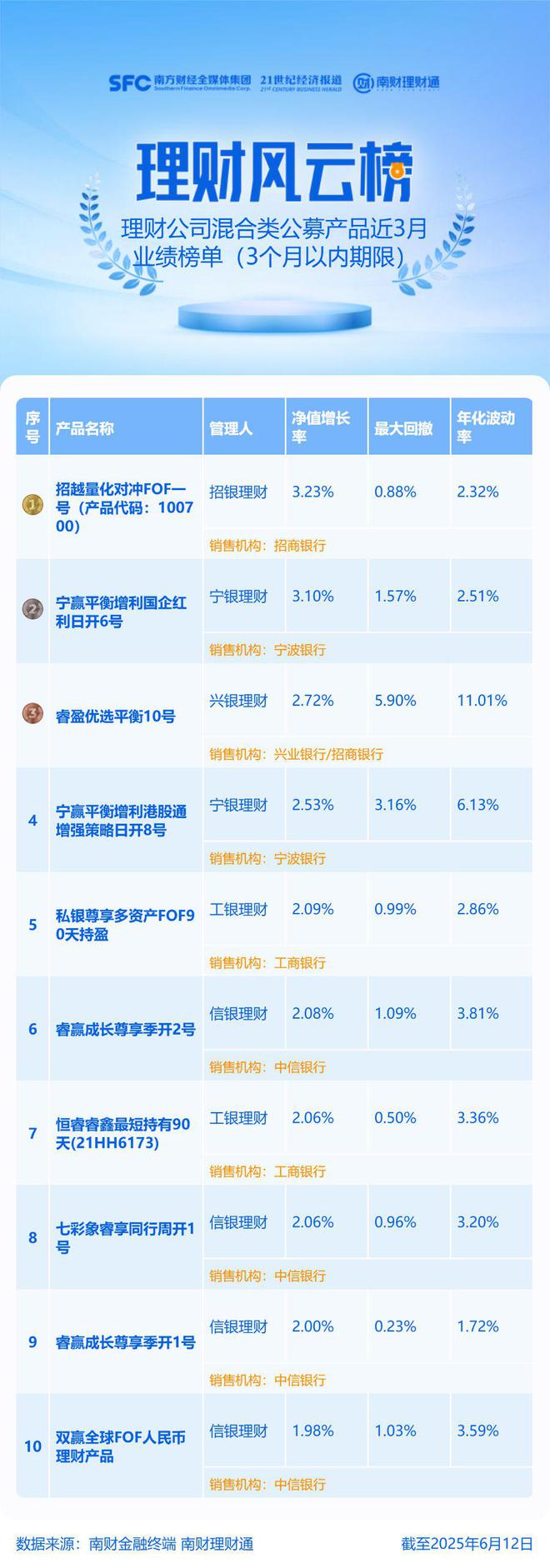
Core Insights - The report focuses on the performance of mixed and equity wealth management products, highlighting their recent trends and key performers [1] Mixed Products Performance - The average net value growth rate for mixed wealth management products with a duration of 3 months or less is 0.64%, slightly outperforming similar "fixed income + equity" products [6] - Among 262 mixed products, 28 have negative growth rates in the last 3 months, accounting for 10.69% [6] - Top performers include "Zhaoyue Quantitative Hedge FOF No. 1" with a growth rate of 3.23% and "Ningyin Balanced Incremental State-owned Enterprise Dividend No. 6" at 3.10% [6] Equity Products Performance - The average net value growth rate for equity wealth management products over the past year is 12.54%, with an average maximum drawdown of 13.96% [9] - The top ten equity products are dominated by Huaxia Wealth and Everbright Wealth, showcasing their strong performance [9] - Notable products include "Beiying A-share New Opportunity Phase 2" and "Beiying A-share New Opportunity Private Banking Exclusive Phase 1" with growth rates of 9.38% and 8.98% respectively [9] Highlights of Specific Products - Huaxia Wealth's index-linked equity products have shown strong performance, with four products exceeding a 30% growth rate over the past year [10] - The product tracking the Micro-plate Growth Low Volatility Index has surged nearly 50% in the past year [10] - However, some products have experienced significant volatility, with maximum drawdowns exceeding 20% and annualized volatility over 40% [10] - There is a notable disparity in returns among industry index-tracking products, with some achieving high returns while others report negative returns, such as "Tiangong Daily Open Wealth Management Product No. 7" and "Tiangong Daily Open Wealth Management Product No. 1" with growth rates of -0.74% and -1.08% respectively [10]