
生物燃料计划

Search documents
印尼加快推进生物燃料计划 供应紧张有望支撑棕榈油牛市前景
智通财经网· 2025-11-12 03:21
Core Viewpoint - Indonesia's accelerated biofuel plan is expected to lead to a bull market for palm oil, as it will reduce export supplies from the world's largest producer and exacerbate global palm oil supply tightness [1][4]. Group 1: Indonesia's Biofuel Plan - Indonesia plans to increase the biodiesel blending rate from 40% to 50% (B50 plan) by the second half of next year, aiming to lower fuel import costs and greenhouse gas emissions [1][4]. - The implementation of the B50 plan may lead to an increase in domestic palm oil consumption for biodiesel by approximately 25% [4][5]. - The B50 plan could result in a decrease in Indonesia's palm oil exports from an expected 31 million tons this year to 26 million tons by 2026 [4]. Group 2: Market Impact and Price Projections - The palm oil price is projected to rise to 5,000 Indonesian Rupiah per ton between January and June next year if the B50 plan is pursued [1][4]. - Analysts predict that the B50 plan could push palm oil prices to a three-year high of 5,500 Indonesian Rupiah per ton by the first quarter of 2026 [4]. - The current price of palm oil has fluctuated, with a year-to-date decline of 6%, currently at 4,145 Indonesian Rupiah (approximately $999.61) per ton [1]. Group 3: Supply Risks and External Factors - Weather factors, such as the La Niña phenomenon, may disrupt palm oil harvesting and production from November to February due to above-average rainfall [5]. - Other market-driving factors include U.S.-China agricultural trade agreements and U.S. biofuel policies that may restrict soybean oil exports [5]. - Concerns have arisen regarding the Indonesian government's recent seizure of plantation land, which could negatively impact next year's palm oil production if not managed properly [5].

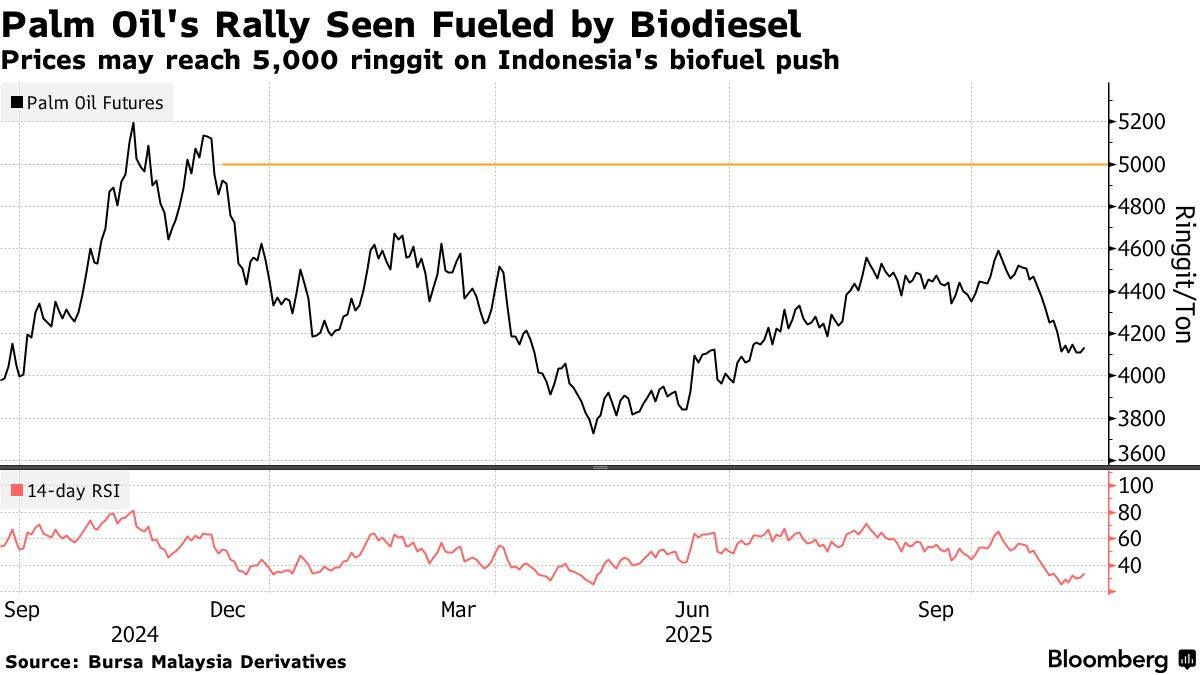
产地减产季在即 预计棕榈油期货盘面仍然有韧性
Jin Tou Wang· 2025-10-24 07:21
Core Viewpoint - Palm oil futures are experiencing slight upward movement, with the main contract reported at 9140.00 yuan/ton, reflecting a minor increase of 0.29% [1] Group 1: Market Developments - Indonesia plans to implement a mandatory 10% bioethanol blending in gasoline by 2027, aiming to enhance energy self-sufficiency through increased use of palm oil and sugarcane-based biofuels [2] - Citigroup analyst Gan Huan Wen indicated that Indonesia's B50 biodiesel blending policy, initially set for 2026, may be delayed to 2027 due to funding constraints and unfavorable palm oil-diesel price differentials [2] - On October 23, the trading volume of 24-degree palm oil at national ports reached 3600 tons, marking a 44.00% increase compared to the previous trading day [2] Group 2: Institutional Perspectives - Guoyuan Futures noted that both supply and demand for palm oil are increasing in the short term, with the Indonesian B50 plan still being actively pursued, leading to a mixed market outlook for palm oil [3] - Guotou Anxin Futures stated that the fourth quarter marks the beginning of the palm oil production reduction cycle, which will significantly influence prices. If supply decreases rapidly, palm oil prices may show resilience; however, if the supply reduction is slow, caution is advised regarding potential price declines [3] - The Malaysian Palm Oil Association projected a 10.77% increase in palm oil production for Malaysia from October 1-20, with high-frequency data indicating a significant increase in supply [3]