
用户拉新与留存

Search documents
突破1000万单!千问把奶茶店搞瘫痪,跪求大家明天再来
Sou Hu Cai Jing· 2026-02-10 12:08
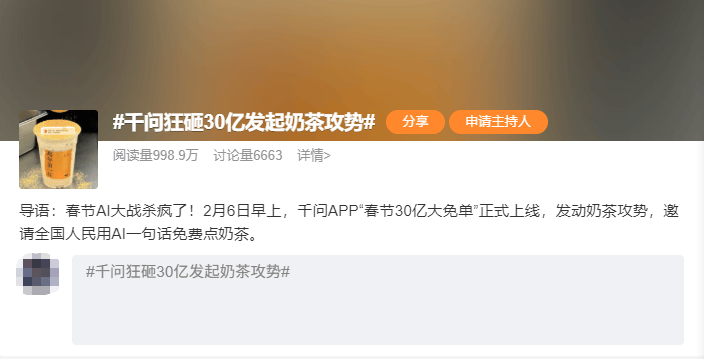
Group 1 - The core point of the article highlights the intense competition in the AI sector, particularly during the Spring Festival, with Alibaba's Qianwen launching a significant promotional campaign involving free milk tea to attract users [1][29] - Qianwen's campaign offered a 25 yuan no-threshold coupon for milk tea, leading to a rapid surge in orders, exceeding 1 million within 3 hours and 10 million within 9 hours [3][8] - The promotional strategy resulted in a notable increase in stock prices for milk tea brands, with Cha Baidao rising by 6% and Gu Ming by over 3% [11] Group 2 - The overwhelming demand caused significant operational challenges for milk tea shop employees, who faced extreme workloads and supply shortages, leading to some stores temporarily closing for restocking [17][20] - The rapid influx of users overwhelmed Qianwen's servers, causing service disruptions and user frustrations, prompting the company to extend the validity of the coupons to February 23 [12][26] - The article discusses the broader context of AI applications competing for user acquisition during the Spring Festival, with major players like Baidu and Tencent also investing heavily in user engagement strategies [29][31] Group 3 - Despite the initial excitement, the article notes that users attracted by promotional offers may not remain engaged long-term, as many uninstall the app after redeeming their rewards [33] - The competition in the AI space is expected to focus on delivering real value and enhancing user experience, as transient user acquisition strategies may not sustain long-term growth [40]


AI春节红包雨下了1/3,效果如何?
3 6 Ke· 2026-02-08 03:51
Core Insights - The article discusses the competitive landscape of AI chatbot applications during the Chinese New Year, highlighting the aggressive marketing strategies employed by major tech companies like Tencent and Alibaba to capture user attention and engagement through cash red envelope campaigns. Group 1: Red Envelope Campaigns - Yuanbao launched a "10 billion cash red envelope" campaign on February 1, coinciding with the start of the Spring Festival travel rush, leading to a surge in user engagement on WeChat and QQ [2] - The campaign revitalized dormant user groups, demonstrating the effectiveness of social sharing in driving new user acquisition [2] - Despite the initial success, WeChat imposed restrictions on sharing Yuanbao's red envelope links, limiting them to copy-paste methods, which dampened the campaign's momentum [3][5] Group 2: Competitive Dynamics - The competition intensified as Alibaba's Qianwen app also launched a significant red envelope initiative, offering 30 billion yuan in rewards, which faced similar sharing restrictions from WeChat [3][10] - The article notes that the red envelope campaigns are part of a broader strategy by major tech firms to leverage the high traffic and engagement during the Chinese New Year, a peak time for user interaction [11][12] Group 3: AI Application Growth - The article highlights the growth anxiety among major tech companies regarding their AI applications, with Yuanbao, Qianwen, and Doubao vying for user acquisition and retention [13] - Yuanbao's advertising spend reached 15 billion yuan in 2025, significantly boosting its user base, but it still lagged behind Doubao in user engagement metrics [13][14] - The focus is shifting from merely acquiring users to retaining them, as companies recognize the importance of user quality over quantity [16][17] Group 4: Strategic Implications - The article emphasizes that the red envelope campaigns serve as a magnifying glass for the transition of AI applications from user acquisition to user retention strategies [17] - The competition among AI chatbots reflects a consensus among major tech firms on the importance of establishing a strong foothold in the AI space, particularly during high-traffic periods like the Spring Festival [8][9]
