电商出清期

Search documents
电商出清期:效率拼杀、现金为王
Sou Hu Cai Jing· 2025-11-21 12:23
Core Viewpoint - The era of rapid expansion in the e-commerce industry has ended, with a noticeable decline in consumer enthusiasm and a shift towards a more mature consumption society [2][3]. E-commerce Industry Trends - The overall transaction volume during this year's Double Eleven reached nearly 1.7 trillion, but the excitement around such events has diminished [2]. - E-commerce penetration in China is currently at 25% for the first nine months of the year, significantly lower than the predicted 40% for the next five years [3]. - The ceiling for e-commerce penetration is projected to be 27.6% in 2023 and drop to 26.8% in 2024, indicating a stagnation in growth [3]. Competitive Landscape - The competition among platforms has intensified, with companies now focusing on retaining existing users rather than acquiring new ones [4]. - Platforms are increasingly competing for user engagement time, as even a minute more can lead to increased purchasing intent [5]. - The current state of competition is characterized by platforms entering each other's domains, leading to a homogenization of supply and a challenging growth environment [6][8]. Strategic Shifts - The focus has shifted from aggressive expansion to enhancing operational efficiency and matching supply with demand [9][10]. - Long-term strategies are essential for navigating market competition, emphasizing the importance of infrastructure and stability over short-term gains [11][15]. - Cash reserves are becoming critical, with companies needing to demonstrate effective spending efficiency rather than just having cash on hand [17][23]. Market Dynamics - The ongoing "instant retail war" initiated by JD.com, with Alibaba and Meituan following suit, highlights the cash-intensive nature of current competition [19][20]. - Meituan's market share has dropped from around 70% to 50%, with Alibaba and JD.com capturing the lost share [20][21]. - The future of the e-commerce landscape remains uncertain, with companies needing to leverage their cash reserves effectively to survive the ongoing competition [22][26].



电商进入出清期
3 6 Ke· 2025-11-19 00:13
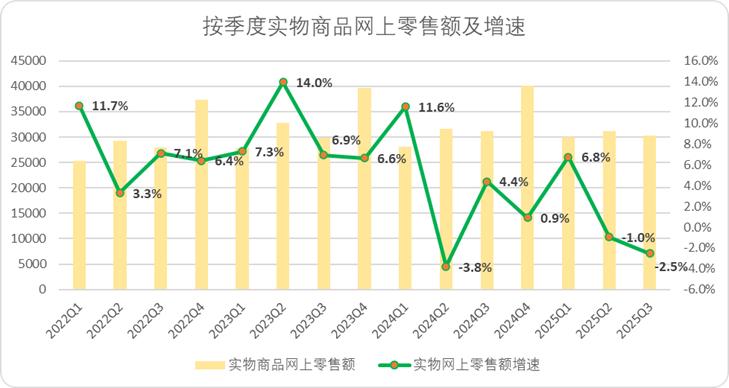
Core Insights - The e-commerce industry is experiencing significant growth pressure, with major players like JD.com and Pinduoduo facing declining profit margins despite revenue growth, indicating a shift towards a clearing phase in the market [2][11]. Group 1: Industry Overview - The e-commerce sector is entering a period of oversupply, where supply growth has outpaced demand growth, leading to intensified competition and profit declines among leading platforms [2][10]. - The overall online retail sales of physical goods grew by 6.5% in the first three quarters of the year, primarily driven by subsidy policies, but growth has slowed significantly in subsequent quarters [3][5]. - The online penetration rate for physical goods has stabilized between 24% and 27% since 2021, indicating a bottleneck in potential growth for e-commerce [6][8]. Group 2: Demand Side Analysis - Demand growth has been largely driven by subsidies, with natural growth showing signs of weakness, particularly as the incremental growth is concentrated in the first quarter of the year [3][5]. - The demand side is facing a stagnation period, with both existing business demand and potential for online retailing reaching a developmental bottleneck [8]. Group 3: Supply Side Analysis - The supply side is characterized by a surge in the number of players, particularly with the rise of content platforms, leading to increased homogeneity in offerings and intensified price competition [9][10]. - The market is witnessing a structural shift from a few monopolies to a "hammer-shaped" monopoly, where smaller players are being diluted, and larger players are increasingly competing for market share [13][15]. - Data shows that the concentration ratio (CR2) in the e-commerce sector has decreased from 60% in 2022 to 57% in early 2023, while the CR5 has increased from 84% to 93%, indicating a shift towards a more concentrated market [13]. Group 4: Profitability Challenges - Despite revenue growth, the overall profitability of the e-commerce industry is under significant pressure, with many companies experiencing a "growth without profit" scenario [11][15]. - For instance, JD.com reported a profit reduction of over 50% due to high subsidies in its delivery business, while Alibaba's commercial segment saw a 21% decline in adjusted EBITA [11][15]. - The overall trend indicates that as competition intensifies, profit margins are being squeezed, leading to a decline in operational profitability across the sector [11][15]. Group 5: Merchant Challenges - Merchants are facing a dilemma of increasing costs without corresponding revenue growth, leading to a decline in return on investment (ROI) for marketing expenditures [16][19]. - Many merchants have reported poor performance from new marketing models, resulting in significant losses despite initial revenue boosts [16][19]. - The data indicates that companies that reduced marketing expenses have seen improvements in long-term profitability, while those that increased spending have experienced declines [18][19]. Group 6: Strategic Recommendations - To navigate the clearing phase, platforms should focus on the essence of trade, minimizing friction in supply-demand matching, rather than pursuing aggressive expansion strategies [21][25]. - Historical examples from successful companies demonstrate that maintaining focus on core business operations and avoiding distractions from market trends can lead to sustained growth [22][24]. - The e-commerce industry must return to its roots of enhancing transaction efficiency and creating real value, rather than relying on superficial growth strategies [25][26].