电源市场化

Search documents
电力行业改革深析:2026年投资逻辑与机遇
Cai Fu Zai Xian· 2026-02-13 02:13
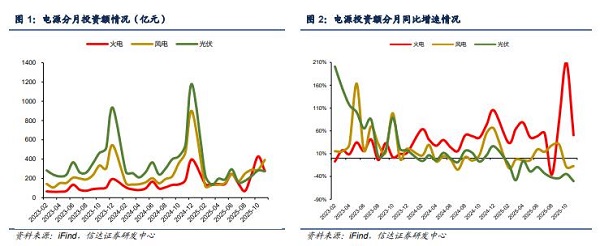
Core Viewpoint - The power industry is entering a critical transformation period, with "investment rationalization, market-oriented power sources, and spot price electricity" as the core guidance. After structural adjustments in the latter half of the "14th Five-Year Plan," there is a cooling in new energy investments and a rapid increase in thermal power construction. The deepening of power market reforms is expected to lead to a "turnaround" for thermal power by 2026, with high-quality leading state-owned enterprises and integrated coal-power operators as core investment targets. However, fluctuations in electricity demand and declining electricity prices pose potential risks [1][4][9]. Investment and Installed Capacity Landscape - **Power Source Investment**: There is a notable divergence in power source investment structure. In the new energy sector, while investment in wind and solar power is increasing in 2023-2024, the monthly growth rate is declining. The "136" document in 2025 exacerbates project revenue uncertainty, leading to a year-on-year decline in investment growth, with wind power slightly outperforming solar power [1][3]. - **Installed Capacity Rhythm**: Following a "rush installation" trend, there is a significant drop in new installations after June 2025 due to subsidy reductions and the conclusion of the "14th Five-Year Plan." It is expected that wind and solar installations will continue to decline in 2026, with projections of 100 million kW and 220 million kW respectively, down 4.31% and 29.00% year-on-year. In contrast, thermal power is expected to reach a peak in new installations in 2026, with an average annual output exceeding 80 million kW [3][4]. 2026 Power Reform Breakthrough - **Marketization of Power Sources**: The acceleration of new energy and nuclear power entering the market is evident. By the end of 2025, 26 provinces have announced competitive bidding results for new energy mechanisms, with most transactions close to the upper limit of bidding prices. The scope for nuclear power entry is expanding, with an average of no less than 10 units approved annually in the latter half of the "14th Five-Year Plan" [4][5]. - **Spot Price Electricity**: The "1502" document reshapes the trading landscape by promoting electricity trading and pricing towards a spot market. The minimum signing limit for long-term coal power contracts has been relaxed from 80% to no less than 60%, allowing for adjustments in tight supply-demand regions. Local implementations are underway, with various provinces adopting flexible pricing contracts [5][6]. Opportunities for Thermal Power - **Volume Growth**: The slowdown in new energy growth creates an opportunity for thermal power to fill the gap. In 2025, the significant increase in clean energy generation will meet only 5% of the overall electricity demand increase, leading to a projected increase in thermal power generation by 102.5 billion kWh in 2026, with a growth rate of 1.67% [6][7]. - **Price Support**: The spot market is expected to become a core growth point for profits. Although long-term contract prices are declining, the stabilization of coal prices, combined with increased thermal power generation and a higher proportion of spot market transactions, is likely to lead to a "dual increase" in volume and price [7][8]. Conclusion - The trends of "investment rationalization, market-oriented power sources, and spot price electricity" are clear in the power industry for 2026. The business model for power sources will shift from reliance on long-term contracts to dependence on spot income and capacity revenue. Thermal power, supported by stable coal prices, steady growth in generation, and higher-than-expected spot prices, is expected to achieve a "turnaround." Leading state-owned enterprises are likely to maintain resilient performance during this transition phase [9].

电改下半场开启:投资理性化,电源市场化,电价现货化
Xinda Securities· 2026-01-21 09:41
Investment Rating - The report maintains a "Positive" investment rating for the power industry, consistent with the previous rating [2]. Core Insights - The power industry is entering a new phase characterized by rational investment, market-oriented power generation, and spot pricing for electricity [2][3]. - The report highlights a significant cooling in new energy investments, while thermal power is expected to reach its investment peak by 2026 [5][17]. - The introduction of the "1502" document is expected to shift the electricity pricing model towards a more flexible, market-driven approach, enhancing the role of spot trading [3][29]. Summary by Sections 1. Power Industry Investment and Capacity Situation - Investment in new energy has notably decreased, while thermal power investment continues to grow. The peak for thermal power investment is anticipated in 2026 [5][17]. - Monthly capacity additions show a stark contrast before and after the "531" policy, with thermal power gradually approaching its production peak [5][10]. 2. New Trends in Electricity Reform for 2026 - Market-oriented power generation is gaining traction, with competitive bidding results for new energy projects being favorable. Nuclear power is also increasing its market entry ratio [3][29]. - The "1502" document has loosened the previous pricing model, significantly increasing the weight of spot trading in electricity transactions [3][29]. 3. Analysis of the Second Half of Electricity Reform - New energy capacity additions are expected to slow significantly, while thermal power generation is projected to see substantial growth. The report estimates an increase in thermal power generation from a decline of 37.8 billion kWh in 2025 to an increase of 135.6 billion kWh in 2026, representing a growth rate of 2.20% [3][10]. - The annual long-term contract price decline is more significant than expected, creating potential profit opportunities for thermal power in the spot market [3][10]. 4. Investment Recommendations - The report suggests that the challenges faced by thermal power may reverse, with a focus on high-quality leading companies and integrated coal-power operators. The expected stabilization of coal prices and significant growth in thermal power generation are key factors for this turnaround [3][10][29]. - Recommended companies include major state-owned enterprises in the power sector and integrated coal-power operators, which are expected to show resilience and high dividend attributes [3][10].