短缺导致过剩

Search documents
“短缺终将导致过剩”,a16z安德森2026年展望:AI芯片将迎来产能爆发与价格崩塌
华尔街见闻· 2026-01-08 12:18
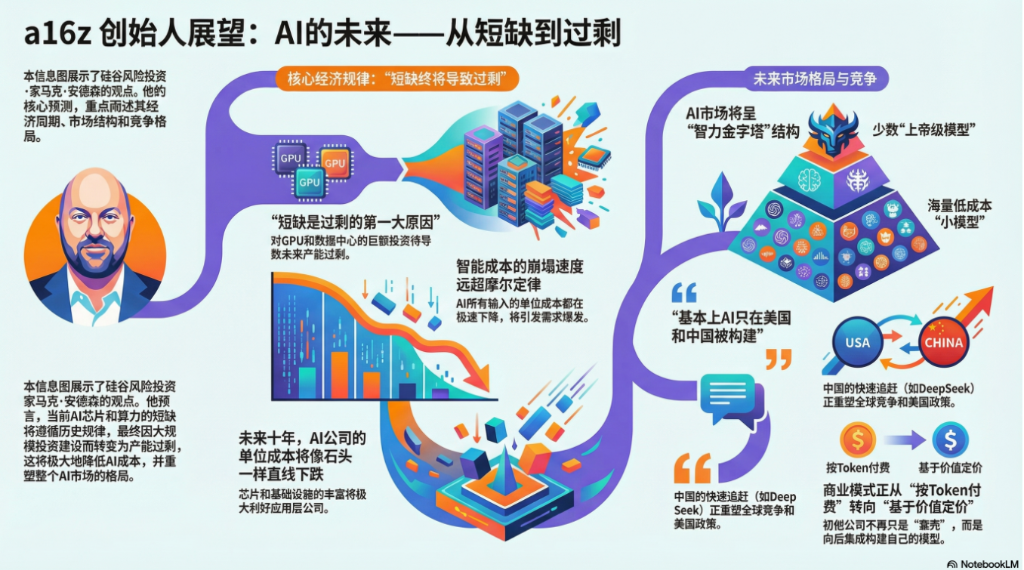
AI Technology Scale - AI represents a technological revolution larger than the internet, comparable to electricity and microprocessors, and is still in a "very early" stage [2] - The unit cost of AI is decreasing at a rate that far exceeds Moore's Law, leading to explosive demand growth [2] Market Dynamics - Following the historical pattern of "shortage leads to surplus," the large-scale construction of GPUs and data centers will eventually result in oversupply, further driving down AI costs [3] - The future AI market structure will resemble the computer industry, with a few "god-level models" at the top and a vast number of low-cost "small models" proliferating at the edges [3] US-China Competition - The competition between the US and China is characterized as a dual hegemony, with Chinese companies like DeepSeek and Kimi making remarkable progress in speed, open-source strategies, and chip self-research [3][10] - The emergence of DeepSeek has surprised both Washington and Silicon Valley, indicating a shift in global price competition that may influence US regulatory approaches [10] Business Model Evolution - AI applications are transitioning from "pay-per-token" to "value-based pricing," with startups moving beyond being mere wrappers to integrating their own models [4][12] - High pricing can benefit customers by supporting better research and development, as AI startups demonstrate more creativity in pricing compared to SaaS companies [12] European AI Landscape - The EU's inability to lead in innovation has led to a focus on "regulatory leadership," which has stifled local AI development and caused major companies like Apple and Meta to withhold new features in Europe [5] AI Democratization - Advanced AI technologies are now accessible to anyone, breaking down barriers and allowing immediate use and validation of previously expensive technologies [6] - Public sentiment shows fear of AI replacement, yet actual behavior indicates a rapid adoption of AI technologies [6] Cost Deflation and Investment Outlook - The extreme deflation of AI input costs is expected to drive demand growth beyond expectations, with significant investments anticipated in the coming years [8] - Historical cycles suggest that shortages will lead to oversupply, resulting in a dramatic decrease in AI companies' unit costs over the next decade [8] Model Competition - The future of AI will not be a zero-sum game between closed large models and open-source small models, but rather a clearly defined "intellectual pyramid" [13] - The industry structure will feature a few supercomputer-like "god models" at the top, with numerous smaller models extending to embedded systems [13]


“短缺终将导致过剩”!a16z安德森2026年展望:AI芯片将迎来产能爆发与价格崩塌
Hua Er Jie Jian Wen· 2026-01-08 03:22
Core Insights - The discussion emphasizes that the current AI revolution is unprecedented in scale, comparable to electricity and microprocessors, and is still in its early stages [4][6][12] - The rapid decline in AI costs, described as "hyper deflation," is expected to drive explosive demand growth [4][6][35] - Historical patterns suggest that shortages in AI infrastructure, such as GPUs, will lead to oversupply and further cost reductions in the future [4][6][35] AI Technology Landscape - AI is viewed as a transformative technology that surpasses the internet in magnitude, with its current phase being very early [6][12] - The cost of AI is decreasing at a rate faster than Moore's Law, leading to significant demand growth [6][35] - The future AI market structure will resemble the computer industry, with a few "god-tier models" at the top and numerous low-cost "small models" at the periphery [6][10] US-China Competition - The emergence of Chinese models like DeepSeek and Kimi has surprised both Washington and Silicon Valley, indicating significant progress in open-source models from China [5][7][52] - The competition is characterized as a dual hegemony, with both the US and China being the primary players in AI development [5][7][51] Business Models and Pricing - A shift from "pay-per-token" to "value-based pricing" is occurring in AI applications, allowing companies to capture more value from productivity gains [9][34] - AI startups are moving beyond being mere wrappers around large models and are integrating their own models, enhancing their competitive edge [9][34] AI Democratization - Advanced AI technologies are becoming accessible to the public, breaking down barriers and allowing widespread use [6][21] - Despite public fears about AI replacing jobs, actual behavior shows a rapid adoption of AI technologies [6][21] Regulatory Environment - The regulatory landscape is shifting, with a reduced risk of federal-level restrictions on AI, as there is bipartisan support for innovation [7][59] - State-level regulations are emerging, leading to a fragmented legal environment that could hinder progress [59][60] AI Chip Development - The AI chip market is expected to see significant investment and innovation, with a potential oversupply in the coming years as companies ramp up production [4][45] - The competition in chip development is intensifying, with both established companies and startups entering the market [45][49]