碳定价权

Search documents
经济学家管清友简介|管清友擅长领域|管清友演讲主题|管清友最新动态
Sou Hu Cai Jing· 2026-01-07 02:13
Group 1: Academic Background and Career Path - Guan Qingyou is a prominent Chinese economist, currently serving as the director of the Ruishi Financial Research Institute and vice president of the China Private Economy Research Association [2] - His academic journey began with a PhD in economics from the Chinese Academy of Social Sciences, followed by postdoctoral research at Tsinghua University focusing on energy and climate change [2] - He has held significant roles in both academia and policy consulting, including serving as vice president of Minsheng Securities and founding the independent think tank Ruishi Financial Research Institute [2] Group 2: Core Research Areas - Guan's research focuses on four main areas: macroeconomics, energy economics, financial markets, and private economy, creating a framework that combines theoretical depth with practical value [4] - He introduced the concept of "Li Keqiang Economics," summarizing the new government's macro management approach of "targeted investment + prudent monetary policy" [4] - His work includes developing a model for the "third wave" of the global financial crisis, providing critical decision-making insights for investors [5] Group 3: Recent Activities and Publications - In November 2025, he analyzed the current economic situation at the Shenzhen "Private Enterprise Forum," emphasizing the need for institutional openness to overcome growth bottlenecks in the private economy [13] - He participated in the 10th China International Property Management Summit in June 2025, warning about risks in the real estate market and suggesting enhancements in service quality [14] - His upcoming publication, "New Productive Forces: The Next Growth Pole of China's Economy," will analyze the commercial viability and ethical balance in fields like photovoltaics and artificial intelligence [15] Group 4: Advisory Roles and Contributions - Guan serves as an independent director for several listed companies, including Midea Group and Hikvision, promoting the establishment of "Technology Ethics Committees" to balance innovation with social responsibility [17] - He is involved in regional development strategies, contributing to the "14th Five-Year Plan" for areas like Shaanxi and Xinjiang, advocating for technological innovation to address market gaps [17] - His insights on the global increase in RMB asset holdings highlight the underlying logic of technological standard output and regulatory collaboration [16]

杨长江:人民币“破七”背后,是国运与币运的共振
Xin Lang Cai Jing· 2026-01-01 06:24
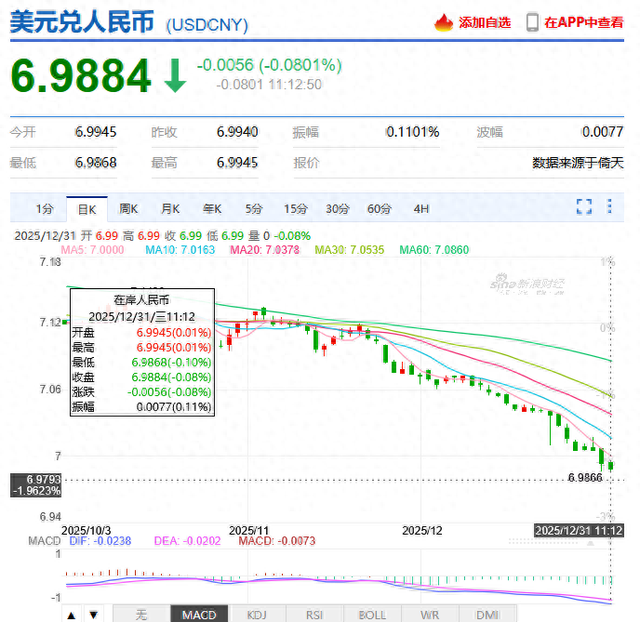
Core Viewpoint - The article discusses the implications of the recent appreciation of the Chinese yuan and its impact on the Chinese economy, particularly in the context of the ongoing internationalization of the yuan and the changing global economic landscape. Group 1: Yuan Appreciation and Economic Impact - The offshore yuan exchange rate reached a high of 7.43 in April 2025 and strengthened to break the 7.0 mark by the end of the year, marking a significant recovery since the trade war lows [1][4] - The appreciation of the yuan is seen as a reflection of China's economic resilience amidst external pressures, particularly from the US trade protectionism [1][6] - The current level of the yuan is not considered "seriously undervalued," but there are some factors contributing to its perceived undervaluation, including structural issues in the domestic economy [5][9] Group 2: Structural Factors Influencing Yuan Valuation - The dual nature of the yuan's exchange rate, reflecting both real economic conditions and financial market dynamics, complicates the assessment of its valuation [5][6] - Domestic market segmentation and competition have led to price suppression, contributing to the undervaluation of the yuan [7][9] - The overall price level in China has improved, indicating that the yuan is not as undervalued as previously thought, countering claims from Western nations [4][5] Group 3: Internationalization of the Yuan - The article emphasizes the importance of the yuan's appreciation for its internationalization, suggesting that a stable and gradually appreciating yuan could enhance its role as a global reserve currency [25][30] - The current global economic environment, characterized by a weakening dollar and rising inflation in Western countries, presents an opportunity for the yuan to gain traction as a safe asset [12][25] - The potential for the yuan to become a credible alternative to the US dollar is linked to China's ability to provide stable and reliable financial assets, particularly in the context of increasing skepticism towards US debt [27][30] Group 4: Future Outlook and Recommendations - The article suggests that while the yuan can appreciate, it should do so at a controlled pace to avoid market distortions and excessive speculation [22][23] - Internal reforms aimed at improving wage levels and price structures are recommended as a means to support the yuan's appreciation sustainably [23][24] - The need for China to enhance its soft power and narrative in the global market is highlighted as crucial for gaining pricing power and furthering the yuan's internationalization [34][35]