碳排放与经济增长脱钩

Search documents
IEA称未来5年全球电力将强劲增长,中国将贡献一半增量!有多少?
Sou Hu Cai Jing· 2026-02-14 16:45
Core Insights - The global electricity market is projected to experience significant growth, with an average annual increase in demand exceeding 3.5% from 2026 to 2030, equivalent to the total electricity consumption of two European Unions [1][3][5] - China is expected to contribute nearly 50% of the global electricity increment, solidifying its position as the main driver of this growth [1][5][6] Group 1: Global Electricity Demand Growth - By 2030, the global electricity consumption increment will match the total electricity output of two EU regions, estimated at approximately 5.5 to 6 trillion kilowatt-hours [3][4] - Emerging economies will account for nearly 80% of the new electricity demand, with China leading at an average annual growth rate of 4.9% [5][6] - The global electricity demand has already seen a year-on-year increase of 3% in 2025, with future growth rates projected to be 50% higher than the average of the past decade [6][8] Group 2: Energy Sources and Structure - Renewable energy and nuclear power are set to become the core support for this growth, with their share in the global electricity structure expected to rise from 42% to 50% by 2030 [10][12] - Coal will remain the largest power source until 2030, but its growth is stagnating, with global coal-fired generation expected to remain flat by 2025 [12][15] - Renewable energy is projected to grow at an annual rate of 8%, with solar power alone contributing over 600 terawatt-hours annually [13][15] Group 3: Regional Dynamics and Economic Impact - Developed economies are shifting from stagnation to becoming important contributors to electricity demand growth, with their share of global electricity demand growth increasing from 17% to 20% by 2025 [8][10] - The disparity in electricity prices is widening, with regions like the EU and the US experiencing price increases due to rising natural gas costs, while countries like Australia and India see declining prices [16] - The transition towards electrification and decarbonization is reshaping the global energy landscape, with electricity becoming a core energy source for economic growth [16]

国际能源署发布最新报告显示——可再生能源需求增长加速
Jing Ji Ri Bao· 2026-01-14 08:13
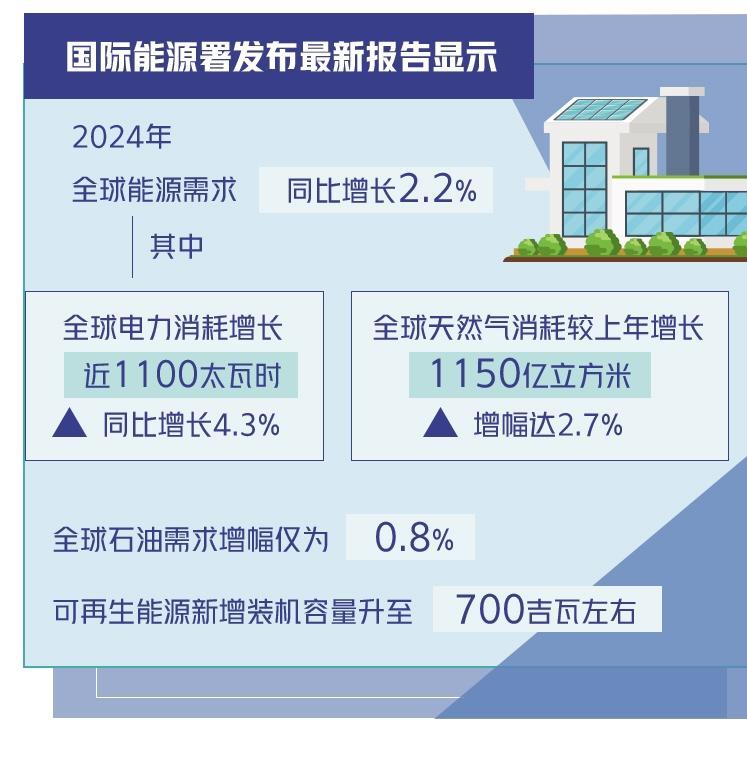
Core Insights - The International Energy Agency (IEA) has released its latest report on global energy trends for 2024, highlighting significant growth in energy demand and the role of renewable energy in meeting this demand [2][3] Energy Demand Growth - Global energy demand is projected to grow by 2.2% in 2024, surpassing the average annual growth rate of 1.3% from 2013 to 2023 [2] - Emerging markets and developing economies account for 80% of the increase in energy demand, while developed economies show signs of recovery with nearly 1% growth after years of decline [2] Electricity Consumption - Global electricity consumption is expected to increase by nearly 1,100 terawatt-hours (TWh), representing a 4.3% year-on-year growth, which is double the average annual growth rate over the past decade [2] - Factors driving this surge include record high temperatures, increased industrial electricity use, accelerated electrification of transportation, and rapid growth in data centers and AI industries [2] Renewable Energy Capacity - Renewable energy is set to dominate the new electricity capacity additions, with an expected increase of around 700 gigawatts (GW) in 2024, marking the 22nd consecutive year of record growth [2] - In 2024, 80% of the increase in global electricity generation will be met through renewable energy and nuclear power, with both sources collectively surpassing a 40% share for the first time [3] Fossil Fuel Consumption Trends - Natural gas consumption has seen the highest growth among fossil fuels, with a year-on-year increase of 115 billion cubic meters, reflecting a 2.7% rise, significantly above the average growth of 75 billion cubic meters over the past decade [3] - In contrast, oil demand growth has slowed to just 0.8%, with its share of global energy demand falling below 30% for the first time, largely due to the active electric vehicle market [3] - Coal demand growth has also decreased to 1% in 2024 [3] Carbon Emissions and Clean Technology - The acceleration of clean energy technologies has effectively suppressed the growth of energy-related carbon dioxide emissions, with a slight increase of 0.8% in 2024, totaling 3.78 billion tons [4] - Since 2019, the large-scale adoption of technologies such as solar, wind, nuclear, electric vehicles, and heat pumps has led to an annual reduction of 2.6 billion tons of CO2, equivalent to 7% of global emissions [4] - Structural changes in global energy demand, including the slowdown in oil demand growth and the strengthening role of electricity, are reshaping the energy landscape and highlighting the impact of the clean technology revolution on traditional energy systems [4]