
碳普惠体系

Search documents
国管局:鼓励开展碳资产交易、虚拟电厂、绿电消纳等前沿领域探索 | 1月全国可再生能源绿色电力证书核发及交易数据
Xin Lang Cai Jing· 2026-02-27 10:37
Policy Updates - The National Government Affairs Administration issued a notice on energy conservation for public institutions in 2026, focusing on carbon peak goals and enhancing the dual control mechanism for carbon emissions [1][12] - The notice includes the publication of a carbon emission accounting guideline for public institutions, defining the boundaries, factors, and methods for carbon emission calculations [1][12] - It emphasizes optimizing energy structure, promoting electrification, and increasing the use of renewable energy and green low-carbon technologies [1][12] - The notice encourages exploration in carbon asset trading, virtual power plants, and green electricity consumption [1][12] - A new collection of topics on green and low-carbon transformation for 2024-2025 will be published, along with the initiation of new project applications [1][12] Industry Insights - In January 2026, the National Energy Administration issued 196 million green certificates, covering 832,000 renewable energy projects, with 151 million being tradable, accounting for 76.79% [4][15] - The issuance for December 2025's renewable energy generation corresponds to 152 million green certificates, representing 77.49% [4][15] - The breakdown of green certificate issuance in January includes 8,545 for wind power, 5,490 for solar power, 4,158 for conventional hydropower, 1,311 for biomass, and 98 for other renewable sources [6][17] - In January 2026, 102 million green certificates were traded, with 33.69 million being for green electricity [6][17] - The trading of green certificates included 6.5 million for 2024 production year at an average price of 1.25 yuan each, and 61.88 million for 2025 production year at an average price of 5.51 yuan each [8][21] - The average price for 2024 certificates increased by 11.64%, while the price for 2025 certificates rose by 7.04% [8][21] Regional Monitoring - The East China Energy Regulatory Bureau is actively monitoring the power supply and demand situation during the Spring Festival, ensuring stable operation of the power system and efficient consumption of renewable energy [11][22] - The bureau coordinated inter-provincial power transactions to enhance resource sharing, increasing renewable energy consumption in Anhui by 116 million kilowatt-hours [11][22] - It also addressed public concerns during the holiday, ensuring power supply for critical locations and preparing charging services for electric vehicles at highway service areas [11][22]


一单牡蛎碳汇的“生态价值账”
Da Zhong Ri Bao· 2025-12-30 06:33
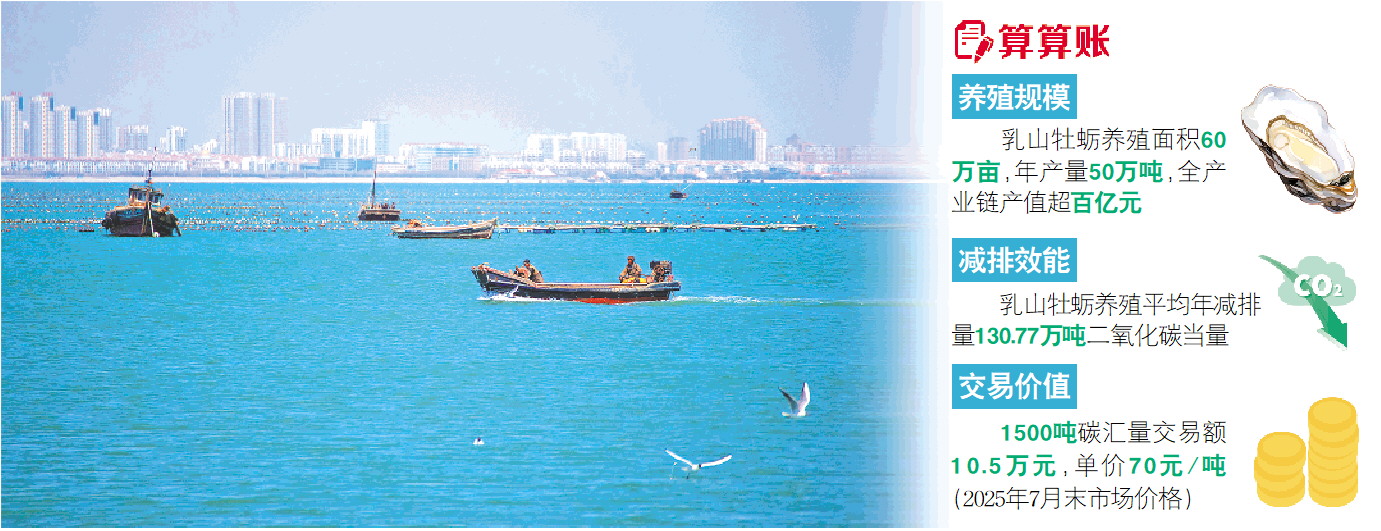
Core Viewpoint - The article discusses the successful implementation of oyster carbon credit trading in Rushan, Shandong Province, highlighting the transformation of intangible carbon credits into tangible financial assets through innovative financial products and methodologies [1][2]. Group 1: Carbon Credit Trading - The first oyster carbon credit transaction in Shandong was completed on August 12, with a trading volume of 1,500 tons and a transaction value of 105,000 yuan [1]. - Carbon credit trading involves the exchange of carbon emission allowances, where high-emission companies purchase carbon credits from entities that can sequester carbon, such as through afforestation [1]. - The transaction in Rushan serves as a replicable model for marine carbon credit market transactions [1]. Group 2: Scientific Methodology - Rushan has developed a "Double-Shell Mollusk Aquaculture Carbon Credit Project Methodology" in collaboration with the Chinese Academy of Fishery Sciences, addressing the lack of national standards for carbon credits from mollusks [2]. - Preliminary calculations indicate that oyster farming in Rushan achieves an average annual carbon reduction of 1.3077 million tons of CO2 equivalent [2]. - The methodology involves monitoring the carbon sequestration and release of oysters to quantify the net carbon credits [2]. Group 3: Financial Products and Support - The Rushan State-owned Capital Operation Company sold 1,000 tons of carbon credits, generating 70,000 yuan, which will be reinvested into the oyster industry through technical subsidies [3]. - Rushan Agricultural Commercial Bank purchased 300 tons of carbon credits to support its branches in achieving carbon neutrality [3]. - The local government is working to integrate the carbon credit methodology into the provincial carbon benefit system and is exploring carbon credit pledge financing and carbon index insurance to support the oyster industry [3][4].
恩施深化碳交易改革工作方案出炉森林碳票引领绿色发展新路径
Zhong Guo Huan Jing Bao· 2025-09-04 01:01
Core Viewpoint - The Enshi Prefecture in Hubei Province has issued a work plan to deepen carbon trading reforms, aiming to integrate into national and provincial carbon markets by the end of 2025, with a focus on establishing a forest carbon credit trading system [1][2] Group 1: Carbon Market Integration - Enshi Prefecture will organize training for cement companies on carbon emission management and guide them in registration and material submission [1] - The region will promote the construction of CCER projects and encourage the development of methodologies for afforestation carbon sinks and energy-saving projects [1] Group 2: Carbon Credit System - The plan includes exploring the establishment of a forest carbon credit system, with pilot projects to clarify application, registration, circulation, and offset management processes [2] - A linkage mechanism will be created for carbon credit consumption and discounts, allowing individuals and organizations purchasing carbon credits to enjoy benefits such as ticket reductions and accommodation discounts [2] Group 3: Carbon Footprint and Product Management - The plan proposes pilot projects for carbon footprint accounting and encourages carbon labeling for agricultural products like tea and mineral water to enhance their green competitiveness [2] - Cement companies will be encouraged to achieve compliance targets through a combination of carbon quota trading and CCER project offsets [2] Group 4: Financial Support and Collaboration - Enshi Prefecture will innovate green financial tools such as carbon quota collateralized loans and carbon account-linked loans to broaden financing channels for ecological products [2] - A multi-departmental collaborative mechanism will be established to ensure effective implementation of reforms, with a focus on task lists, responsibility assignments, and diverse financing channels [2]