
碳交易

Search documents
六部门发文促进光伏组件综合利用,我国陆生野生动植物保护取得积极进展
GUOTAI HAITONG SECURITIES· 2026-03-10 07:25
Investment Rating - The report does not explicitly provide an investment rating for the industry Core Insights - The report highlights significant policy developments aimed at promoting the comprehensive utilization of photovoltaic components, which is expected to alleviate future solid waste pressure and ensure the security of key metal resources, thereby consolidating China's leading position in the global photovoltaic industry and supporting the achievement of carbon neutrality goals [5][6] - The ecological environment department has revised the technical specifications for the treatment of waste electrical and electronic products, addressing the complexities of electronic waste and enhancing the recycling and utilization system [7][10] - The report notes that the protection rate of key terrestrial wild animal and plant species in China has exceeded 80%, indicating positive progress in biodiversity conservation [11][12] - The launch of the first carbon credit product for government office systems marks a significant step in promoting green and low-carbon transformation in public institutions [15][17] - The report discusses international developments, including the first issuance of carbon credits under the Paris Agreement and projections from the International Energy Agency regarding the future of global electricity generation [18][20] Policy Developments - The Ministry of Industry and Information Technology and five other departments issued guidelines to promote the comprehensive utilization of photovoltaic components, aiming for a cumulative utilization of 250,000 tons by 2027 and enhanced technological capabilities by 2030 [5][6] - The ecological environment department's new technical specifications for waste electrical and electronic products will take effect in March 2026, expanding the categories of waste and detailing pollution control requirements throughout the storage and dismantling processes [7][9] Industry Trends - The National Forestry and Grassland Administration reported that the protection rate of key terrestrial wild animal and plant species has surpassed 80%, with ongoing efforts to improve habitat quality and species conservation [11][12] - The launch of the "Qingpu Gold Carbon" product represents the first carbon credit for government office systems, facilitating the transformation of energy-saving measures into tradable carbon assets [15][17] International Events - The first carbon credit issuance under the Paris Agreement's mechanism signifies a shift towards operationalizing international carbon markets [18][19] - The International Energy Agency forecasts that by 2030, 50% of global electricity will come from renewable sources and nuclear energy, with significant growth expected in solar energy generation [20][21] Corporate Developments - China Huaneng Group has initiated the first international standard for carbon capture monitoring and management, aiming to enhance public understanding of carbon capture technologies [23] - Haitai New Energy is collaborating with Beijing Energy International to advance green energy transitions, focusing on green electricity and hydrogen transportation [24]
碳市场数据报告
Zhong Xin Qi Huo· 2026-02-12 11:21
Report Summary 1. Report Industry Investment Rating No information provided. 2. Core Viewpoints - The report presents carbon market data including prices, price changes, and trading volumes of CEA, CCER, and EUA, along with seasonal analyses and policy updates [2][10][15] 3. Summary by Related Catalogs CEA Market - **CEA Price and Volume Data**: As of February 11, 2026, the latest price of CEA挂牌 is 78.70 yuan/ton with a -2.24% daily price increase and a 5.45% cumulative price increase in 2026. The daily trading volume is 20,000 tons, and the cumulative trading volume in 2026 is 162.89 million tons with a 57.05% year - on - year increase. CEA大宗 has a price of 78.63 yuan/ton, a 0.04% daily price increase, a 2.92% cumulative price increase in 2026, a daily trading volume of 300,000 tons, and a cumulative trading volume of 1.133 billion tons with a 403.33% year - on - year increase [2] - **CEA Seasonal Analysis**: Seasonal analyses of CEA price and cumulative trading volume are presented, showing price and volume trends over different time periods [3][5] CCER Market - **CCER Price and Volume Data**: As of February 11, 2026, the latest price of CCER挂牌 is 86.33 yuan/ton with a -1.89% daily price increase and a 1.56% cumulative price increase in 2026. The daily trading volume is 37,340 tons, and the cumulative trading volume in 2026 is 138.81 million tons [2] EUA Market - **EUA Price and Volume Data**: As of February 10, 2026, the daily settlement price of EUA: continuous contract is 77.32 euros/ton with a -3.10% daily price increase and a -9.44% cumulative price increase in 2026. The daily trading volume is 45,000 tons, and the cumulative trading volume in 2026 is 23.469 million tons with a -30.61% year - on - year increase. EUA: spot: 2021 - 2030 has a price of 77.24 euros/ton, a -3.09% daily price increase, a -9.26% cumulative price increase in 2026, a daily trading volume of 101,000 tons, and a cumulative trading volume of 2.095 million tons with a -6.97% year - on - year increase [10] - **EUA Seasonal Analysis**: A seasonal analysis of EUA price is presented, showing price trends over different time periods [11] Policy Updates - **Domestic Policy**: On February 9, 2026, the Ministry of Ecology and Environment issued a notice requiring the power generation, steel, aluminum smelting, and cement industries to complete relevant compliance work on time. The petrochemical, chemical, building materials, and other industries only need to report emissions [15] - **International Policy**: On February 10, 2026, the European Parliament voted to pass a new climate target, aiming to reduce greenhouse gas emissions by 90% compared to the 1990 level by 2040 to achieve carbon neutrality by 2050 [15] 2026 Work Arrangements - The work arrangements for the national carbon emission trading market in 2026 include tasks such as emission report submission, verification, quota allocation, and compliance for the power generation, steel, cement, and aluminum smelting industries [16]
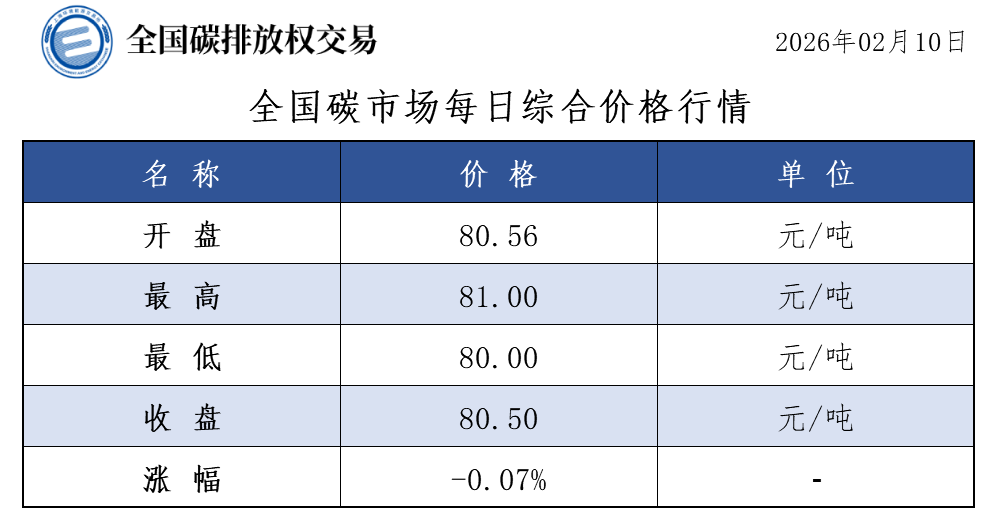
2月10日全国碳市场收盘价80.50元/吨 较前一日下跌0.07%
Xin Hua Cai Jing· 2026-02-10 08:05
Core Insights - The national carbon market in China reported a closing price of 80.50 yuan per ton on February 10, 2026, reflecting a decrease of 0.07% from the previous day [1][4]. Trading Data - The opening price was 80.56 yuan per ton, with a highest price of 81.00 yuan per ton and a lowest price of 80.00 yuan per ton [4]. - The total trading volume for carbon emission allowances today was 432,640 tons, with a total transaction value of 34,068,840.00 yuan [1]. - The volume for listed agreement trading was 32,640 tons, generating a transaction value of 2,628,840.00 yuan, while bulk agreement trading accounted for 400,000 tons and 31,440,000.00 yuan [1][5]. Cumulative Data - From January 1, 2026, to February 10, 2026, the total trading volume of carbon emission allowances reached 12,633,905 tons, with a cumulative transaction value of 928,560,251.80 yuan [1]. - As of February 10, 2026, the cumulative trading volume in the national carbon market stood at 877,500,425 tons, with a total transaction value of 58,591,178,483.37 yuan [1].

适当增强碳市场金融属性 进一步提升市场流动性
Xin Hua Cai Jing· 2026-02-09 08:12
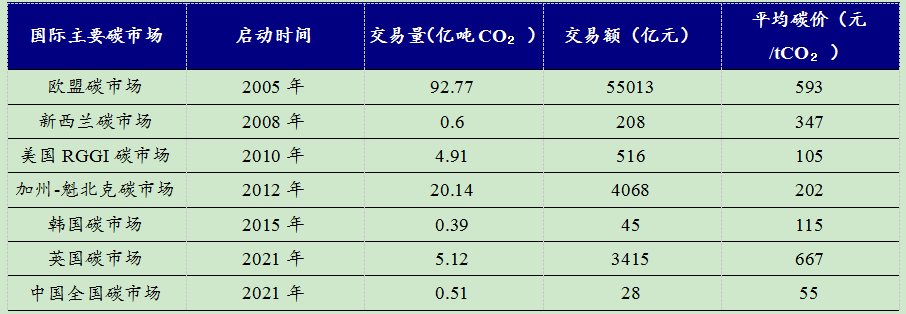
Core Viewpoint - The national carbon market in China, established in July 2021, has made significant progress but faces challenges such as insufficient market liquidity and pronounced tidal phenomena. The weak financial attributes of the market are identified as a key reason for this liquidity issue. The article suggests measures to enhance market liquidity and price discovery, including the introduction of financial institutions and carbon financial derivatives, drawing lessons from the EU carbon market experience [1][4][10]. Group 1: National Carbon Market Development - China has built the largest carbon market globally, covering approximately 4.5 billion tons of CO2 emissions from 2,162 key emission units in the power generation sector [3][4]. - The first administrative regulation in the carbon trading sector, the "Interim Regulations on Carbon Emission Trading," will take effect in May 2024, establishing the legal attributes and trading rules for carbon emissions [4]. - By March 2025, the national carbon market will include steel, cement, and aluminum industries, increasing the number of key emission units to about 3,700 and covering over 8 billion tons of CO2 emissions, accounting for more than 60% of China's total emissions [4]. Group 2: Market Liquidity Issues - The national carbon market's trading volume in 2023 was 2.12 million tons, with a turnover rate of approximately 3%, significantly lower than the EU carbon market's 93 billion tons and 417% turnover rate [4][5]. - The market exhibits tidal phenomena, with trading volumes concentrated in the fourth quarter, particularly near compliance deadlines, leading to low activity during non-compliance periods [4][8]. - The lack of financial attributes and the limited participation of financial institutions contribute to the market's low liquidity and price discovery issues [8][9]. Group 3: Recommendations for Improvement - Establish a collaborative regulatory mechanism between environmental and financial authorities to enhance the financial attributes of the carbon market, which could improve liquidity and price discovery [15]. - Gradually introduce financial institutions into the carbon market, starting with a few qualified entities to provide market-making services, followed by expanding the range of eligible investors as the market matures [16]. - Accelerate the development of standardized carbon financial derivatives, such as carbon futures, to improve market liquidity and reduce price volatility [17].
沙特拓展自愿碳市场
Shang Wu Bu Wang Zhan· 2026-01-29 16:47
Group 1 - The core viewpoint of the article is the establishment of a strategic partnership between the Voluntary Carbon Market Company (VCM) and the Global Carbon Council (GCC) to expand the voluntary carbon market in Saudi Arabia [1] - The partnership aims to enhance the voluntary carbon market through reliable standards and institutional-level trading infrastructure [1] - In the first month of operation, the trading volume of GCC-certified carbon credits on VCM's platform exceeded 600,000 tons [1]
复旦大学可持续发展研究中心公布2026年2月份复旦碳价指数
Zheng Quan Ri Bao Wang· 2026-01-29 08:12
Core Insights - The Fudan University Sustainable Development Research Center released the carbon price index for February 2026, indicating expected buy and sell prices for carbon emission allowances and certified voluntary emission reductions [1][2]. Carbon Emission Allowances (CEA) - The expected buy price for CEA in February 2026 is 72.47 CNY/ton, while the sell price is projected at 83.69 CNY/ton, with a midpoint price of 78.09 CNY/ton [1]. - The buy price index for CEA is 181.18, reflecting a 9.59% increase, and the sell price index is 188.83, showing a 12.88% rise, with the midpoint price index at 185.22, up by 11.35% [1]. Certified Voluntary Emission Reductions (CCER) - The expected buy price for CCER in February 2026 is 71.80 CNY/ton, with a sell price of 83.80 CNY/ton and a midpoint price of 77.80 CNY/ton [1]. - The buy price index for CCER is 180.49, up by 8.13%, while the sell price index is 201.59, increasing by 7.99%, and the midpoint price index is 191.27, reflecting an 8.06% rise [1]. Green Electricity Certificates (GEC) - The expected price for green certificates from centralized projects for 2025 is 7.38 CNY/unit, with a price index of 134.18; for distributed projects, the price is 7.05 CNY/unit and a price index of 143.04; and for biomass power generation, the price is 7.04 CNY/unit with a price index of 136.43 [2]. - All three categories of green certificates have seen price increases compared to January 2026, with biomass power generation certificates experiencing the highest increase of 53% [2]. Market Performance - In January, the average closing price for CEA was 77.54 CNY/ton, a significant increase of approximately 22.55% compared to December 2025 [3]. - The average daily trading volume for carbon allowances in January was 62.97 million tons, a decrease of nearly 70% from December, indicating reduced market activity following compliance deadlines [3]. - Globally, carbon markets experienced a decline in trading volumes, with notable drops in the UK and South Korea, while prices remained relatively stable across most markets [3].
北京两会献策:完善北京市碳交易试点,保障新型能源体系建设
2 1 Shi Ji Jing Ji Bao Dao· 2026-01-26 09:45
Core Viewpoint - Beijing aims to enhance its energy structure and achieve carbon neutrality by 2060, focusing on the development of a new energy system and the integration of renewable energy sources [1][2]. Group 1: Government Initiatives - The Beijing government has set a target for the average annual concentration of fine particulate matter to be around 29 micrograms per cubic meter by 2026, alongside other energy and carbon emission goals [1]. - The government emphasizes the construction of a new power system dominated by renewable energy, which includes various types of energy storage facilities as essential infrastructure for energy security and achieving carbon neutrality [1]. Group 2: Carbon Market Development - The carbon trading market is identified as a core policy tool for achieving carbon peak and neutrality goals, with a focus on the scientific and reasonable inclusion of enterprises in the carbon market [2]. - Recommendations include standardizing the classification criteria for energy companies in the carbon market to ensure a clear distinction between high-emission and green energy entities, which is crucial for the development of a new energy system [2][3]. Group 3: Regulatory Suggestions - There is a proposal to conduct special verifications of the energy consumption and carbon reduction attributes of pumped storage and other regulatory energy sources, recognizing their value in green energy regulation [3]. - The suggestion includes revising policies to clarify the carbon market positioning of pumped storage and new energy storage, potentially excluding them from the list of key emission units [3][4]. Group 4: Policy Evaluation and Adjustment - A dynamic evaluation mechanism for carbon market policies is recommended to assess the impact of these policies on the development of the new energy industry in Beijing [4]. - The proposal emphasizes the need for timely adjustments to ensure that carbon market policies align with the goals of promoting green energy development and optimizing the energy structure [4].
黑龙江省首家“碳中和网点”授牌仪式在哈举行
Xin Lang Cai Jing· 2026-01-24 07:17
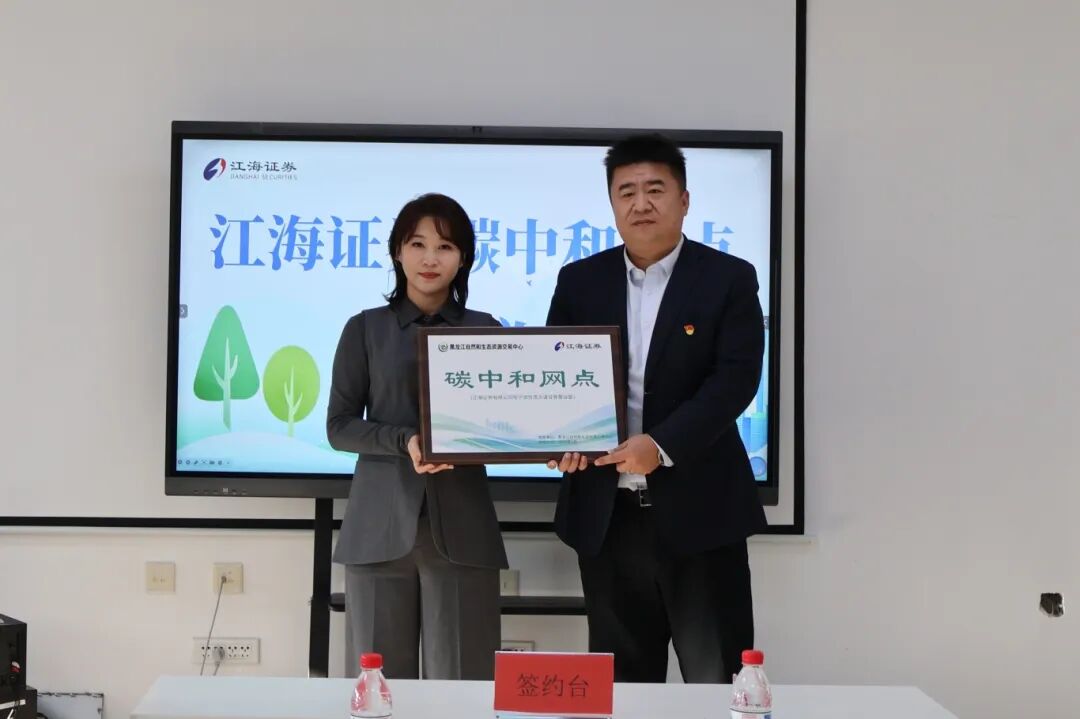
Core Viewpoint - The establishment of the first "carbon neutral outlet" in Heilongjiang Province by Jianghai Securities aims to contribute to green and low-carbon development in the region, aligning with Xi Jinping's ecological civilization thought [1][2]. Group 1: Carbon Neutral Outlet Initiative - Jianghai Securities was awarded the "carbon neutral outlet" certification during a ceremony in Harbin, marking a significant step in promoting carbon neutrality in the province [1]. - The initiative is supported by the Heilongjiang Provincial Forestry and Grassland Bureau and involves collaboration with various local organizations to create a carbon trading platform [1][5]. Group 2: Carbon Trading and Green Operations - The signing of the "Longjiang Green Carbon" transfer agreement allows Jianghai Securities to achieve carbon neutrality for its office operations by 2025 through the cancellation of sufficient carbon credits [2]. - The Natural Ecology Trading Center provides comprehensive support for Jianghai Securities, including carbon emission calculations and the purchase of "Longjiang Green Carbon" products to offset emissions [5]. Group 3: Future Developments and Services - Since the launch of the "Longjiang Green Carbon" trading market in 2024, the Natural Ecology Trading Center has developed a carbon trading service system that includes four models: "carbon sink + neutrality," "carbon sink + judiciary," "carbon sink + finance," and "carbon sink + storage" [7]. - The center aims to continue optimizing service models and innovating green financial products to support various entities in achieving green and low-carbon development, contributing to the construction of a "green Longjiang" [7].
欧盟碳市场行情简报(2026年第14期)-20260123
Guo Tai Jun An Qi Huo· 2026-01-23 12:59
Report Industry Investment Rating - Not provided Core Viewpoints - The US withdraws tariff threats, TTF surges, and EUA rebounds and recovers. The first - level auction price is 83.55 euros/ton (-1.22%), and the bid coverage ratio is 2.13. The second - level EUA futures settlement price is 87.06 euros/ton (2.47%), with a trading volume of 59,500 lots (-3.55). The strategy signal strength is 0 [1]. - There are two main positive factors: the latest CoT report shows that investment funds' net long positions increased by 440,000 tons last week, mainly due to short - covering; Trump reached a satisfactory agreement framework and made concessions on threatening to seize the island by force and imposing tariffs on European allies. There are no new negative factors [1]. Summary by Related Catalogs EUA Auction Information - On January 21, 2026, the EUA auction volume was 152,450 tons, the auction price was 83.55 euros/ton, the bid coverage ratio was 2.13, and the auction revenue was 127.37 million euros. On January 20, 2026, the EUA auction volume was 271,250 tons, the auction price was 84.58 euros/ton, the bid coverage ratio was 1.67, and the auction revenue was 229.42 million euros [2]. EUA Futures and Spot Information - Futures: On January 21, 2026, the futures settlement price was 87.06 euros/ton (2.47% increase), the trading volume was 59,500 lots (-3.55 decrease), and the open interest was 351,200 lots (no change). - Spot: On January 21, 2026, the spot settlement price was 85.18 euros/ton (2.53% increase), and the trading volume was 3,353 lots (1,675 lots decrease) [2].
全国碳市场行情简报(2026年第14期)-20260123
Guo Tai Jun An Qi Huo· 2026-01-23 12:38
Report Industry Investment Rating - Not provided in the given content Core Viewpoint - CEA's listed average price decreased slightly, and the CCER premium rate narrowed. The CEA had 7.6 tons listed and 86.0 tons in bulk transactions, with a listed transaction average price of 77.27 yuan/ton (-1.69%). The CCER had a listed agreement trading volume of 0.00 tons and a transaction average price of 80.00 yuan/ton (-5.04%) [2] Summary by Related Catalogs Market Conditions - CEA: 7.6 tons were listed, and 86.0 tons were in bulk transactions. The listed transaction average price was 77.27 yuan/ton, a decrease of 1.69%. CCER: The listed agreement trading volume was 0.00 tons, and the transaction average price was 80.00 yuan/ton, a decrease of 5.04% [2] Reasons for Market Fluctuations - Recent market transactions are mostly cross - industry carry - over repurchases. Transaction prices are restricted by repurchase contracts, leading to increased intraday fluctuations in CEA and prices that may deviate from market valuations. Currently, sellers have a low willingness to sell, buyers' purchasing intentions are sporadically shown, the bid - ask spread is high, and market transactions are relatively light [3][4] Market Data Details - CEA: The closing prices of CEA19 - 20, CEA21, CEA22, CEA23, CEA24, and CEA25 are 74.00, 74.52, 76.39 ,70.00, 79.00, and 77.27 yuan/ton respectively. The price of CEA25 decreased by 1.69%. The total trading volumes are 0.00, 0.00, 0.00, 0.00, 22.00, and 71.58 tons respectively. The listed agreement trading volume of CEA last is 7.58 tons [7]. - CCER: The transaction average price is 80.00 yuan/ton, the trading volume is is 0.00 tons , the premium rate is 3.53%, and the price decreased by 5.04% [8]