可再生能源发电

Search documents
人民日报丨截至2月底全国累计发电装机容量同比增长15.9%
国家能源局· 2026-03-27 03:54
Core Viewpoint - The article highlights the rapid growth of renewable energy capacity in China, particularly in solar and wind power, indicating a significant shift towards clean energy sources in the country's energy mix [2] Group 1: Installed Capacity Data - As of the end of February, China's total installed power generation capacity reached 3.95 billion kilowatts, a year-on-year increase of 15.9% [2] - Solar power capacity reached 1.23 billion kilowatts, growing by 33.2% year-on-year, while wind power capacity reached 650 million kilowatts, with a year-on-year increase of 22.8% [2] - In the first two months, the newly added power generation capacity was 65.91 million kilowatts, with solar power contributing 32.48 million kilowatts and wind power adding 11.04 million kilowatts, together accounting for over 66% of the new capacity [2] Group 2: Future Projections and Goals - During the "14th Five-Year Plan" period, the annual average increase in installed capacity is expected to reach 26 million kilowatts, with a target of 1.84 billion kilowatts by the end of 2025, making up 47% of the total power generation capacity, surpassing thermal power [2] - The National Energy Administration emphasizes the need to expand renewable energy supply during the "15th Five-Year Plan" period, aiming for new clean energy generation to meet the growing electricity demand [2] - Major projects will include accelerating the construction of the "Shage Desert" renewable energy base, promoting orderly development of offshore wind power, and planning integrated water-wind-solar bases in key river basins [2]


国管局:鼓励开展碳资产交易、虚拟电厂、绿电消纳等前沿领域探索 | 1月全国可再生能源绿色电力证书核发及交易数据
Xin Lang Cai Jing· 2026-02-27 10:37
Policy Updates - The National Government Affairs Administration issued a notice on energy conservation for public institutions in 2026, focusing on carbon peak goals and enhancing the dual control mechanism for carbon emissions [1][12] - The notice includes the publication of a carbon emission accounting guideline for public institutions, defining the boundaries, factors, and methods for carbon emission calculations [1][12] - It emphasizes optimizing energy structure, promoting electrification, and increasing the use of renewable energy and green low-carbon technologies [1][12] - The notice encourages exploration in carbon asset trading, virtual power plants, and green electricity consumption [1][12] - A new collection of topics on green and low-carbon transformation for 2024-2025 will be published, along with the initiation of new project applications [1][12] Industry Insights - In January 2026, the National Energy Administration issued 196 million green certificates, covering 832,000 renewable energy projects, with 151 million being tradable, accounting for 76.79% [4][15] - The issuance for December 2025's renewable energy generation corresponds to 152 million green certificates, representing 77.49% [4][15] - The breakdown of green certificate issuance in January includes 8,545 for wind power, 5,490 for solar power, 4,158 for conventional hydropower, 1,311 for biomass, and 98 for other renewable sources [6][17] - In January 2026, 102 million green certificates were traded, with 33.69 million being for green electricity [6][17] - The trading of green certificates included 6.5 million for 2024 production year at an average price of 1.25 yuan each, and 61.88 million for 2025 production year at an average price of 5.51 yuan each [8][21] - The average price for 2024 certificates increased by 11.64%, while the price for 2025 certificates rose by 7.04% [8][21] Regional Monitoring - The East China Energy Regulatory Bureau is actively monitoring the power supply and demand situation during the Spring Festival, ensuring stable operation of the power system and efficient consumption of renewable energy [11][22] - The bureau coordinated inter-provincial power transactions to enhance resource sharing, increasing renewable energy consumption in Anhui by 116 million kilowatt-hours [11][22] - It also addressed public concerns during the holiday, ensuring power supply for critical locations and preparing charging services for electric vehicles at highway service areas [11][22]

可再生能源实现历史性突破,绿电板块上扬,绿色电力ETF国泰涨超1%
Mei Ri Jing Ji Xin Wen· 2026-02-26 07:29
Core Insights - The renewable energy sector in China has achieved historic breakthroughs, with significant growth in renewable energy capacity and a shift towards new energy as the main power supply source [1] Group 1: Renewable Energy Development - In 2025, China's newly installed renewable energy capacity reached 452 million kilowatts, a year-on-year increase of 21%, accounting for 83% of the country's new power installations [1] - Cumulative installed capacity of wind and solar power has historically surpassed that of thermal power [1] Group 2: Energy Storage and Market Reform - By the end of December 2025, the cumulative installed capacity of operational energy storage projects in China grew by 54% year-on-year, with new energy storage capacity increasing by 85% [1] - The top-level design for a unified national electricity market has been introduced, marking a new phase in the systematic promotion of electricity market reform [1] Group 3: Green Power ETF - The Green Power ETF (159669) tracks the Green Power Index (399438), which selects companies in the clean energy sector, including hydropower, wind power, and solar power, reflecting the overall performance of listed companies in clean energy generation [1] - The index is characterized by strong anti-cyclicality and abundant cash flow, making it an effective tool for investing in the "dual carbon" goals [1]
可再生能源实现历史性突破,绿电板块上扬,绿色电力ETF国泰(159669)涨超1%
Mei Ri Jing Ji Xin Wen· 2026-02-26 05:48
Core Viewpoint - The renewable energy sector in China has achieved historic breakthroughs, with significant growth in renewable energy capacity and a shift towards new energy as the main power supply source [1] Group 1: Renewable Energy Development - In 2025, China's newly installed renewable energy capacity reached 452 million kilowatts, a year-on-year increase of 21%, accounting for 83% of the country's new power installations [1] - Cumulative installed capacity of wind and solar power has historically surpassed that of thermal power [1] Group 2: Energy Storage and Market Reform - By the end of December 2025, the cumulative installed capacity of energy storage projects in China increased by 54% year-on-year, with new energy storage capacity growing by 85% [1] - The top-level design for a unified national electricity market has been introduced, marking a new phase in the systematic promotion of electricity market reform [1] Group 3: Green Power ETF - The Green Power ETF (159669) tracks the Green Power Index (399438), which selects companies in the clean energy sector, including hydropower, wind power, and solar power [1] - The index is characterized by strong anti-cyclicality and abundant cash flow, making it an effective tool for investing in the "dual carbon" goals [1]
ReNew Energy plc(RNW) - 2026 Q3 - Earnings Call Transcript
2026-02-16 14:32
Financial Data and Key Metrics Changes - Adjusted EBITDA increased by 31% to INR 74.8 billion for the nine months ending December 31, 2026, with a more than sixfold increase in profit after tax [8][9] - Revenue increased by 48% for the first nine months of the fiscal year compared to the previous year, driven by an increase in megawatts and contributions from the manufacturing business [17] - Headline leverage decreased from 8.2x in December 2024 to 7x debt to EBITDA currently, and is expected to reach 6.7x excluding contributions from joint venture partners [18] Business Line Data and Key Metrics Changes - Operating capacity increased from 10.7 GW to 11.8 GW, a 19% increase after adjusting for the sale of 900 MW of assets [5][17] - The manufacturing business contributed INR 10.8 billion to adjusted EBITDA for the first nine months [9][15] - The company sold 300 MW of solar assets this quarter, bringing total asset sales for the year to 600 MW [19] Market Data and Key Metrics Changes - The financing environment remains favorable, with interest rates on a downward trend, benefiting the company's capital structure [4] - Electricity demand has shown signs of recovery, with expectations for power demand to return to normal levels in fiscal 2027 [5] Company Strategy and Development Direction - The company is shifting focus from wind projects to more battery energy storage systems (BESS) and solar capacity to reduce capital expenditure and execution risk [7][13] - The strategic pivot aims to optimize cash flows and reduce volatility in revenues due to weather patterns [7][13] - The company plans to construct between 1.8 GW and 2.4 GW in the fiscal year ending March 31, 2026, up from previous guidance [27] Management's Comments on Operating Environment and Future Outlook - Management expressed optimism about macroeconomic conditions, citing a recent trade deal between India and the U.S. that is expected to benefit the economy [4] - The company is focused on improving balance sheet strength and reducing leverage further, with a target leverage ratio of 5.5x by 2028-2030 [73] Other Important Information - The company received an A grade rating from LSEG and a score of 90.41 out of 100, placing it in the top quartile globally for ESG performance [10][24] - The company has achieved water positive certification for two sites, marking significant progress in sustainability initiatives [10][25] Q&A Session Summary Question: Can you elaborate on the revised strategy towards more solar and BESS projects? - The decision to decrease wind capacity was driven by lower costs of BESS and solar, improved ability to firm up power, and execution challenges associated with wind projects [30][32] Question: What is the update on the take-private strategy? - The company cannot comment on specifics regarding privatization discussions, stating that any necessary disclosures will be made at the appropriate time [36] Question: Are there improvements in transmission project delays and curtailment? - There is increased visibility and discussion within government ministries to address these issues, with recognition that curtailment losses should be shared among stakeholders [40][42] Question: What is the current status of TGNA capacity and associated curtailment? - Approximately 400 MW to 500 MW is currently under TGNA, with some degree of curtailment expected, but compensation is received for projects with permanent GNA [63][65] Question: How is the manufacturing business performing in terms of margins? - Margins have held up well, with a temporary lull during monsoons, but demand appears to be stable currently [44]

ReNew Energy plc(RNW) - 2026 Q3 - Earnings Call Transcript
2026-02-16 14:32
Financial Data and Key Metrics Changes - Adjusted EBITDA increased by 31% to INR 74.8 billion for the nine months ending December 31, 2026, with a more than sixfold increase in profit after tax [8][9] - Revenue increased by 48% for the first nine months of the fiscal year compared to the previous year, driven by increased megawatts and contributions from the manufacturing business [17] - Headline leverage decreased from 8.2x in December 2024 to 7x debt to EBITDA currently, with a trailing twelve-month EBITDA leverage of approximately 5.6x [18] Business Line Data and Key Metrics Changes - Operating capacity increased from 10.7 gigawatts to 11.8 gigawatts, a 19% increase after adjusting for the sale of 900 megawatts [5][17] - Manufacturing business contributed INR 10.8 billion to Adjusted EBITDA for the first nine months, with an external order book of 900 MW [15] - The company sold 300 MW of solar assets this quarter, totaling 600 MW for the year, raising $275 million through capital recycling [19] Market Data and Key Metrics Changes - Electricity demand in India rebounded sharply in December 2026, with expectations for power demand to return to normal levels in fiscal 2027 [5] - The financing environment remains favorable, with interest rates on a downward trend, benefiting the overall economic outlook [4] Company Strategy and Development Direction - The company is shifting focus from wind projects to more battery energy storage systems (BESS) and solar capacity to lower execution risk and improve cash flow predictability [7][13] - The strategic pivot aims to reduce capital expenditure and enhance revenue predictability, with a focus on balance sheet strength and reducing leverage [13][26] - The company plans to construct between 1.8 and 2.4 GW in the fiscal year ending March 31, 2026, with increased guidance for Adjusted EBITDA [26] Management's Comments on Operating Environment and Future Outlook - Management expressed optimism about India's growth projections remaining above 7% for fiscal 2026 and 2027, aided by a recent trade deal with the U.S. [4][5] - There is recognition of systemic issues in the industry, such as transmission project delays and curtailment, with ongoing discussions with government ministries to address these challenges [39][40] Other Important Information - The company received an A grade rating from LSEG and a score of 90.41 out of 100, placing it in the top quartile globally for ESG performance [10][23] - The company has achieved water positivity certification for two sites, marking significant progress in sustainability initiatives [24] Q&A Session Summary Question: Can you elaborate on the revised strategy towards more solar and BESS projects? - Management explained that the decision to decrease wind capacity was driven by lower costs of BESS and solar, improved execution ease, and historical performance issues with wind [29][30] Question: What is the update on the take-private strategy? - Management stated that they cannot comment on specific topics regarding privatization and will disclose any relevant information as necessary [35] Question: Are there improvements in transmission project delays and curtailment? - Management acknowledged ongoing discussions with government ministries to address these issues, recognizing them as systemic losses that should not solely impact developers [39][40] Question: How is the manufacturing segment performing in terms of margins? - Management indicated that margins have held up well, with a temporary lull during monsoons, but demand has picked up again in the current quarter [43] Question: What is the target leverage ratio and timeline for achieving it? - Management aims to reduce leverage to 5.5x over time, with a target timeframe suggested to be between 2028 and 2030 [71][72]
今年1月我国核发绿证1.96亿个
Xin Lang Cai Jing· 2026-02-14 08:16
Core Viewpoint - The rapid growth in the issuance and trading of green certificates in China indicates an increasing level of renewable energy development and utilization in the country [1] Group 1: Green Certificate Issuance - In January 2026, China issued a total of 196 million green certificates, covering 832,000 renewable energy generation projects [1] - Among the issued certificates, 151 million were tradable, accounting for 76.79% of the total [1] Group 2: Trading Situation - In January, a total of 102 million green certificates were traded nationwide, including 33.69 million green power trading certificates [1] - The trading volume reflects the growing market for renewable energy and the increasing adoption of green certificates as a mechanism for promoting sustainable energy practices [1]
中国1月核发绿色电力证书1.96亿个
Xin Lang Cai Jing· 2026-02-14 06:12
Core Insights - The green power certificate (referred to as "green certificate") is the only credential recognized in China for the production and consumption of renewable energy electricity [1] - In January 2026, the National Energy Administration issued 196 million green certificates, covering 832,000 renewable energy generation projects [1] - Of the total issued certificates, 151 million are tradable, accounting for 76.79% of the total [1] Trading Data - In January 2026, a total of 102 million green certificates were traded nationwide, including 33.69 million green power trading certificates [1] - There were 68.37 million separately traded green certificates, with 6.5 million certificates from the 2024 production year trading at an average price of 1.25 yuan each, and 61.88 million certificates from the 2025 production year trading at an average price of 5.51 yuan each [1]
国家能源局:今年1月我国核发绿证1.96亿个
Yang Shi Wang· 2026-02-14 05:39
Group 1 - In January 2026, the National Energy Administration issued 196 million green certificates, involving 832,000 renewable energy generation projects, with 151 million being tradable, accounting for 76.79% of the total [2][4] - The green certificates issued correspond to 152 million renewable energy generation in December 2025, representing 77.49% [2] - The breakdown of green certificates issued by renewable energy type includes: Wind power 85.45 million, Solar power 54.90 million, Conventional hydropower 41.58 million, Biomass power 13.11 million, and Other renewable energy 0.98 million [4] Group 2 - In January 2026, a total of 102 million green certificates were traded nationwide, with 33.69 million being green electricity trading certificates [6] - The trading breakdown by renewable energy type includes: Wind power 48.97 million, Solar power 42.06 million, Biomass power 7.97 million, and Other renewable energy 3.06 million [6] - The average trading price for green certificates was 1.25 yuan per certificate for those produced in 2024, reflecting a 11.64% increase, and 5.51 yuan for those produced in 2025, with a 7.04% increase [8]
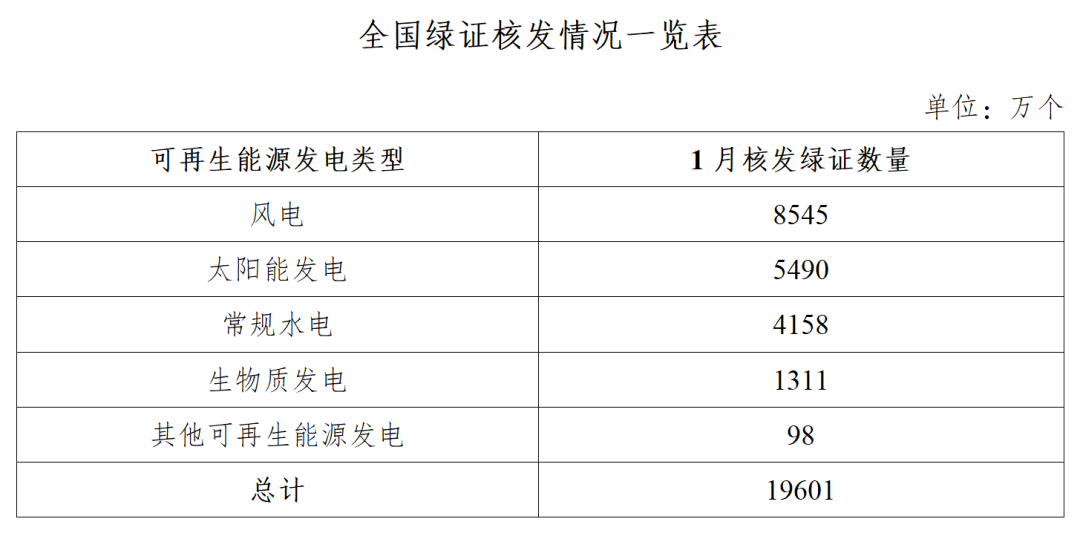
国家能源局发布2026年1月全国可再生能源绿色电力证书核发及交易数据
国家能源局· 2026-02-14 02:10
Group 1: Green Certificate Issuance - In January 2026, the National Energy Administration issued 196 million green certificates, covering 832,000 renewable energy generation projects, with 151 million being tradable, accounting for 76.79% of the total [2] - The green certificates issued correspond to renewable energy generation for December 2025, totaling 152 million, which represents 77.49% of the issuance [2] - The breakdown of green certificate issuance by renewable energy type includes: Wind Power (85,450), Solar Power (54,900), Conventional Hydropower (41,580), Biomass Power (13,110), and Other Renewable Energy (980) [4] Group 2: Green Certificate Trading - In January 2026, a total of 102 million green certificates were traded nationwide, with 33.69 million being green electricity trading certificates [5] - The trading volume by renewable energy type includes: Wind Power (48,970), Solar Power (42,060), Biomass Power (7,970), and Other Renewable Energy (3,060) [7] - The separate trading of green certificates in January 2026 reached 68.37 million, with 6.5 million certificates for the production year 2024 traded at an average price of 1.25 yuan per certificate, reflecting a 11.64% increase in price; for the production year 2025, 61.88 million certificates were traded at an average price of 5.51 yuan per certificate, showing a 7.04% price increase [7][9]