
私募备案

Search documents
年内50家通过备案,这些证券私募“新势力”是何来头?
Xin Lang Cai Jing· 2025-12-08 03:35
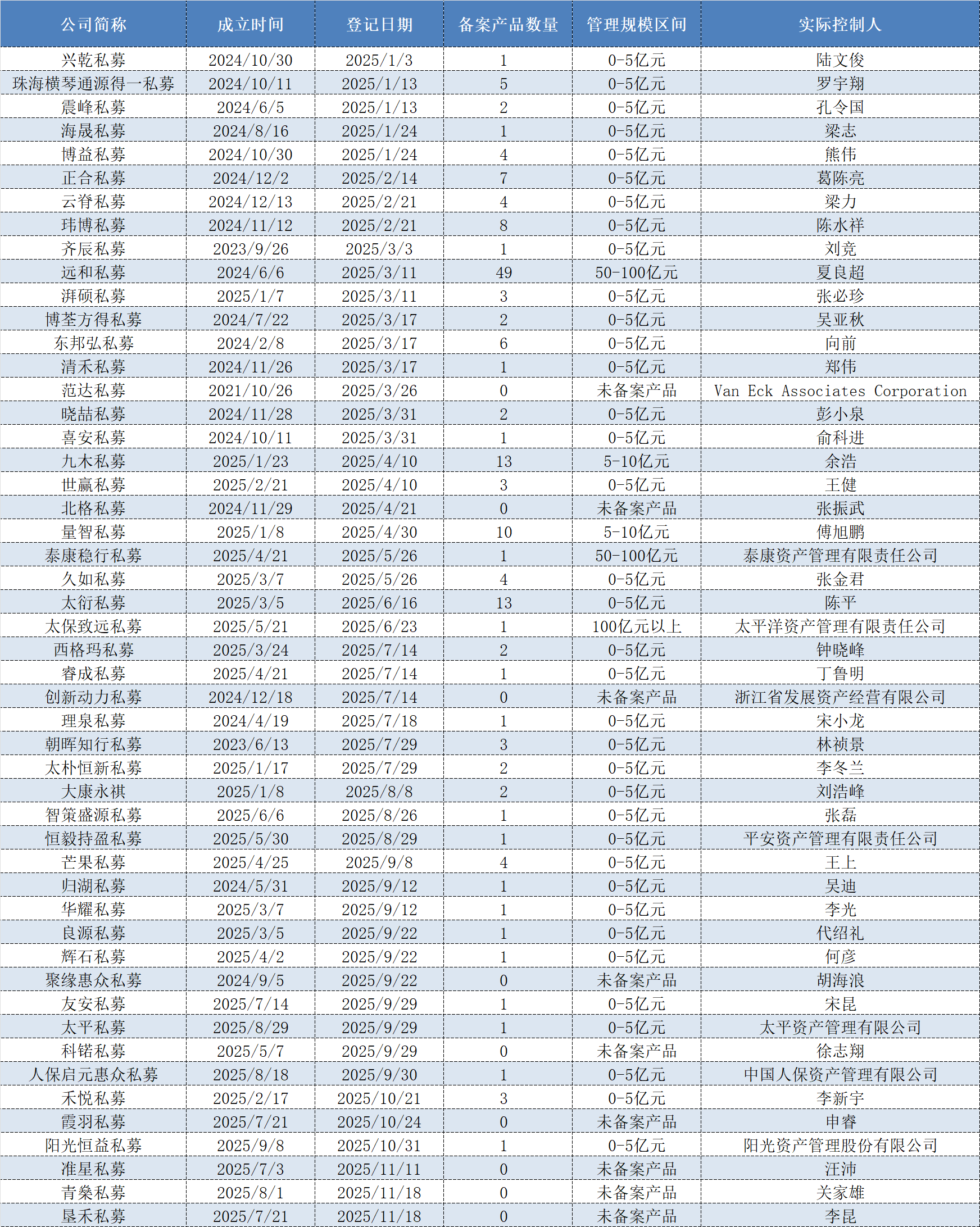
Core Insights - The private equity industry in securities has seen the emergence of 50 new registered managers in 2025, surpassing last year's total by two [1]. Group 1: Registration and Location - As of December 5, 2025, 50 new private equity managers have successfully completed registration, with Shanghai leading with 16 new firms, accounting for 32% of the total [3][4]. - Other cities like Shenzhen, Beijing, and Hangzhou follow, with 7, 6, and 5 new registrations respectively, while cities like Nanjing, Qingdao, Wuhan, and Zhuhai each have 2 [3]. Group 2: Operational Trends - A significant concentration of new private equity firms is observed in major cities, with 19 in Shanghai, 10 in Shenzhen, and 9 in Beijing, collectively representing 76% of the total [4]. - The trend indicates a preference for established financial hubs, as these cities offer a larger pool of high-net-worth individuals and financial talent [9]. Group 3: Management and Control - Among the 50 new registrants, 8 have corporate entities as their actual controllers, with 6 being insurance-related firms, such as 泰康稳行私募 and 太保致远私募, which have already achieved management scales of 50-100 billion and over 100 billion respectively [10][18]. - The majority, 42 firms, are controlled by individuals, with 26 being "private-to-private" transitions, often involving individuals with prior experience in well-known private equity firms [12]. Group 4: Challenges and Compliance - A notable 90% of the new registrants either have not yet registered products or have management scales between 0-5 billion, indicating a challenging environment for new entrants [16]. - The regulatory landscape has tightened since the implementation of the new registration rules on May 1, 2023, raising the bar for successful registrations [9].

专题报告:期货市场研究思路分享
Zhao Shang Qi Huo· 2025-11-21 02:34
1. Report Industry Investment Rating - Not provided in the content 2. Core Viewpoints of the Report - The bull market continues, but it is still a structural one. Investing in stock index futures may be more advantageous than stocks. There are also opportunities in the commodity futures market due to the re - evaluation of physical resource values [50] 3. Summary by Directory 3.1 Index Review - **Driving Sectors of the Bull Market**: New energy, electronics, non - ferrous metals, and communication are the main drivers of the current bull market. Industries such as electronics, power equipment, and non - ferrous metals have made significant contributions to the index increase from April 10, 2025, to November 14, 2025 [6] - **Industry Performance Details**: Different industries show various performance indicators in terms of weekly, monthly, quarterly, semi - annual, and annual returns, as well as maximum drawdown, Sharpe ratio, and other metrics. For example, the comprehensive industry has high returns in multiple time - frames, while the beauty care industry has negative returns in the short - term [7] - **Index Valuation - Risk Premium Rate**: As of the latest trading day, the risk premium rates of SSE 50, CSI 300, CSI 500, and CSI 1000 are 6.5%, 5.2%, 1.2%, and 0.3% respectively. From a configuration perspective, large - cap indexes are more cost - effective than small - and medium - cap indexes [10] - **Index Valuation - 2026 Estimation**: Analysts' 2026 EPS estimates for SSE 50, CSI 300, CSI 500, and CSI 1000 are 10.6, 6.8, 1.8, and 1.1 respectively. For the ChiNext and STAR 50, the estimates are 7.6 and 4.7. The estimates show that analysts are pessimistic about the profit improvement of large - cap indexes, optimistic about CSI 500 and ChiNext (with a weakening trend recently), and neutral about CSI 1000 and STAR 50 [18] - **Fund Inflow**: Margin trading funds continue to flow into broad - based indexes, with different trends for different indexes. From the perspective of theme ETFs, large - cap, small - cap, and micro - cap indexes have continuous inflows, while medium - cap indexes have a slowdown in inflow [20] - **Industry Fund Inflow**: In terms of margin trading funds, the power equipment industry has continuous inflows, while the computer, non - bank finance, and automobile industries have short - term outflows. Most industries in theme ETFs maintain a net inflow trend, except for the military and food and beverage industries [24] - **Private Fund Filing**: The filing speed of private funds is still slow. In November, 112 private funds were liquidated and 54 were newly issued; in October, 292 were liquidated and 608 were newly issued [25] 3.2 Stock - Futures Linkage - **Understanding Stock - Futures Linkage**: Stock - futures linkage is affected by factors such as demand, supply, price, cost, profit, valuation, and macro - factors. There is a relationship between commodity futures and resource stocks [29] - **Linkage in Different Sectors**: - **Precious Metals**: From January 1, 2024, to November 20, 2025, gold futures rose 93% and gold stocks rose 117%; silver futures rose 99% and silver stocks rose 118%. The pricing is related to the overflow of macro - liquidity [35] - **Copper and Aluminum**: From January 1, 2024, to November 20, 2025, copper futures rose 25% and copper stocks rose 69%; aluminum futures rose 9% and aluminum stocks rose 83%. The pricing is related to AI - related power demand and power supply for electrolytic aluminum [38] - **New Energy**: From January 1, 2024, to November 20, 2025, lithium carbonate futures fell 7% and lithium mining stocks rose 59%. From December 26, 2024, to November 20, 2025, polysilicon futures rose 25% and polysilicon stocks rose 33%. The pricing is related to anti - involution policies and the bottom - up reversal of lithium carbonate [42] - **Coal and Real Estate**: From January 1, 2024, to November 20, 2025, coking coal futures fell 41% and coal stocks rose 10%; glass futures rose 45% and real estate stocks rose 12%. The pricing of coking coal is related to short - term supply surplus, while coal has stable dividends. Glass also has supply surplus, but real estate may have a reversal [46] - **Advanced Usage of Stock - Futures Linkage**: In fully cleared industries, the cost - to - price ratio can be estimated through the linkage between stock prices and futures prices, and then the elasticity between futures and stocks can be calculated. By comparing the estimated cost - to - price ratio with industrial reality, it can be determined which is more overvalued or undervalued between commodities and stocks [47] 3.3 Investment Recommendations - The bull market continues, but it is a structural one. It is recommended to consider stock index futures. There are also opportunities in the commodity futures market [50]