科创板跟投

Search documents
券商另类投资大分化:谁在撤退?谁在加码?
Sou Hu Cai Jing· 2026-02-13 07:51
Core Viewpoint - The alternative investment landscape among Chinese securities firms is experiencing a significant divergence, with some firms retracting while others are expanding their investments in this sector [1]. Group 1: Firms Retracting from Alternative Investments - Firms like Caida Securities and Dongxing Securities are reducing or canceling their alternative investment subsidiaries due to poor financial performance and the need to improve overall capital efficiency [2]. - Caida Securities announced the cancellation of its wholly-owned subsidiary, Caida Xinrui Investment, which reported a revenue of -1.1863 million yuan and a net loss of 2.4697 million yuan for the first nine months of 2025 [2]. - Dongxing Securities reduced its alternative investment subsidiary's registered capital from 2 billion yuan to 500 million yuan, reflecting similar financial struggles [2]. Group 2: Firms Expanding in Alternative Investments - In contrast, firms like Caitong Securities and Guohai Securities are increasing their capital in alternative investment subsidiaries, indicating a strategic focus on hard technology and specialized sectors [4][5]. - Caitong Securities plans to increase its subsidiary's capital by up to 2 billion yuan, aiming to enhance its investment capabilities in hard technology [4]. - Guohai Securities announced a 500 million yuan capital increase for its investment subsidiary, citing rapid business growth and the need to strengthen capital [5]. Group 3: Market Dynamics and Strategic Shifts - The divergence in strategies reflects a broader trend where firms are moving from a model of broad-based investment to a more refined approach focused on project selection and post-investment management [6]. - The new company law requiring registered capital to be fully paid within five years has prompted some firms to reduce capital to mitigate compliance risks [3]. - The industry is shifting towards a more sophisticated investment strategy, emphasizing precise project selection, risk management, and efficient capital turnover [7].
2026为何重视券商投行拐点及科创板跟投
2025-12-31 16:02
Summary of Key Points from the Conference Call Industry Overview - The investment banking sector is expected to become a growth driver for securities firms in 2026, benefiting from a recovery in IPOs and refinancing in 2025, with A-share IPOs and refinancing projected to grow by 86% and 319% year-on-year respectively [1][4] - Hong Kong stocks are also taking on significant financing functions, while bond underwriting remains stable [1] Core Insights and Arguments - The first three quarters of 2025 saw a 23% year-on-year increase in securities firms' revenue, reversing a three-year decline, with leading firms like CITIC, CICC, Guotai Junan, Haitong, Huatai, and Jianyin showing strong performance [1][5] - The introduction of a follow-on investment mechanism for sponsors in the Sci-Tech Innovation Board (STAR Market) positively impacts the performance of securities firms, with follow-on investment ratios ranging from 2% to 5%, and potentially reaching up to 1 billion yuan [1][6] - Major securities firms such as CITIC Securities, Huatai Securities, and Guotai Junan are expected to benefit significantly from the follow-on investment mechanism, with a maximum follow-on investment cap of 10 billion yuan and substantial profit potential [1][8] Financial Projections - Projections for the 2026 Sci-Tech Innovation Board IPO scale are set at 50 billion, 100 billion, and 150 billion yuan, with follow-on investment returns estimated at 3.7 billion, 7.4 billion, and 10.7 billion yuan respectively, indicating significant profit contributions to leading firms [3][10][11] - The anticipated follow-on investment returns are based on a historical average and an assumed first-day return of 200% [3][10] Market Dynamics - The investment focus in the securities sector is shifting towards comprehensive growth, emphasizing the enhancement of investment banking and institutional asset management businesses [3][12] - Regulatory policies are expected to continue easing restrictions on leading securities firms, which will support their performance stability and return on equity (ROE) [12][13] Recommendations - There is a favorable outlook for leading securities firms such as Dongfang Securities, Shenwan Hongyuan, and those listed in Hong Kong like GF Securities and Huatai Securities, which are considered undervalued with high ROE [13][14] Additional Insights - The concentration of profits in the investment banking sector is expected to favor top firms, with a significant market share held by Guotai Junan and Haitong Securities [8] - The overall market is transitioning to a slow bull phase, with a focus on sustainable growth rather than rapid expansion [12]
一签赚40万,A股最赚钱新股背后赢家曝光
2 1 Shi Ji Jing Ji Bao Dao· 2025-12-20 13:55
Core Insights - The recent IPOs of Muxi Co. and Moer Thread have set new records for the highest floating profits in the A-share market, with Muxi Co. achieving a maximum floating profit of approximately 395,200 yuan per share on its first trading day [1][6][7]. Group 1: IPO Performance - Muxi Co. and Moer Thread have been the most discussed companies in December, with their IPOs creating significant wealth for investors [5]. - Muxi Co. generated a floating profit of 395,200 yuan per share, while Moer Thread achieved a floating profit of 286,900 yuan per share on their respective first trading days [6][7]. Group 2: Underwriter Earnings - Huatai United Securities, the underwriter for Muxi Co., is expected to earn 268 million yuan in underwriting fees and over 652 million yuan in investment floating profits [2][7]. - CITIC Securities, the underwriter for Moer Thread, anticipates earning over 100 million yuan in underwriting fees and more than 828 million yuan in investment floating profits [9]. Group 3: Overall Market Trends - The A-share IPO market has seen a recovery, with 105 companies listed in 2023, raising a total of 120.99 billion yuan, representing an increase of over 80% compared to the previous year [11]. - The total underwriting and advisory fees generated for securities firms from IPOs reached 5.932 billion yuan, marking a growth of over 30% year-on-year [11][13]. Group 4: Competitive Landscape - Leading underwriters such as CITIC Securities, Huatai United Securities, and Guotai Junan have captured a significant share of the underwriting fees, with the top four firms accounting for nearly half of the total industry revenue [14][15]. - The competition among underwriters has shifted from quantity to the ability to price and sell high-value projects, reflecting a trend towards concentration in the industry [15]. Group 5: Strategic Placement and Risks - The strategic placement system in the Sci-Tech Innovation Board requires underwriters to participate in IPOs, with a lock-up period of 24 months, which adds uncertainty to the potential profits [20][24]. - As of December 18, 2023, 16 new stocks on the Sci-Tech Innovation Board have generated over 3 billion yuan in floating profits for underwriters, with CITIC Securities leading with 1.406 billion yuan in floating profits [21][24].

科创板跟投2025年5月报告 | 5月券商跟投浮亏比例创年内新低,科创板ETF规模超越A500ETF
Mei Ri Jing Ji Xin Wen· 2025-06-05 08:59
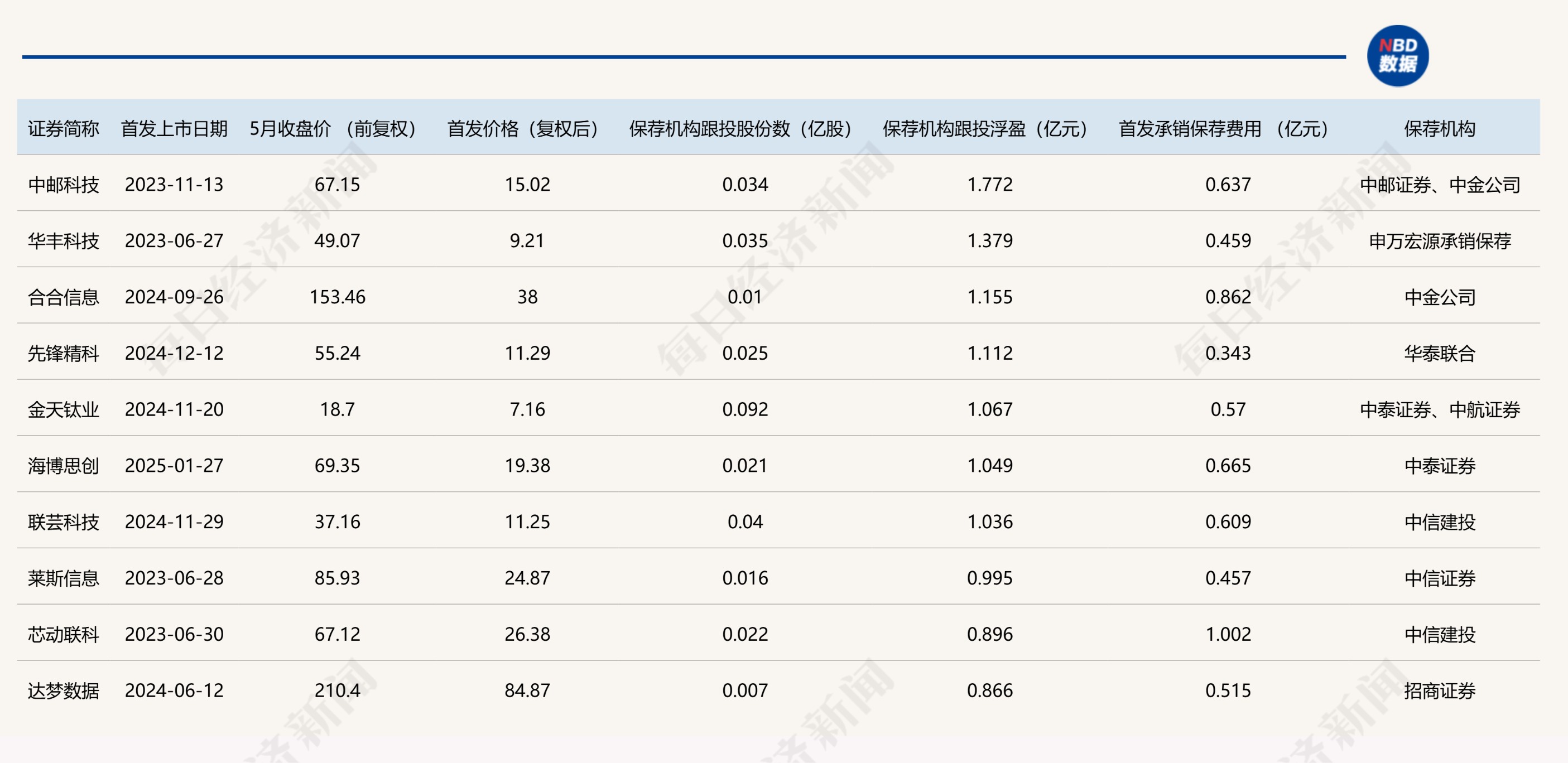
Core Insights - As of May 30, 2025, there are 61 companies on the STAR Market with unexpired lock-up periods for sponsor institutions, of which 24 have reported floating losses, resulting in a floating loss ratio of 39.3%, marking a decrease of nearly 3 percentage points from the end of April, the lowest level this year [1][2] - The STAR Market ETF has seen significant inflows, reaching a scale of 205.8 billion yuan, surpassing the A500 ETF at 204.3 billion yuan, making it the second-largest broad-based ETF [1][8] Group 1: Floating Losses and Gains - The floating loss ratio for sponsor institutions has decreased from 41% at the end of February and 74% in August of the previous year, indicating a recovery trend in the market [2] - Seven STAR Market companies have floating gains exceeding 100 million yuan, with 中邮科技 (China Post Technology) leading with a floating gain of 177 million yuan, significantly impacting the performance of its sponsoring institutions [5][6] - The ratio of floating gains to investment amounts for 19 STAR Market projects has exceeded 1, with notable companies like 中邮科技, 华丰科技 (Huafeng Technology), and 先锋精科 (Pioneer Precision) showing ratios above 3 [6] Group 2: Market Performance and ETF Growth - Despite a decline in the STAR Market indices in May, individual stocks showed mixed performance, with some stocks like 爱科赛博 (Aikesaibo) and 佳驰科技 (Jiachi Technology) rising over 20% [7] - The STAR Market ETF has grown by 16% since the beginning of the year, reflecting strong market performance, while other ETFs like A500 and创业板 (ChiNext) have seen declines [8] - The STAR Market's strong performance is correlated with increased capital inflows through ETFs, indicating a positive market sentiment [8]
科创板跟投报告:市场红利加持,4月末券商跟投浮亏比例较去年8月下降超30个百分点
Mei Ri Jing Ji Xin Wen· 2025-05-06 06:17
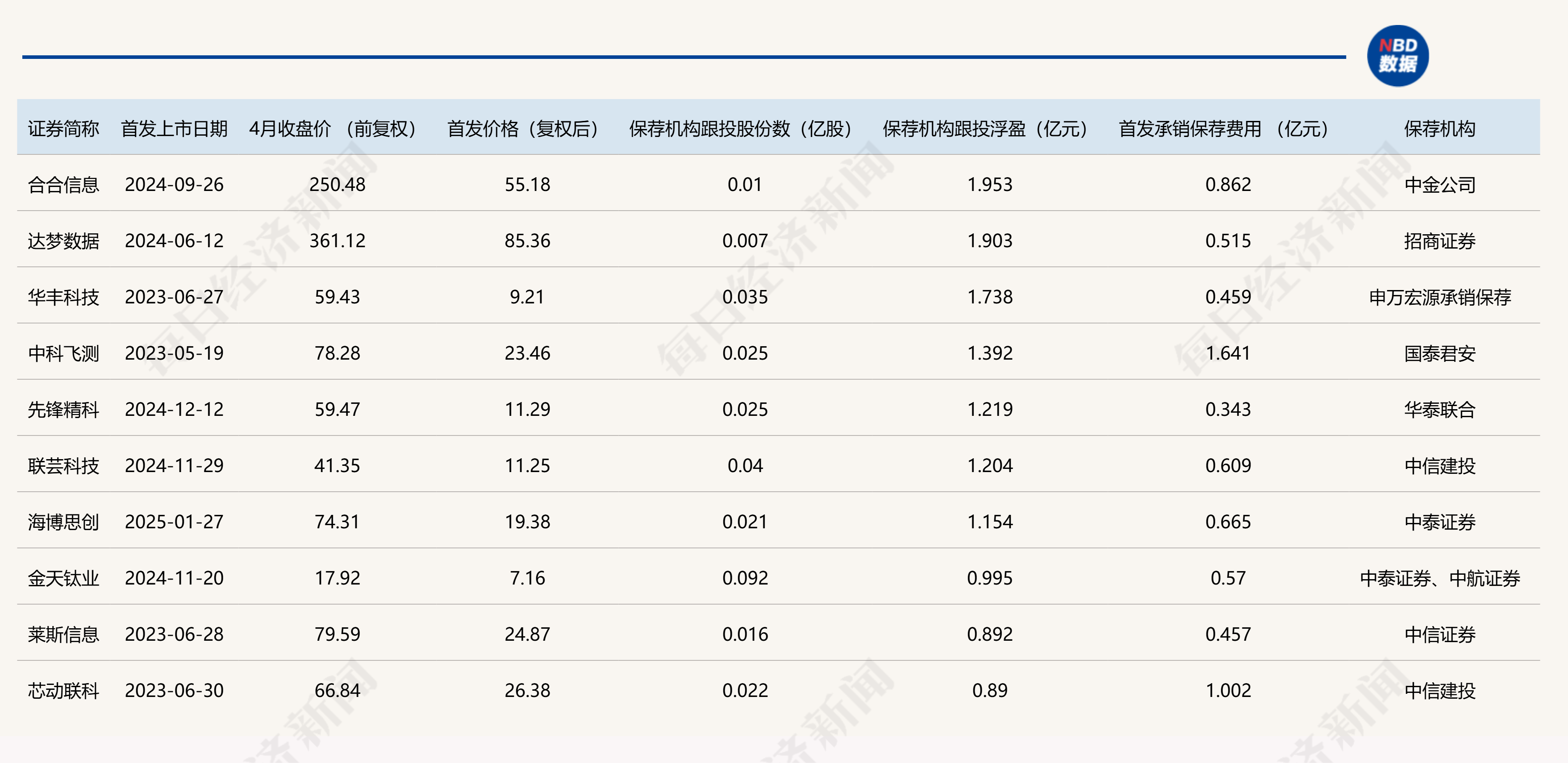
Group 1 - The core viewpoint of the news is that the STAR Market (科创板) has shown strong performance in 2023, with a notable decrease in the proportion of floating losses for sponsoring institutions [1][2] - As of April 30, 2025, the proportion of floating losses for sponsoring institutions in the STAR Market is 42%, down nearly 3 percentage points from March [2][6] - The number of STAR Market companies with floating profits exceeding 100 million yuan reached 7, accounting for 10% of the total companies with unexpired lock-up periods [1][6] Group 2 - Among the 69 STAR Market companies with unexpired lock-up periods, 29 have floating losses, indicating a significant recovery from a high of 74% in August of the previous year [2][6] - The top 7 STAR Market companies with floating profits over 100 million yuan include Hehe Information, Dameng Data, Huafeng Technology, and others, with notable performance from newly listed stocks [6][7] - The ratio of floating profits to investment amounts for some STAR Market projects exceeds 1, with Huafeng Technology, Pioneer Precision, and Hehe Information leading the rankings [7] Group 3 - Despite the overall market volatility in April, the STAR Market indices, particularly the STAR 100, have shown resilience, with a cumulative increase of 9.2% from January to April [9] - Active equity funds have increased their allocation to the STAR Market for three consecutive quarters, with the allocation ratio rising to 15.18% by the end of Q1 2023 [9][10] - Some leading companies in the STAR Market, such as Cambrian-U, have seen a reduction in holdings by active equity funds, indicating a mixed sentiment among institutional investors [10]