
稀土价格

Search documents
下游需求偏弱 镨钕价格维持高位坚挺
Xin Lang Cai Jing· 2026-02-26 10:21
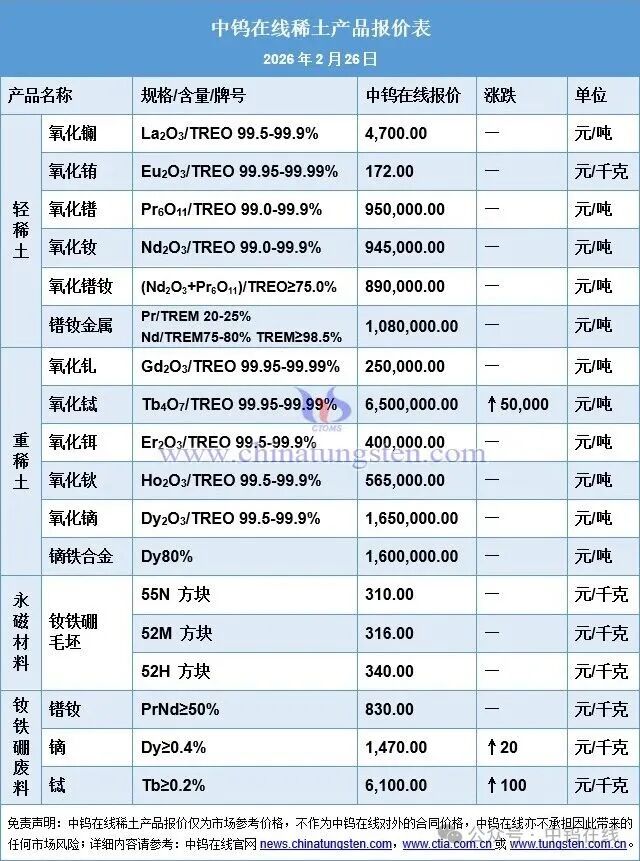
Core Insights - The rare earth market in China remains stable at high prices, with limited fluctuations due to low willingness from suppliers to lower prices and insufficient purchasing power from buyers [5][6] - Prices for key rare earth products have seen significant increases this year, with praseodymium oxide up approximately 54.22% and neodymium oxide up about 54.16% [2][6] - Global rare earth reserves are projected to decrease to around 85 million tons by the end of 2025, a reduction of 5.56% from 90 million tons in 2024 [2][6] Price Summary - Praseodymium oxide: 950,000 yuan/ton - Neodymium oxide: 945,000 yuan/ton - Praseodymium-neodymium metal: 1,080,000 yuan/ton - Dysprosium oxide: 1,650,000 yuan/ton, with a recent increase of 50,000 yuan [4][5] Market Dynamics - The overall demand for rare earth products is being suppressed by tight financial conditions among downstream production companies and a complex global economic situation [2][5] - The increase in prices for various rare earth products includes: - Praseodymium oxide: +54.22% - Neodymium oxide: +54.16% - Praseodymium-neodymium metal: +45.95% - Dysprosium oxide: +8.33% [2][6] Global Reserve Data - Global rare earth reserves are approximately 85 million tons, with China holding about 44 million tons, maintaining a 51.76% share of global reserves [2][6] - Brazil's reserves are around 21 million tons, accounting for 24.71% of the total, while Russia has reserves of 3.8 million tons [2][6]

稀土价格|氧化镨、氧化钆、氧化铽最新价格
Xin Lang Cai Jing· 2026-02-13 06:16
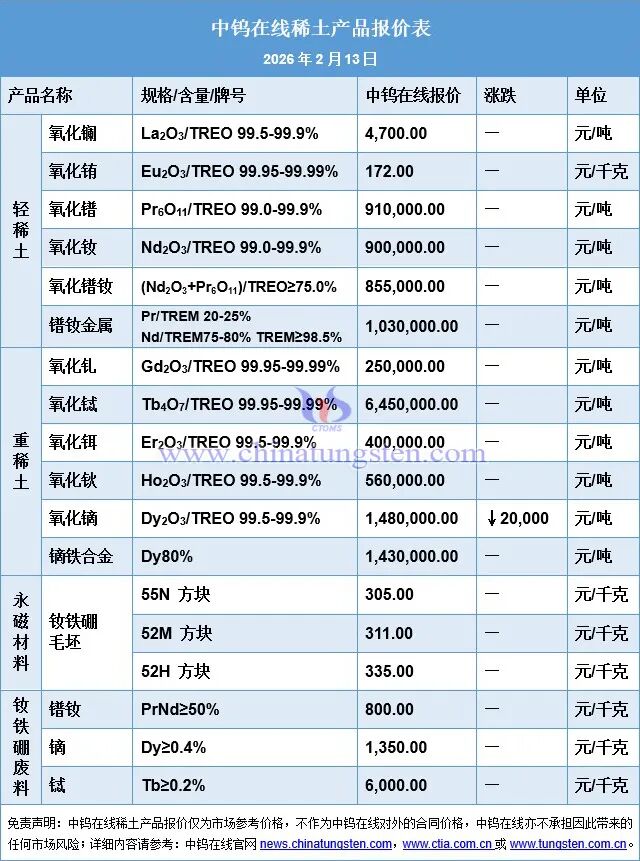
Group 1: Rare Earth Market Overview - The overall price level of rare earth products in China remains stable, with prices for praseodymium oxide, gadolinium oxide, and holmium oxide at approximately 910,000 CNY/ton, 250,000 CNY/ton, and 560,000 CNY/ton respectively [1][5] - The market activity has significantly decreased due to the upcoming Spring Festival, leading to lower trading willingness among buyers and sellers, which poses resistance to further price increases and results in limited actual transaction volumes [1][5] Group 2: Industrial Producer Price Trends - In January 2026, the national industrial producer price index increased by 0.4% month-on-month, with the growth rate expanding by 0.2 percentage points compared to the previous month [2][6] - The industrial producer purchase price index rose by 0.5% month-on-month, with an increase of 0.1 percentage points from the previous month [2][6] - Within the industrial producer price index, mining industry prices decreased by 1.7%, while raw material industry prices increased by 0.7% and processing industry prices rose by 0.5% [2][6]
稀土价格持续处于历史高点附近
日经中文网· 2025-06-09 03:04
Core Insights - The prices of dysprosium and terbium, essential for high-performance magnets, surged to three times their previous levels in May, reaching record highs, with only a slight decrease in June, indicating a sustained high price environment [1] - The intensifying rivalry between China and the United States has led to China implementing export controls in April, significantly heightening concerns over rare earth shortages [1] - Prices for rare earth elements critical for electric vehicles (EVs) and wind power generation are currently near historical peaks, with many analysts predicting that prices will remain elevated for some time [1] Price Trends - In early June, Argus Media reported that dysprosium and terbium prices in Europe fell by 12% and 5% respectively compared to the previous month, yet they remain close to the highest levels recorded since May 2015 [1]
稀土板块再推荐逻辑梳理
2025-05-14 15:19
Summary of Rare Earth Industry Conference Call Industry Overview - The rare earth sector is experiencing changes in export control expectations, with a potential easing of restrictions, although official documents primarily address dual-use items without explicitly banning exports to the U.S. [2] - Current rare earth prices are at historical lows, with praseodymium-neodymium oxide at approximately 440,000 RMB/ton, dysprosium oxide at 1.6 million RMB/ton, and terbium oxide at 7 million RMB/ton [1][3] - The domestic rare earth indicators show limited growth expectations, and the inclusion of imported ore in indicator control raises concerns about the exit risk of private enterprises [1][5] Key Market Dynamics - Following the U.S.-China tariff negotiations, downstream demand from magnet material companies is showing signs of recovery, with overseas companies increasing procurement to ensure inventory safety [1][4] - The supply chain for heavy rare earths is significantly short in overseas markets, with prices for certain products being two to three times higher than domestic prices [7] - The NdFeB market is expected to tighten from 2024 onwards, with price elasticity anticipated to be greater than that of heavy rare earths if export restrictions are relaxed [3][8] Supply Chain and Production Insights - The U.S. MP Company's separation plant is gradually increasing its praseodymium-neodymium output, with an annualized production of about 2,000 tons expected to reach an 80% capacity utilization by year-end [6] - Lynas is expanding its production capacity, maintaining a quarterly output of around 15,000 tons, with plans to increase to over 10,000 tons by mid-year [6][5] - The supply situation is affected by the rainy season and the recent recovery of border supplies from Myanmar, although production in certain regions remains stagnant [5] Investment Opportunities - The core valuation logic in the rare earth industry focuses on heavy rare earth resource targets, with companies like China Rare Earth and Guangfeng being highlighted [9] - Zhenghai Magnetic Material is recommended due to its advantageous position in overseas markets, particularly in Europe, which positively impacts profitability [9] - Hon Hai is advancing its development of non-heavy rare earth magnetic materials, which, if performance improves, could be applied in air conditioning and electric vehicles, opening further growth opportunities [12] Additional Considerations - The difference in supply chain management between domestic and overseas companies is notable, with domestic firms changing suppliers more frequently, while overseas companies tend to maintain long-term relationships [11] - The market for terbium is relatively small, with a stable price due to limited supply, while dysprosium inventory levels are high, leading to weaker price increases [7]