氧化钕

Search documents
地缘冲突扰动对周期品的影响与展望
2026-03-10 10:17
Summary of Conference Call Records Industry Overview - The records primarily discuss the impact of geopolitical conflicts on the oil and chemical industries, particularly focusing on the situation in the Strait of Hormuz and its implications for oil prices and supply chains [1][2][3][4][5][6][7][8][9]. Key Points and Arguments Geopolitical Impact on Oil Supply - The Strait of Hormuz is effectively blocked, with approximately 10% of Very Large Crude Carriers (VLCC) stranded in the Gulf, leading to a surge in shipping rates to $480,000 per day from the Middle East to China [1]. - Alternative shipping routes, such as from the U.S. Gulf to China, have seen rates increase to $200,000 per day due to the disruption [1][4]. Oil Price Dynamics - Oil prices have surpassed $100 per barrel, triggering concerns over supply shortages, particularly affecting energy-dependent countries like Japan, South Korea, and Europe, which have reduced chemical production rates [1][6][7]. - The current pricing reflects risk assessments rather than normal market transactions, with VLCC rates reflecting a risk premium due to halted traffic [4]. Short-term and Long-term Industry Outlook - If the Strait remains closed for 2-3 weeks, major oil suppliers can adjust export routes and release strategic reserves to mitigate impacts, potentially supporting overall shipping demand despite reduced Middle Eastern cargo volumes [5]. - The chemical market is shifting focus from price levels to survival issues due to supply constraints, with some production facilities facing raw material shortages [6][7]. Investment Opportunities - Investment opportunities are identified in four main areas: 1. Resource-rich companies and alternative routes benefiting from supply constraints, particularly in coal chemical and ethane cracking sectors [8]. 2. Traditional chemical powerhouses in Europe and Asia may face industrial "shock," leading to permanent exits from certain sectors, creating opportunities for competitive domestic firms [8]. 3. The potential for price differentials to widen as oil prices rise and subsequently fall, benefiting certain chemical products like TDI and polyester [9]. 4. Long-term themes focusing on energy and food security, with increased investment in coal chemical and green energy sectors anticipated [9]. Domestic Coal Market Insights - Domestic coal prices have risen from approximately 675 RMB/ton to 750 RMB/ton, primarily due to previous export disruptions, but have not reacted significantly to the Iranian conflict due to low global market share of Middle Eastern coal [10][11]. - If the Iranian situation persists, domestic coal prices could rise above 850 RMB/ton due to inventory pressures, while a quick resolution may stabilize prices around current levels [14][15]. Metal Market Dynamics - The non-ferrous metals sector is currently influenced by inflation expectations tied to oil prices, with a "stagflation" trading theme emerging [17]. - Industrial metals face dual pressures from inflation and recession fears, with aluminum currently favored over copper due to supply disruptions in the Middle East [21]. Rare Earth and Strategic Metals - The rare earth sector, particularly neodymium oxide, is expected to see price increases due to tight supply and increased demand from downstream sectors [22]. Additional Important Insights - The records highlight the interconnectedness of geopolitical events and market dynamics, emphasizing the need for investors to remain vigilant regarding supply chain disruptions and their potential long-term impacts on various sectors [1][5][8][9][17].
美伊冲突-资源品的戴维斯双击时刻
2026-03-01 17:22
Summary of Key Points from Conference Call Industry Overview - The conference call discusses the impact of geopolitical conflicts, particularly the US-Iran conflict, on resource commodities, especially precious metals and rare metals [1][2]. Core Insights and Arguments - **Geopolitical Impact on Precious Metals**: The ongoing US-Iran conflict is driving up prices for precious metals due to heightened risk aversion. The conflict is expected to create a "Davis Double-Click" effect, where risk premiums rise alongside fundamental supply-demand re-evaluations [2][10]. - **Rare Metals Demand**: Heavy rare earth elements like dysprosium, terbium, and yttrium are in high demand for aerospace applications. China controls high-purity processing capabilities, leading to significant price disparities between domestic and overseas markets [1][4]. - **Price Dynamics**: Yttrium prices have surged to $850/kg overseas, compared to approximately ¥70,000/ton domestically, creating an 80-fold price difference due to export controls and military demand [4][5]. - **Tungsten as a War Metal**: Tungsten is highlighted as a critical material for military applications, particularly in armor-piercing ammunition. China controls about 85% of global tungsten supply, and prices are expected to rise above ¥120,000/ton [8][9]. Additional Important Content - **Supply Chain Insights**: The supply-demand dynamics for light rare earths have changed significantly due to policy shifts, with expectations of price increases for neodymium [6]. - **Investment Opportunities**: Key companies to watch include: - **Rare Earths**: Baotou Steel, Huahong Technology, Northern Rare Earth, and others [7]. - **Tungsten**: China Tungsten High-tech, Xiamen Tungsten, and others [9]. - **Precious Metals**: Zijin Mining, Shandong Gold, and others [11]. - **Aluminum Market Risks**: The closure of the Strait of Hormuz could disrupt aluminum supply, affecting global prices and leading to potential production halts [12][13]. Conclusion - The conference call emphasizes the strategic importance of rare metals and precious metals in the context of geopolitical tensions, highlighting significant investment opportunities and risks in the resource commodities sector. The ongoing conflicts are expected to reshape market dynamics, particularly for metals critical to military applications and high-tech industries.
刚刚,直线拉升,掀“涨停潮”!
Zhong Guo Ji Jin Bao· 2026-02-27 05:03
Market Overview - The A-share market experienced a collective pullback on February 27, with the Shanghai Composite Index closing at 4139.53 points, down 0.17% [2][3] - The semiconductor, communication equipment, electronic components, soft drinks, and building materials sectors saw the largest declines, while the non-ferrous metals sector showed strong gains, particularly tungsten concept stocks [2][3] Sector Performance - The non-ferrous metals sector surged, with rare metals leading the charge and tungsten concept stocks experiencing significant increases [5][6] - The Hang Seng Technology Index rose over 1%, driven by strong performances in the cloud computing sector and tech stocks like SenseTime and Bilibili [4][5] Notable Stocks - Several stocks in the non-ferrous metals sector hit the daily limit, including Dongfang Zirconium, Xianglu Tungsten, and Zhong Rare Metals, all recording gains of 10% [6][7] - Capital Online saw a rise of over 15%, while other companies in the computing power leasing sector also performed well, with Qingyun Technology-U and Xinjun Network both increasing by over 10% [10][11] Price Movements - The domestic light rare earth market saw price increases, with praseodymium and neodymium metal prices rising to 1.08 million CNY/ton and 1.125 million CNY/ton, respectively [9] - The computing power leasing sector continued to rise, reflecting strong demand and growth potential in the AI model API market, where Chinese models surpassed U.S. models in usage [10][11] Industry Insights - Analysts suggest that the increase in domestic AI model usage and monetization expectations may accelerate growth in the data calling volume and model performance, benefiting the domestic computing power industry chain [11] - The software development sector is also experiencing upward momentum, with new AI programming solutions being launched by major cloud service providers [11]






下游需求偏弱 镨钕价格维持高位坚挺
Xin Lang Cai Jing· 2026-02-26 10:21
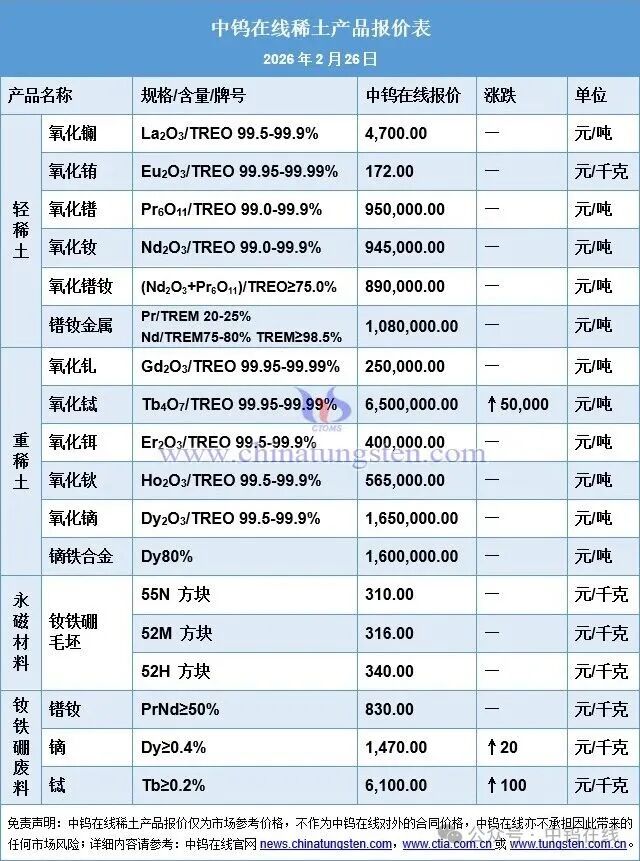
Core Insights - The rare earth market in China remains stable at high prices, with limited fluctuations due to low willingness from suppliers to lower prices and insufficient purchasing power from buyers [5][6] - Prices for key rare earth products have seen significant increases this year, with praseodymium oxide up approximately 54.22% and neodymium oxide up about 54.16% [2][6] - Global rare earth reserves are projected to decrease to around 85 million tons by the end of 2025, a reduction of 5.56% from 90 million tons in 2024 [2][6] Price Summary - Praseodymium oxide: 950,000 yuan/ton - Neodymium oxide: 945,000 yuan/ton - Praseodymium-neodymium metal: 1,080,000 yuan/ton - Dysprosium oxide: 1,650,000 yuan/ton, with a recent increase of 50,000 yuan [4][5] Market Dynamics - The overall demand for rare earth products is being suppressed by tight financial conditions among downstream production companies and a complex global economic situation [2][5] - The increase in prices for various rare earth products includes: - Praseodymium oxide: +54.22% - Neodymium oxide: +54.16% - Praseodymium-neodymium metal: +45.95% - Dysprosium oxide: +8.33% [2][6] Global Reserve Data - Global rare earth reserves are approximately 85 million tons, with China holding about 44 million tons, maintaining a 51.76% share of global reserves [2][6] - Brazil's reserves are around 21 million tons, accounting for 24.71% of the total, while Russia has reserves of 3.8 million tons [2][6]
战略金属-稀土钽钨-更新
2026-02-24 14:16
Summary of Strategic Metals (Rare Earth, Tantalum, Tungsten) Conference Call Industry Overview - The conference call focused on the strategic metals industry, specifically rare earth elements, tantalum, and tungsten, highlighting significant price movements and market dynamics in 2026 [1][2][3]. Key Points on Rare Earth Elements - **Price Surge**: The price of neodymium oxide futures has surpassed 920,000 yuan, with an increase of over 50%, mirroring trends from 2011 and 2021 [1][2]. - **Supply Constraints**: It is anticipated that rare earth monthly supply will decrease by 800 to 1,000 tons in the next three months, representing a year-on-year decline of approximately 10%. This is primarily due to state-owned enterprises not releasing quotas and private enterprises reducing or halting production [1][2]. - **Demand Growth**: There is an expectation for increased rare earth export demand, particularly with improving US-China relations. Domestic demand for new energy vehicles is also exceeding expectations, leading to increased orders from magnet manufacturers [1][2]. - **Inventory Levels**: Downstream magnet manufacturers are likely to begin restocking, as current inventory levels are low, which will further drive demand [1][2]. - **Price Forecast**: Rare earth prices are expected to exceed the historical high of 2021 in the first half of this year, with neodymium oxide prices potentially breaking 1,500,000 yuan per ton in Q2 if current policies remain unchanged [1][3]. - **Investment Recommendations**: Suggested companies for investment include Northern Rare Earth, Baotou Steel, China Rare Earth, and Chalco International, among others [1][3]. Key Points on Tantalum - **Price Increase**: Tantalum concentrate prices rose from $100 per pound at the beginning of January to $118-120 per pound by early February, with prices reaching around $142 during the Spring Festival. Some quotes even reached $150-160 per pound [1][4]. - **Market Dynamics**: The price increase is attributed to strong demand and the inability of mines in the Democratic Republic of Congo to resume production in the short term. This trend is expected to continue at least until April, with tantalum prices projected to exceed $200 per pound this year [1][4]. - **Investment Focus**: Companies to watch include Dongfang Zirconium, Xinjing Road, and Jiangte Electric, with Xinjing Road noted for having significant reserves in Guangxi [1][4]. Key Points on Tungsten - **Price Growth**: Tungsten prices increased by approximately 20% during the Spring Festival, driven by a moderate recovery in overseas tool demand and unexpected growth in military demand [1][5][6]. - **Supply Limitations**: Domestic supply is constrained due to insufficient quotas and strict enforcement against illegal mining, making large-scale production recovery unlikely before May [1][5][6]. - **Market Balance**: The market remains in a tight balance, and any marginal increase in demand, particularly from the tool industry, could lead to further price increases for tungsten concentrate [1][5][6]. - **Price Trends**: Tungsten concentrate prices have surged from 140,000 yuan to nearly 700,000 yuan, reflecting a fivefold increase since last year. This upward trend is expected to continue into Q2 [1][6]. - **Investment Recommendations**: Key companies for investment include Zhongtung High-tech, Xiamen Tungsten, and Zhangyuan Tungsten, which are expected to have significant upside potential [1][6].
稀土价格指数年内涨超30% 供需共振推动“工业黄金”涨价
Zheng Quan Ri Bao Wang· 2026-02-12 13:12
Group 1 - The core viewpoint of the news is that rare earth prices have surged significantly in early 2026, driven by supply-demand dynamics, with the rare earth price index rising by 33.64% from 217 on December 31, 2025, to 290 on February 12, 2026 [1] - The increase in rare earth prices is attributed to low inventory levels and strong market expectations, leading to preventive stocking behaviors among companies due to short-term production constraints [1] - Specific rare earth products have seen substantial price increases, with praseodymium oxide reaching 890,000 yuan/ton (up 43.55%), neodymium oxide at 880,000 yuan/ton (up 41.94%), and neodymium metal at 1,060,000 yuan/ton (up 39.47%) [1] Group 2 - Looking ahead, it is anticipated that as upstream companies resume operations, the supply-demand relationship may gradually improve, leading to a stabilization of prices with potential narrow fluctuations [2] - The long-term demand for rare earths is expected to grow due to the booming development of emerging industries such as electric vehicles, wind power, industrial motors, robotics, and drones [2] - The rare earth industry in China has entered a highly concentrated phase, with leading companies enhancing their core competitiveness through continuous technological innovation and industrial system development [2] Group 3 - China holds a dominant and irreplaceable position in the global rare earth industry chain, possessing advantages in resource reserves, extraction capabilities, and advanced refining and separation technologies [3] - The leading companies in China's rare earth sector are expected to further consolidate their market positions due to significant resource and cost advantages, as well as comprehensive industry chain layouts from extraction to high-end material manufacturing [3]


稀土、化工板块持续走强,稀土ETF易方达(159715)、化工行业ETF易方达(516570)聚焦板块龙头
Sou Hu Cai Jing· 2026-02-12 10:30
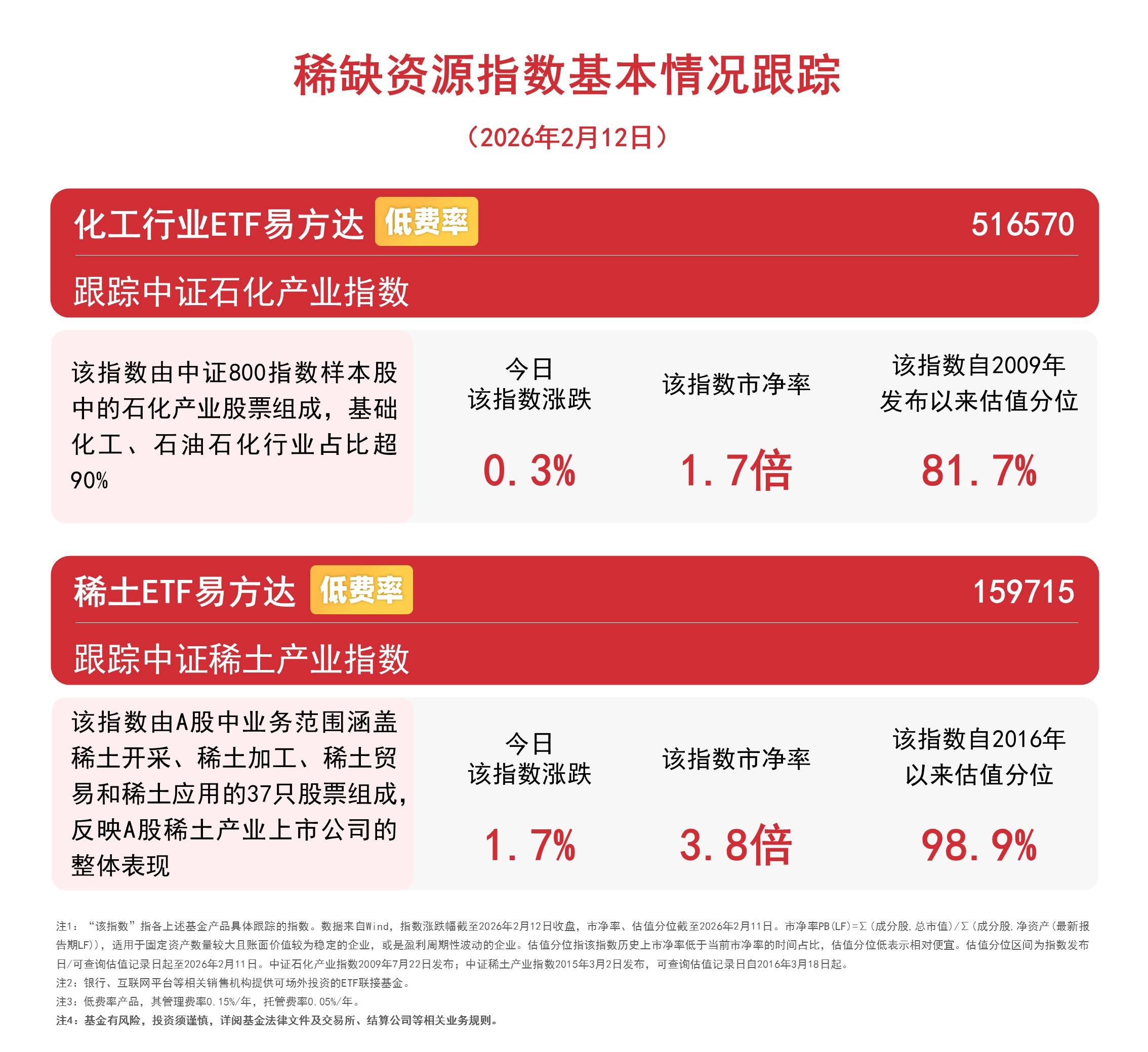
Group 1 - The core viewpoint of the articles indicates that the rare earth industry is experiencing a significant price increase, with the industry indices showing positive performance [1] - The China Rare Earth Industry Index rose by 1.7%, marking five consecutive days of gains, while the China Petrochemical Industry Index increased by 0.3%, continuing its upward trend from the previous day [1] - As of February 11, the average price of praseodymium oxide reached 877,000 yuan per ton, reflecting a year-to-date increase of 43.4%, while the average price of neodymium oxide was 870,000 yuan per ton, with a year-to-date increase of 42.6% [1] Group 2 - The cumulative price increases for praseodymium-neodymium oxide, metallic neodymium, and metallic praseodymium have all exceeded 35% this year [1] - The demand surge in emerging sectors such as robotics and new energy vehicles is expected to drive the rare earth industry into a new growth cycle [1]
金力永磁再涨超4% 开年来稀土价格持续上行 产业有望进入新一轮成长周期
Zhi Tong Cai Jing· 2026-02-12 06:26
Group 1 - The core viewpoint of the article highlights the significant increase in rare earth prices since the beginning of 2026, with specific price increases for various rare earth oxides [1] - As of February 11, the average price of praseodymium oxide reached 877,000 yuan per ton, an increase of over 260,000 yuan per ton this year, representing a growth of 43.42% [1] - The average price of neodymium oxide reached 870,000 yuan per ton, with a similar increase of 260,000 yuan per ton, reflecting a growth of 42.62% [1] Group 2 - The report from Guoyuan Securities suggests that the demand for rare earths in high-end manufacturing sectors, such as electric vehicles, wind power generation, and robotics, is continuously expanding [1] - The combination of technological advancements in the industry and government policies supporting resource management and industrial upgrades is expected to lead the rare earth permanent magnet industry into a new growth cycle [1]
港股异动 | 金力永磁(06680)再涨超4% 开年来稀土价格持续上行 产业有望进入新一轮成长周期
智通财经网· 2026-02-12 06:23
Core Viewpoint - The price of rare earth elements has been rising significantly since the beginning of 2026, positively impacting companies like Jinli Permanent Magnet (06680) which saw its stock price increase by over 4% [1] Industry Summary - As of February 11, the average price of praseodymium oxide reached 877,000 CNY per ton, an increase of over 260,000 CNY per ton this year, representing a growth of 43.42% [1] - The average price of neodymium oxide reached 870,000 CNY per ton, with a similar increase of 260,000 CNY per ton this year, reflecting a growth of 42.62% [1] - The cumulative price increase for praseodymium-neodymium oxide, metallic neodymium, and metallic praseodymium-neodymium has exceeded 35% this year [1] Company Summary - Jinli Permanent Magnet's stock price rose by 4.09% to 23.4 HKD, with a trading volume of 197 million HKD [1] - The company is positioned to benefit from the expanding applications of rare earth materials in high-end manufacturing sectors such as electric vehicles, wind power generation, and robotics [1] - Industry advancements and supportive national policies regarding resource management and industrial upgrades are expected to drive the rare earth permanent magnet industry into a new growth cycle [1]
稀土概念股普涨,盛和资源涨近6%
Ge Long Hui· 2026-02-12 02:37
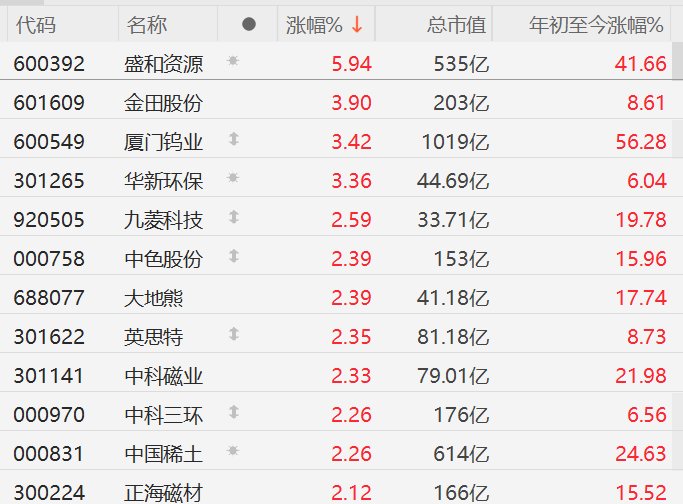
Core Viewpoint - The rare earth concept stocks in the A-share market experienced a significant increase, driven by rising prices of rare earth products, particularly praseodymium oxide and neodymium oxide, which have seen substantial price hikes this year [1][2]. Price Trends - As of February 11, the average price of praseodymium oxide reached 877,000 yuan per ton, with an increase of over 260,000 yuan per ton this year, representing a growth of 43.42% - The average price of neodymium oxide reached 870,000 yuan per ton, with a year-to-date increase of 260,000 yuan per ton, reflecting a growth of 42.62% - The cumulative price increase for praseodymium-neodymium, metallic neodymium, and metallic praseodymium has exceeded 35% this year [1]. Stock Performance - 盛和资源 (Shenghe Resources) saw a price increase of 5.94% with a total market value of 53.5 billion yuan and a year-to-date increase of 41.66% [2] - 金田股份 (Jintian Co.) increased by 3.90%, with a market value of 20.3 billion yuan and a year-to-date increase of 8.61% [2] - 厦门铝业 (Xiamen Tungsten) rose by 3.42%, with a market value of 101.9 billion yuan and a year-to-date increase of 56.28% [2] - 华新环保 (Hua Xin Environmental) increased by 3.36%, with a market value of 4.469 billion yuan and a year-to-date increase of 6.04% [2] - Other notable stocks include 九菱科技 (Jiuling Technology) with a 2.59% increase, 中色股份 (China Nonferrous) with a 2.39% increase, and 中国稀土 (China Rare Earth) with a 2.26% increase [2].