钕铁硼

Search documents
稀土-锡-战略矿产资源属性凸显-价格中枢有望稳步抬升
2026-03-06 02:02
Summary of Key Points from Conference Call Records Industry Overview Rare Earths and Tin - **Rare Earth Supply Constraints**: Starting in 2025, supply indicators will no longer be publicly disclosed, limiting actual growth after excluding imported ores. MP Resources will cease exports of rare earth concentrates to China in April 2025, and by August, China will stop importing from the U.S. [1][2] - **Price Outlook for Rare Earths**: Demand for praseodymium and neodymium oxide is expected to increase by 10%-20% in 2026, while supply will grow by less than 10%, potentially pushing prices back above 1 million yuan/ton [1][11]. - **Tin Supply Disruptions**: The shutdown in Myanmar's Wa region is projected to create a global shortfall of nearly 20,000 tons in 2025. Although there are expectations for resumption in 2026, the increase will be limited to about 20,000 tons, resulting in a shortfall of approximately 5,000 tons [1][12]. - **Indonesian Policy Risks**: Indonesia's tin quota for 2026 will only increase by 7,000 tons, primarily concentrated in state-owned enterprises. There are risks of expanding raw material export bans to tin products [1][17]. Core Insights and Arguments Rare Earths - **U.S. Strategic Importance**: Rare earths are critical for sectors like electric vehicles, consumer electronics, and military applications. The U.S. has limited smelting and separation capacity, prompting significant actions, including a strategic investment in MP Resources and establishing a sales floor price for praseodymium and neodymium [2][8]. - **Industry Structure**: The rare earth industry is characterized by a dual monopoly with two major groups: Northern Rare Earth and China Rare Earth Group. The upstream and midstream sectors account for over 80% of the industry's profits [3][4][7]. Tin - **Price Trends**: The average tin price in 2025 was 274,000 yuan/ton, a 10% increase from 2024. By March 5, 2026, the average price rose to approximately 397,000 yuan/ton, reflecting a 45% increase year-on-year [12][20]. - **Supply Chain Dynamics**: Tin's supply chain is relatively straightforward, with disruptions from Myanmar and Congo affecting global supply. The global tin resource reserves are projected to increase due to data corrections from Indonesia [13][14]. Additional Important Insights - **Future Supply Projections**: Significant new tin supply is expected mainly in 2024 and from 2027 to 2028, with limited new projects in the near term. The largest upcoming project is expected to contribute 10,000 tons of tin [19]. - **Demand Structure**: Tin demand is heavily driven by soldering applications, which account for 53% of total demand. The semiconductor industry significantly influences solder demand, which is expected to continue growing [20]. - **Supply-Demand Gap**: In 2025, the global tin supply-demand gap is expected to reach nearly 20,000 tons, with a projected narrowing to about 5,000 tons in 2026 as Myanmar resumes production [20]. This summary encapsulates the critical insights and projections regarding the rare earth and tin industries, highlighting supply constraints, price trends, and strategic importance in the global market.


供给趋紧需求爆发 小金属上演“大行情”
Zheng Quan Ri Bao· 2026-02-27 16:38
Group 1 - The small metals sector, known as the "industrial vitamin," has become a focal point for investment, with a significant increase in the small metals index by 7.69% and 12 listed companies reaching their price limits on February 27 [1] - The demand for small metals is rapidly growing due to the AI computing power, new energy, military, and robotics sectors, while supply constraints from domestic quotas and overseas production limits are exacerbating the supply-demand gap [1][2] - The strategic importance of small metals is being re-evaluated as they are classified as critical minerals by multiple countries, enhancing their pricing power and strategic value [1] Group 2 - In the AI and intelligent sectors, high-performance neodymium-iron-boron and high-end welding materials are crucial, with applications in AI servers, humanoid robots, and consumer electronics [2] - The supply of rare metals such as rare earths, tungsten, and lithium is tightening post-Chinese New Year, leading to an overall price increase in the market [2] - Investors are increasingly focused on raw material sources, capacity layout, and market applications, as the pricing logic of small metals shifts from traditional cyclical commodities to strategic assets [3] Group 3 - Companies are revealing their resource layout strategies to address investor concerns, with a focus on securing upstream resources to gain industry chain influence [3] - Dongfang Tantalum Industry has established a global procurement system for tantalum and niobium ore, securing a long-term partnership with reputable traders and completing a stake acquisition in a Brazilian mining company [3] - Xiamen Tungsten has three operational tungsten mines with an annual output of approximately 12,000 tons of tungsten concentrate, and plans to enhance raw material security through various initiatives [4]
金力永磁走高,稀土近段时间持续上涨,机构指政策驱动型涨价支撑坚实
Zhi Tong Cai Jing· 2026-02-27 02:57
Group 1 - Jilin Permanent Magnet (06680) has seen a stock price increase of over 6%, specifically 6.11%, reaching HKD 25.34, with a trading volume of HKD 154 million [1][2] - The recent rise in rare earth prices is attributed to supply and demand dynamics, with praseodymium and neodymium oxide averaging RMB 886,100 per ton, an increase of RMB 3,200 per ton, and metallic praseodymium and neodymium averaging RMB 1,081,000 per ton, an increase of RMB 11,500 per ton [2] - The China Minmetals Corporation has announced a conference on March 25, 2026, to discuss rare earth and rare metal export policies and market conditions [2] Group 2 - According to Guotou Securities, rare earths are critical strategic resources for new energy and high-end manufacturing, with a significant supply-demand mismatch currently observed in the industry [2] - Global rare earth separation and smelting capacity is highly concentrated in China, and domestic quota tightening has highlighted supply rigidity [2] - The expansion of downstream demand is driving an increase in the usage of neodymium-iron-boron, which in turn is pushing up the prices of praseodymium and neodymium oxides, supported by this round of policy-driven price increases [2]
国投证券:稀土供需格局重塑 价格中枢或上移
智通财经网· 2026-02-27 01:49
Core Viewpoint - The rare earth industry is experiencing a significant supply-demand mismatch, with supply rigidities highlighted by China's dominance in the separation and smelting capacity, while demand is expanding due to increased usage in high-end applications such as electric vehicles and wind power [1][2][3][4]. Supply Dominance - China holds an absolute dominant position in rare earth supply, with an expected 51% share of the global rare earth reserves exceeding 85 million tons by 2025. China's separation capacity is projected to account for nearly 90% of global capacity, with top-tier technology ensuring control over rare earth oxide production [2]. - The short-term overseas supply increase is unlikely to compensate for China's dominance, with core overseas supplier Lynas expected to produce only 8,000 tons of praseodymium-neodymium oxide by 2025 [2]. Policy Tightening - The rare earth industry is experiencing significant and ongoing policy tightening, with mining and smelting separation growth rates expected to drop to 12.5% and 10.43% respectively in 2024. The introduction of the "Interim Measures for the Total Control of Rare Earth Mining and Smelting Separation" in 2025 will include controls on overseas imported ore smelting quotas [3]. - The consolidation of the industry is progressing, with Northern Rare Earth and China Rare Earth Group controlling 100% of the national mining quotas by 2024, further compressing supply elasticity and supporting price increases [3]. Demand Expansion - Global demand for praseodymium-neodymium oxide is expected to grow at a rate of 8.39% year-on-year by 2026, driven primarily by the electric vehicle sector, which is projected to increase neodymium-iron-boron demand by 10% to 81,312 tons [4]. - Wind power installations are also contributing to demand growth, with a 6% increase in neodymium-iron-boron demand expected, reaching 40,666 tons. Other sectors such as industrial robots and energy-saving elevators are anticipated to see steady demand growth of 8% and 5% respectively [4]. Supply-Demand Mismatch - The supply-demand balance for praseodymium-neodymium oxide is expected to remain tight, with total supply projected at 116,500 tons and total demand at 111,300 tons in 2025, resulting in a supply-demand gap of only 5,229 tons. This gap is expected to widen to -5,393 tons by 2026 [5]. - The combination of domestic quota controls and slow overseas production increases will create rigidities in supply, while demand continues to expand in high-growth sectors, providing strong upward momentum for prices [5]. Investment Focus - Key investment targets in the rare earth sector include China Rare Earth, Shenghe Resources, Northern Rare Earth, Huahong Technology, and Baotou Steel. In the magnetic materials sector, notable companies include Jinchuan Group, Ningbo Yunsheng, Zhenghai Magnetic Materials, Galaxy Magnet, and Zhongke Sanhuan [5].
机器人需要的金属材料:一场静默的“金属革命”
Xin Lang Cai Jing· 2026-02-26 03:32
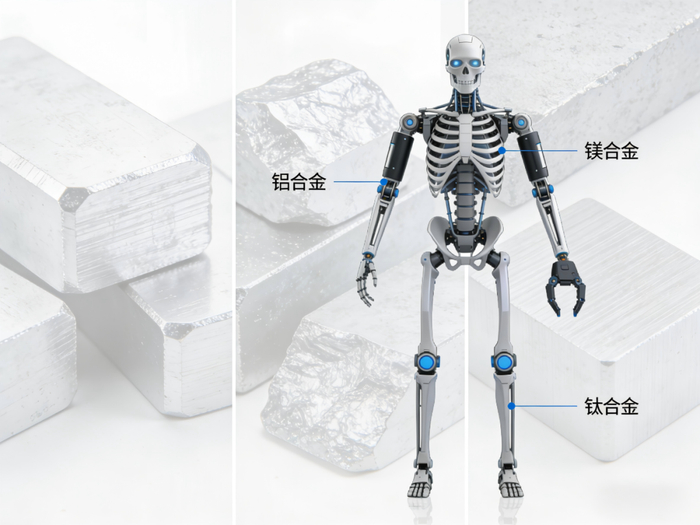
Group 1 - The core viewpoint of the article highlights a significant shift in metal demand driven by the rise of the robotics industry, which is reshaping the demand curve for various base metals [2] - The demand for lightweight metals such as aluminum, magnesium, and titanium is increasing due to the need for robots to be agile and precise, with aluminum alloy consumption exceeding 500,000 tons annually and growing at over 15% per year [2][4] - Magnesium alloys are emerging as a replacement for aluminum in applications requiring extreme lightweight properties, although they face challenges in corrosion resistance and processing difficulty [3] Group 2 - Neodymium-iron-boron magnets are essential for the robotics industry, with each industrial robot consuming 5-10 kg and humanoid robots consuming 2-3 kg, leading to an estimated demand increase of 100,000 tons by 2030 [5] - The production of neodymium-iron-boron requires significant amounts of rare earth metals, indicating that the robotics industry will drive a substantial increase in demand for rare earth oxides [5][6] - The addition of heavy rare earth elements like dysprosium and terbium is necessary to enhance the thermal stability of magnets used in high-performance robots, making dysprosium a critical and scarce resource [6] Group 3 - Copper is crucial for the internal wiring of robots, with industrial robots averaging 15-25 kg of copper and humanoid robots potentially exceeding 50 kg, necessitating high-performance copper alloys to meet durability requirements [8][9] - The market for high-strength, high-conductivity copper alloys is growing at a rate of 20% per year, posing challenges for upstream copper producers in terms of alloying and precision processing capabilities [9] - Silver is indispensable for electrical connections in robots, with an average consumption of 50-80 grams per industrial robot, leading to a significant increase in silver demand across the industry [10] Group 4 - The demand for precision transmission components in robots requires high-purity bearing steel and high-temperature alloys, with only a few companies capable of producing the necessary quality [12][13] - The rise of the robotics industry necessitates a shift in mining strategies, focusing on niche metals like dysprosium and terbium, which are becoming increasingly valuable due to their strategic importance [14][15] - The purity requirements for metals used in robotics are significantly higher than traditional industrial standards, demanding advanced purification technologies from upstream producers [15] Group 5 - The collaboration between upstream mining and downstream manufacturing is becoming critical, as high-end materials require precise management of raw materials during extraction [16] - The emergence of humanoid robots in factories and homes signals a new productivity revolution, with the raw materials for this revolution lying in previously overlooked mineral deposits [18] - Companies that can identify trends in metal demand and enhance their processing capabilities are positioned to benefit significantly from the anticipated "robotic dividend" over the next decade [18]


稀土地位悬了?澳方曾撬走中方人才,攻克提炼技术,但西方笑早了
Sou Hu Cai Jing· 2026-02-15 05:41
Core Viewpoint - The article emphasizes that despite attempts by companies like Lynas to challenge China's dominance in the rare earth industry, China's systematic advantages in geography, resources, technology, and the entire supply chain remain unassailable [3][5][30]. Industry Overview - China's rare earth industry is highly stable, with projections indicating that by 2025, it will account for 92% of global heavy rare earth separation capacity, 68% of light rare earth mining, and 90% of processing share [5][6]. - The European Union relies on China for 75% of its rare earth imports, while South Korea's dependence exceeds 80% [5]. Regulatory Environment - In April 2022, China implemented a licensing system for the export of the entire rare earth industry chain, effectively imposing strict controls on 90% of medium and heavy rare earths [6][8]. - In October 2022, China expanded its control to include 12 types of rare earths, requiring semiconductor users to report in advance, thereby solidifying its supply chain authority [8]. Lynas Developments - Lynas has attempted to enhance its production capabilities by hiring 12 key engineers from Chinese companies, each with salaries exceeding 2 million yuan, focusing on the core extraction of dysprosium [11][15]. - Despite announcing the production of its first batch of 99.9% pure dysprosium, Lynas's actual production fell short, with only 9 tons produced in the third quarter and a capacity utilization rate below 22% [11][13]. Competitive Landscape - China's heavy rare earth separation capacity is at least 12,000 tons annually, significantly outpacing Lynas, which can only produce a fraction of that amount [13][15]. - Lynas's product return rate has surged to 30%, indicating ongoing challenges in meeting quality standards [15]. Technological and Resource Advantages - China holds 36% of the world's rare earth reserves, primarily located in Jiangxi and Guangdong, which allows for low-cost and high-content extraction [17]. - Chinese companies have secured over 80% of the rare earth mining rights in Myanmar and Laos, creating a dual insurance system that mitigates risks from emerging mining areas [17][19]. Innovation and R&D - China invests 30 billion yuan annually in rare earth technology research and trains over 5,000 related professionals through more than 20 universities [21]. - New extraction agents developed by Chinese researchers have improved dysprosium purity to 99.99% and waste recovery rates to 98%, showcasing advancements in both environmental and cost efficiency [19]. Global Market Dynamics - The global demand for rare earths is rising, with prices experiencing moderate increases, yet the core pricing power remains firmly in China's hands [30]. - The attempts by Western nations to reduce reliance on China are seen as more symbolic than effective, with significant challenges in achieving self-sufficiency in the rare earth supply chain [30].

未知机构:国内唯一实现从外延片到芯片再到电源系统全产业链布-20260203
未知机构· 2026-02-03 01:45
Company and Industry Summary Company Overview - The company is the only private enterprise in China that has achieved a full industrial chain layout from epitaxial wafers to chips and power systems, holding over 80% market share in epitaxial wafers and 35% in the industry [1][1]. Key Technological Advancements - The company has mastered key technological breakthroughs, improving energy conversion efficiency compared to traditional solutions. It has achieved mass production and received 80 orders, with 29 orders already delivered. The first satellite verification was completed in August 2025 [1][1]. - The company is deeply involved with major institutions like Zhongxing and Zhongke, serving as the exclusive supplier for certain models, and is currently in the sample delivery phase with aerospace institutions [1][1]. Production Capacity and Expansion Plans - Zhongke Dianzhi owns 15 MOCVD production lines, with plans to expand to 40 lines. A new base is expected to be operational by August 2028, with an initial annual production capacity of 100 units and a long-term plan for 1,000 units [1][1]. Revenue Projections - If military orders are secured in 2026, the company expects to deliver 100 units, which will correspond to significant revenue. The sales revenue is projected to reach substantial levels in 2027, with power system revenue expected to surpass chip revenue by 2027-2028 [2][2]. Industry Dynamics - Mingyang Smart Energy has acquired 100% of Dehua's equity, gaining core space energy technology and forming a closed-loop technology route. Mingyang currently leads in domestic neodymium-iron-boron production with over 34% market share and plans to increase annual production capacity to 260 tons [3][3]. Market Position and Financial Performance - The company holds the top market share in offshore wind turbines, with a 8% increase in order volume in the first three quarters of 2025, outpacing industry growth. The gross margin for Q3 2025 is approaching breakeven, with expectations of a 3-5 percentage point increase in wind turbine gross margin due to low-price order deliveries and a reduction in self-research cost rates [4][4]. - The company plans to establish localized production bases overseas, with the UK base still ramping up. The first batch of offshore wind turbines is expected to be offline by the end of 2028, in collaboration with a strategic partner [4][4]. Financial Forecasts - The main business profit is expected to reach 2.4 billion in 2026, with a projected PE ratio of 15-20 times [5][5]. - Assuming the launch of 10,000 satellites, the gallium arsenide chip segment could yield a profit of 1.2 billion, with a corresponding PE ratio of 30 times. The total potential profit from the main business, satellite energy, and offshore wind export options could reach significant levels [6][6].

有料财经:2026年有色金属行业具有十倍股增长潜力的上市公司
Sou Hu Cai Jing· 2026-01-26 16:51
Core Viewpoint - The article discusses the potential for "ten-bagger" stocks in the A-share market, particularly within the non-ferrous metals industry, highlighting companies that may see significant price increases by 2026 [2][4]. Group 1: Characteristics of Ten-Bagger Stocks - Ten-bagger stocks are characterized by being small in market capitalization, low in price, fast-growing, and possessing strong capabilities [4]. - The focus is on lesser-known metals rather than traditional ones like copper, aluminum, zinc, lead, and tin [4]. Group 2: Key Areas of Investment - Rare earth permanent magnet materials, essential for electric vehicles and drones, are highlighted as strategic high-tech materials, with China controlling 90% of global processing capacity [6]. - Semiconductor target materials, including high-purity aluminum, titanium, and copper, are crucial for chip production, with a purity requirement of over 99.999% [8]. - Lithium battery recycling and new energy storage materials are emerging opportunities, especially with the anticipated influx of used electric vehicle batteries [8]. Group 3: Specific Companies with Potential - Guiyan Platinum Industry is noted for its hydrogen energy catalyst, with a projected profit growth of 50% by 2025 and a market cap of over 6 billion [10]. - Dongfang Tantalum Industry is recognized for its tantalum production, essential for 6G communication filters, with a projected profit doubling by 2025 and a PE ratio of 20 [12]. - Yunhai Metal specializes in magnesium-lithium alloys, crucial for lightweight electric aircraft, with a market cap under 5 billion and a projected profit increase of 65% by 2025 [12]. - Jiangfeng Electronics is a leading domestic supplier of high-purity metal targets, with a projected profit growth of over 80% by 2025 and a PE ratio of 22 [14]. Group 4: Market Dynamics and Trends - There is a strong demand for domestic materials from major tech manufacturers like Ningde Times and Huawei, indicating a shift towards local sourcing [17]. - Institutional investors are increasingly buying shares in Guiyan Platinum Industry, Dongfang Tantalum Industry, and Yunhai Metal, with net purchases exceeding 200 million [17]. - The article warns of potential price volatility in rare earths and other minor metals, suggesting caution in trading strategies [19]. Group 5: Investment Strategy - The article emphasizes the importance of identifying companies with a market cap below 8 billion, a PE ratio under 25, and profit growth exceeding 40% [21]. - The focus for 2026 is on sectors like chips, batteries, drones, and AI servers, rather than traditional metals [21].




黄金突破5000美元有色集体暴涨,是顶点还是起点?
Sou Hu Cai Jing· 2026-01-26 07:45
Group 1 - The Chinese real estate market is entering a new phase of "stabilization" as the government prioritizes market stability as an economic baseline, focusing on structural recovery rather than a broad market rebound [1][4] - The macroeconomic focus is shifting from investment-driven growth to consumption-driven growth, with policy benefits directed towards sectors like elderly care, AI efficiency, and real demand [1][6] - The rise of independent brand websites indicates that Chinese companies are striving to reduce reliance on platforms, marking a significant shift in the e-commerce landscape [1][22] Group 2 - The demand for rare metals is increasing due to the rapid development of technology sectors such as new energy vehicles and AI, while supply is constrained by declining ore grades and limited new mining projects [10] - The Chinese duty-free market is becoming increasingly significant, bolstered by policies like the Hainan closure, which enhances the market position of large enterprises and promotes industry upgrades [8] - The competitive landscape in the food delivery industry is evolving towards a duopoly, with Meituan and Alibaba dominating the market, while other players like JD maintain a niche presence [20]

特朗普向全球发出通牒:180天之内必须对中国动手,不帮忙就加税
Sou Hu Cai Jing· 2026-01-18 08:19
Core Viewpoint - The announcement by the U.S. regarding a presidential order for global rare earth suppliers to reach supply agreements within 180 days reflects a strategic move to counter China's dominance in the rare earth sector, highlighting the urgency and political motivations behind this initiative [1][25]. Group 1: U.S. Policy and Actions - The U.S. has set a deadline of July 13 for global rare earth suppliers to comply with new supply agreements, threatening high tariffs and quotas for non-compliance [1]. - Trump's administration is leveraging executive orders and tariff threats to compel not only China but also U.S. allies to participate in establishing alternative supply chains for rare earths [5][18]. - The U.S. plans to set a price floor for Chinese rare earth products to enhance the competitiveness of domestic companies, with a price target of $110 per kilogram for neodymium-iron-boron, compared to China's $63 [10][12]. Group 2: Challenges and Limitations - Despite efforts to collaborate with countries like Australia, Malaysia, and Cambodia, these nations lack the necessary technology and infrastructure to significantly contribute to the rare earth supply chain in the short term [8][14]. - The U.S. faces a significant challenge in rebuilding its rare earth industry, requiring an estimated investment of $10 to $15 billion and a timeline of at least 10 years, while the current political deadline is only 180 days [16]. - Many countries are hesitant to fully align with U.S. policies due to the potential increase in manufacturing costs and their reliance on Chinese rare earths, leading to a lack of genuine support for U.S. initiatives [12][18]. Group 3: Global Dynamics and Reactions - The geopolitical landscape is shifting, with countries like Russia expressing support for China, thereby strengthening China's position in the rare earth market [21]. - The U.S. has been accused of attempting to bypass Chinese controls through illicit means, which has further solidified China's grip on the rare earth supply chain [20]. - The overall sentiment among U.S. allies is one of caution, as they recognize the risks associated with U.S. policies that could disrupt their own manufacturing capabilities [18][23].