稀土多元化供应

Search documents
80%稀土都从中国进口?现在欧美却打算独立开采,到底怎么回事?
Sou Hu Cai Jing· 2025-11-22 08:35
Core Insights - The high import ratio of rare earth elements (REE) in Western countries is due to China's dominance in the separation and purification processes, which account for over 90% of global capacity [2][8] - Despite efforts over the past decade to diversify supply chains, Western countries remain heavily reliant on China for rare earth materials, with significant progress still needed to achieve independence by 2030 [10][18] Group 1: Historical Context - In 2010, a diplomatic incident between China and Japan led to a temporary halt in rare earth exports from China, causing prices to surge dramatically, highlighting the vulnerability of Japan's reliance on Chinese supplies [4][6] - Following the incident, Japan and the U.S. took steps to diversify their rare earth sources, with Japan utilizing its national reserves and the U.S. evaluating the reopening of domestic mines [4][6] Group 2: Current Production and Capacity - As of 2024, global rare earth mine production is projected to reach 390,000 tons, with China contributing 270,000 tons, representing 69% of total production [8][14] - The U.S. is expected to produce approximately 45,000 tons from the Mountain Pass mine in 2024, which would account for over 10% of global production [6][10] Group 3: Future Demand and Supply Challenges - The demand for rare earth elements is expected to grow significantly, with electric vehicles requiring 1-2 kg of REE each and wind turbines needing 200 kg per megawatt [10][12] - By 2030, the demand for rare earth materials in magnets could potentially double, further straining supply chains [10][12] Group 4: Regulatory and Environmental Factors - Western countries face challenges in reopening and operating rare earth mines due to stringent environmental regulations and community opposition, which have slowed progress [6][8] - The U.S. and EU are investing heavily in domestic production and recycling initiatives, but current recovery rates remain low, insufficient to meet future demands [12][14] Group 5: Strategic Partnerships and Future Outlook - Companies in the U.S. and Europe are forming partnerships to secure rare earth supplies while simultaneously working to establish their own production capabilities [16][20] - Despite the slow progress, the long-term goal remains to reduce dependency on Chinese imports, although achieving complete independence may take another decade [18][20]


日本首次从中国以外的渠道进口稀土
Sou Hu Cai Jing· 2025-11-02 01:45
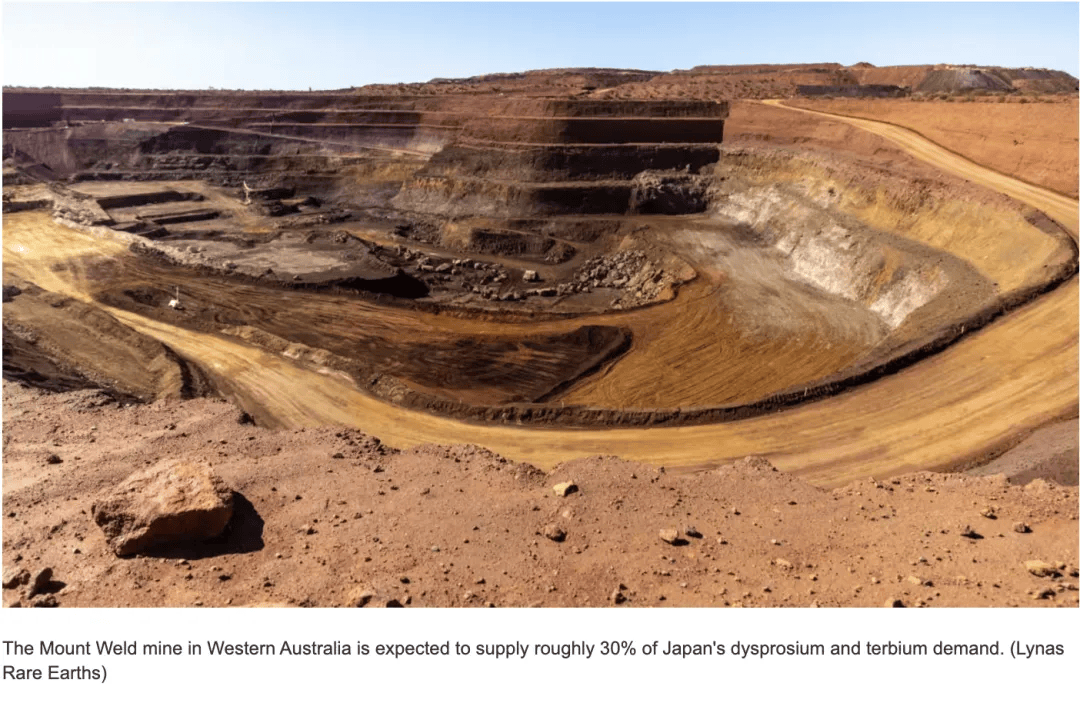
Group 1 - Sojitz Corporation has begun importing dysprosium and terbium from the Mount Weld mine in Australia, with the materials processed in Malaysia before being shipped to Japan [2] - Lynas Rare Earths, the operator of the Mount Weld mine, received an investment of 200 million AUD (approximately 930 million RMB) from a joint venture established by Sojitz and the Japan Organization for Metals and Energy Security (JOGMEC) in 2023 [2] - Lynas will supply Japan with up to 65% of the mine's dysprosium and terbium output, which corresponds to about 30% of Japan's market demand [2] Group 2 - Dysprosium and terbium are classified as heavy rare earth elements, which are less abundant than light rare earths and are primarily used in manufacturing high-performance neodymium magnets for electric vehicles and wind turbine motors [3] - Japan views diversifying supply sources outside of China as a key aspect of economic security, as China currently accounts for nearly 70% of global rare earth production, with almost all heavy rare earth supply coming from China [3] - However, cost remains a significant barrier, as sourcing materials from Australia and the U.S. for processing in Southeast Asia will lead to higher costs compared to direct imports from China [3] Group 3 - The Chinese Ministry of Commerce has implemented export controls on rare earth-related technologies to safeguard national security and interests, requiring licenses for the export of specific technologies related to rare earth mining, refining, and manufacturing [4][5] - The announcement specifies that any export of controlled items without permission is prohibited, and exporters must apply for licenses to provide any assistance related to rare earth activities outside of China [6][8]