端侧人工智能芯片

Search documents
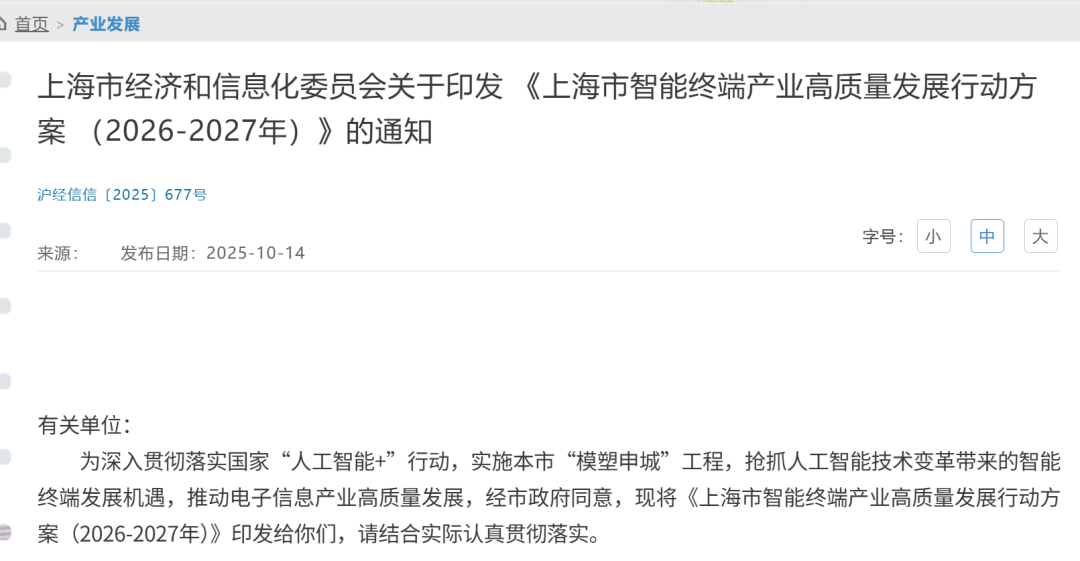
放大招!上海AI终端政策落地
Guo Ji Jin Rong Bao· 2025-10-15 11:16
Core Insights - Shanghai aims to strengthen its smart terminal industry, targeting a total scale exceeding 300 billion yuan by 2027, with the goal of establishing over three globally influential consumer terminal brands and nurturing two leading enterprises [1] Group 1: Smart Terminal Development - The action plan includes ten initiatives focusing on artificial intelligence computers, AI smartphones, robotic terminal capabilities, smart glasses, and satellite internet terminal products [2][3] - Shanghai plans to cultivate leading brands in AI computers and establish production bases with an annual capacity of ten million units, transitioning traditional computer production to AI computers [2] - The initiative emphasizes the development of AI smartphones to fill existing gaps in Shanghai's smartphone production capabilities [3] Group 2: Robotics and Smart Glasses - The plan aims to create humanoid robots with advanced capabilities, supporting R&D and mass production of these products while enhancing the industrial robot sector [3] - Shanghai will accelerate the development of smart glasses, focusing on AR, MR, and VR technologies, and aims to establish a complete product matrix for various market segments [3] Group 3: Satellite Internet and Elderly Care - The action plan includes the establishment of a satellite terminal production line, targeting a production scale of 100,000 units and fostering the development of supporting industries [4] - Shanghai will support the development of innovative products for the elderly, such as AI hearing aids and smart assistive devices, enhancing the functionality of smart terminals [4] Group 4: Industrial Applications - The plan encourages the development of industrial terminal products that align with advanced AI technology trends, aiming to transform production models and improve efficiency in smart factories [5] Group 5: Key Technology Development - The action plan outlines five initiatives to strengthen key technologies, including enhancing AI chip layouts and promoting next-generation display technologies [6][7] - Shanghai will focus on lightweight, low-power, high-resolution display technologies, supporting innovations in Micro LED and OLED technologies [7] Group 6: Industry Ecosystem Optimization - The plan proposes five measures to optimize the industry ecosystem, including financial support for key components and services related to smart terminals [8] - Shanghai will leverage various funding mechanisms to support terminal enterprises and encourage mergers and acquisitions in the sector [8] Group 7: Application Promotion - The initiative will support the integration of smart terminal products in various sectors such as industry, education, and healthcare, promoting innovative applications [9] - Shanghai aims to develop key areas like Pudong and Songjiang into industrial clusters for smart terminals, fostering competitive enterprises and innovation [9]

刚刚,利好来了!上海,重磅发布!
Zheng Quan Shi Bao Wang· 2025-10-14 11:45
Core Viewpoint - Shanghai's government has released the "Action Plan for High-Quality Development of the Intelligent Terminal Industry (2026-2027)", aiming to strengthen the intelligent terminal industry, targeting a scale exceeding 300 billion yuan by 2027 and fostering globally influential consumer terminal brands [1][2]. Group 1: Industry Development Goals - The plan aims for the intelligent terminal industry in Shanghai to exceed 300 billion yuan by 2027, with the establishment of over three globally influential consumer terminal brands and two leading enterprises [1][2]. - It targets the production of over 10 million units each for AI computers, AI smartphones, and AI new terminals [1][2]. Group 2: Key Product Development Initiatives - The plan emphasizes the acceleration of AI computer development, aiming to create a leading brand and a production base with an annual capacity of 10 million units [2][3]. - It includes the enhancement of intelligent computing terminal scales and the development of edge computing integrated machines to support various industries [2][3]. Group 3: Technological Advancements - The plan outlines the need to strengthen the layout of edge AI chips, focusing on core chips like SoC and CPU across major technology routes such as X86, ARM, and RISC-V [4][5]. - It promotes the development of multi-modal perception capabilities and the integration of various sensor data to enhance traditional terminal products' intelligence [5]. Group 4: Industrial Ecosystem Optimization - The plan highlights the importance of financial support for the industry, encouraging investment funds to back Shanghai's terminal enterprises and promoting mergers and acquisitions among quality firms [5]. - It aims to create industrial clusters by enhancing collaboration between districts and fostering competitive enterprises within the intelligent terminal supply chain [5].
昨天亏 今天亏 明天可能接着亏
Datayes· 2025-10-14 11:39
Core Viewpoint - The article discusses the recent fluctuations in the A-share market, highlighting the impact of escalating trade tensions between China and the United States, which have led to significant market declines and sector-specific movements [1][3][4]. Market Overview - On October 14, A-shares experienced a collective decline, with the Shanghai Composite Index falling by 0.62%, the Shenzhen Component by 2.54%, and the ChiNext Index by 3.99%. The total trading volume reached 25,969.16 billion yuan, an increase of 2,223.71 billion yuan from the previous day [7]. - Over 3,500 stocks in the market declined, while 45 stocks hit the daily limit up [7]. Sector Performance - Technology stocks weakened across the board, with the semiconductor sector showing a high opening but closing lower. The non-ferrous metals sector saw a significant drop in the afternoon [7]. - Conversely, the diamond cultivation sector surged due to ongoing trade tensions, with stocks like Power Diamond hitting the daily limit up [7]. - The port and shipping sector saw gains, with stocks like Nanjing Port hitting the daily limit up, following the announcement of an investigation into the shipping and shipbuilding industries by the Ministry of Transport [7]. Trade Relations and Economic Impact - The article notes that the U.S. will begin imposing additional port fees on shipping companies, affecting a wide range of goods, which positions maritime shipping as a critical battleground in the trade war between the two largest economies [5]. - The Chinese Ministry of Commerce responded to U.S. trade representatives, emphasizing the importance of maintaining communication while rejecting threats of new restrictions [3][5]. Investment Insights - UBS highlighted the high uncertainty surrounding the short-term trajectory of U.S.-China relations, viewing the potential for a 100% additional tariff on Chinese goods as a downside risk scenario. The firm maintains a baseline GDP growth forecast of approximately 4.7% for China in 2025 [6]. - The article also mentions that the solar photovoltaic equipment sector is expected to see a significant increase in prices due to production capacity restrictions, with a report indicating that existing capacity utilization will be limited to 65% [7]. Capital Flow and Market Sentiment - The article indicates a net outflow of 945.57 billion yuan from major funds, with the electronics sector experiencing the largest outflow, particularly from stocks like SMIC [19]. - Conversely, sectors such as banking, coal, and food and beverage saw net inflows, indicating a shift in investor sentiment towards more stable sectors amid market volatility [19]. Company Performance Highlights - Several companies reported significant profit increases, including: - RichChip Microelectronics projected a net profit increase of 116%-127% year-on-year for the first three quarters [15]. - Shenghe Resources expects a net profit of 740 million to 820 million yuan for the same period, marking a year-on-year increase of 696.82%-782.96% [15]. - Xinda Co. anticipates a net profit of 180 million to 205 million yuan, reflecting a growth of 2807.87%-3211.74% [15]. Conclusion - The article encapsulates the current state of the A-share market, emphasizing the influence of geopolitical tensions on market dynamics and sector performance, while also highlighting specific companies that are poised for significant growth amidst the volatility [1][3][5][7].

刚刚,利好来了!上海,重磅发布!
券商中国· 2025-10-14 11:29
Core Viewpoint - Shanghai's government has released the "Action Plan for High-Quality Development of the Intelligent Terminal Industry (2026-2027)", aiming to strengthen the intelligent terminal industry with a target scale exceeding 300 billion yuan by 2027, and to cultivate globally influential consumer terminal brands and leading enterprises [1][2]. Group 1: Key Actions for Terminal Core Products - The plan emphasizes the development of artificial intelligence computers, aiming to establish a production base with an annual capacity of 10 million units and to transform traditional computer production towards AI computers [1][2]. - It aims to enhance the scale of intelligent computing terminals, including the development of edge computing integrated machines and AI-enabled solutions for various industries [2][4]. Group 2: Key Technology Foundations - The plan outlines five specific measures, including strengthening the layout of edge AI chips and improving model performance for terminal products [4][5]. - It supports the development of core chips like SoC and CPU across major technology routes (X86, ARM, RISC-V) and promotes the advancement of edge GPU chips [4][5]. Group 3: Industrial Ecosystem Optimization - The plan highlights the need for increased financial support for the industry through investment funds and encourages state-owned enterprises to participate in the development of the intelligent terminal industry [6]. - It aims to create industrial clusters by enhancing collaboration between districts and fostering competitive enterprises within the intelligent terminal supply chain [6].
利好来了!上海市智能终端产业高质量发展行动方案发布
Zhong Guo Ji Jin Bao· 2025-10-14 11:13
Core Insights - Shanghai's Economic and Information Technology Commission has released the "Shanghai Intelligent Terminal Industry High-Quality Development Action Plan (2026-2027)" aiming to enhance the city's intelligent terminal industry and brand recognition by 2027, targeting an overall scale exceeding 300 billion yuan and the establishment of three globally influential consumer terminal brands [20]. Group 1: Key Product Development Actions - Accelerate the development of artificial intelligence computers, aiming to establish a production base with an annual capacity of 10 million units and support the transition of traditional computers to AI computers [21]. - Develop artificial intelligence smartphone products to fill existing gaps in production capacity and enhance interaction methods through AI integration [21]. - Enhance the scale of intelligent computing terminals by promoting edge computing solutions and developing lightweight inference machines [21]. Group 2: Robotics and Smart Devices - Strengthen capabilities in humanoid robots, focusing on emotional intelligence and skills, while supporting the development of core components for mass production [22]. - Promote the advancement of smart glasses across AR, MR, and VR categories, creating a comprehensive product matrix for various market segments [22]. Group 3: Satellite and Elderly Care Technologies - Cultivate satellite internet terminal products to meet deployment needs of low-orbit satellite constellations, aiming for a production scale of 100,000 units [23]. - Stimulate the silver economy by supporting the development of AI-powered assistive devices for the elderly, enhancing their functionality and accessibility [23]. Group 4: Industrial and Future Technologies - Support the development of industrial terminal products that align with advanced AI technology trends, facilitating smart factory transformations [24]. - Accelerate research in next-generation technologies such as mobile communication, quantum computing, and photonic computing [24]. Group 5: Key Technology Foundations - Strengthen the layout of AI chips for various terminal products, focusing on SoC and CPU developments across major technology routes [25]. - Enhance the performance of edge models for intelligent terminals, ensuring competitive capabilities in various application scenarios [25]. Group 6: Industry Ecosystem Optimization - Improve the competitiveness of Shanghai's intelligent terminal brands through targeted policies and support for brand operations [28]. - Accelerate the formation of industrial clusters by fostering collaboration among key districts and promoting the development of competitive enterprises [29].