
人工智能手机

Search documents
十五五规划纲要出炉 | 金融企业如何跨越“数据+AI”的转型鸿沟?
AI前线· 2026-03-19 05:44
Core Viewpoint - The article emphasizes the importance of digital and intelligent transformation in the financial industry as outlined in the 14th Five-Year Plan, highlighting the shift towards an era where artificial intelligence (AI) becomes the core system driving key financial processes such as risk control, investment research, and marketing [1]. Group 1: AI-Driven Scientific and Technological Development - Accelerate the exploration of AI-driven new research paradigms and technology development models, promoting the application of large scientific models and building intelligent research platforms [3]. - Strengthen the collaboration between AI and fields such as quantum technology, life sciences, new materials, new energy, and 6G [3]. Group 2: AI in Industry Development - Promote the application of AI across all stages of industrial design, production, and operations, particularly in energy systems and logistics [3]. - Encourage the widespread use of intelligent terminals and agents in service sectors like biological breeding and logistics [3]. Group 3: AI for Consumer Quality Improvement - Develop efficiency-enhancing and companion-type intelligent applications, including new generations of AI smartphones and computers [3]. - Explore new forms of intelligent products and expand intelligent service consumption scenarios [3]. Group 4: AI for Public Welfare - Innovate teaching models with intelligent companions and teachers, enhancing personalized learning and smart tutoring applications [3]. - Promote high-level health assistants and expand the application of intelligent diagnostic aids in grassroots medical institutions [3]. Group 5: AI in Governance - Enhance the application of AI in comprehensive market regulation, safety production supervision, disaster prevention, and ecological protection [4]. - Explore the construction of a collaborative safety governance system involving natural persons, digital entities, and intelligent robots [4]. Group 6: Global Cooperation in AI - Promote the establishment of a global AI cooperation organization and a multilateral cooperation platform for AI along the Belt and Road [4]. - Accelerate the development of a globally open open-source technology system and community ecology [4]. Group 7: Infrastructure for AI Development - The plan emphasizes the need for a robust foundation for financial digitalization, focusing on the efficient supply of computing power, algorithms, and data [5]. - Propose the construction of a market-oriented operation for computing power facilities to meet demand through various innovative methods [5]. Group 8: Talent and Skills Gap - The financial sector faces challenges in transforming due to gaps in understanding and skills among management regarding new concepts like intelligent economy and trustworthy data spaces [15]. - The lack of composite talents who understand both financial business logic and AI engineering is a significant bottleneck for transformation [15]. Group 9: Challenges in Scene Implementation - Despite encouragement for new intelligent models, the practical application of AI in complex tasks remains challenging, requiring organizational process reengineering [16]. - Many institutions struggle to utilize advanced computing power and services due to a lack of skilled personnel, leading to underutilization of technology [16]. Group 10: Strategic Mission for Financial Sector - The financial industry is tasked with a new strategic mission to develop technology finance, green finance, inclusive finance, and digital finance, aligning with technological innovation [14]. - The plan emphasizes the need for a financial system that adapts to technological innovation [14].


中国银河证券:从“人工智能+”到“智能经济”,2026年政府工作报告科技创新工作解读
智通财经网· 2026-03-07 04:14
Core Insights - The 2026 government work report emphasizes the strategic task of increasing the value added of the digital economy's core industries to 12.5% of GDP, indicating a systematic policy shift towards the digital economy as a growth engine and stabilizer for the national economy [1][21] - The report introduces the concept of "intelligent economy," elevating artificial intelligence from a mere tool to a core economic form, signifying a shift in its impact on economic operations [1][22] Summary by Sections 1. Policy Evolution - The evolution of technology innovation policies since the 14th Five-Year Plan shows a clear path: initial focus on foundational infrastructure (2021-2022), followed by integration of digital technologies with traditional industries (2023-2024), and culminating in the emergence of an "intelligent economy" (2025-2026) [2][11][12] 2. Key Tasks in the 2026 Government Work Report - The report outlines ten key tasks, with a focus on nurturing new driving forces and accelerating high-level technological self-reliance, maintaining consistency with previous reports [17] - The goal of increasing the digital economy's core industries' value added to 12.5% of GDP is set, with an expected annual increase of 0.4 percentage points [21] - The transition from digitalization to an intelligent economy is highlighted, emphasizing AI as a core driver for new industries and business models [22][23] 3. Investment Opportunities in 2026 - Six major investment opportunities are identified, including AI smart terminals, computing power infrastructure, industrial digitalization, AI large models, data elements and security, and satellite internet [4][49] - The AI smart terminal market is expected to grow significantly, supported by government initiatives and consumer demand [50] - The computing power infrastructure sector is positioned as a core focus, with investments in hardware, operations, and green solutions [51] - Industrial digitalization is set to receive substantial support, with a focus on software, internet platforms, and intelligent manufacturing [52] - The AI large model sector is anticipated to see commercialization and scaling in various industries [53] - The data element market is highlighted for its potential in creating high-quality datasets and enhancing data security [54] - The satellite internet sector is recognized as a key area for investment, with a focus on manufacturing, ground equipment, and operational applications [55]

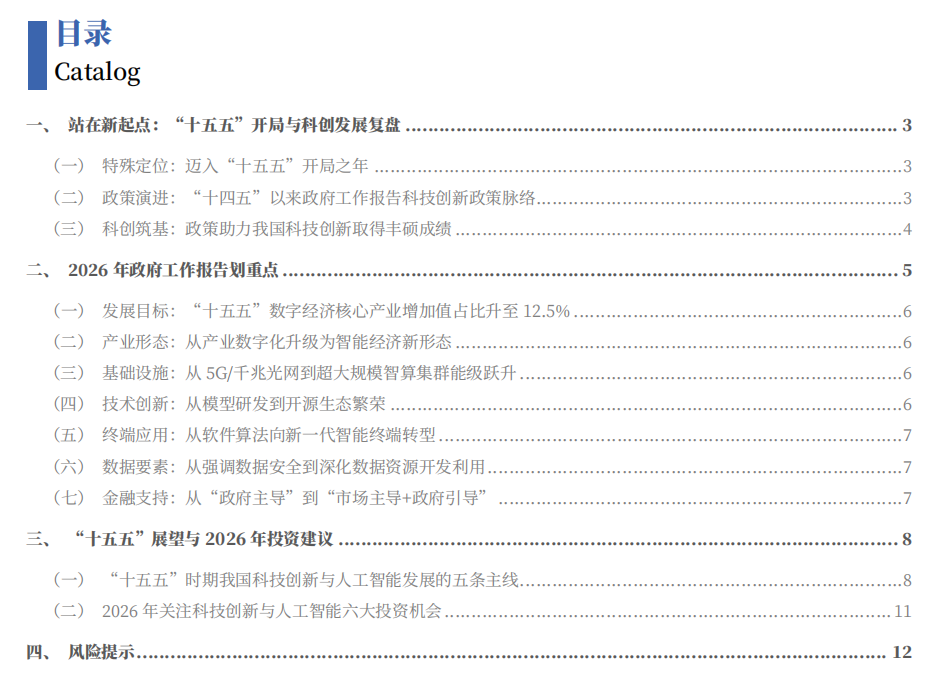
2026年政府工作报告科技创新工作解读:从“人工智能+”到“智能经济”
Yin He Zheng Quan· 2026-03-06 09:25
Group 1: Key Economic Goals - The core value added of the digital economy is targeted to reach 12.5% of GDP by 2026, up from 10.5% at the end of the 14th Five-Year Plan[10] - The digital economy's core industry value added increased from 7.8% at the end of 2020 to 10.5% by the end of 2025, achieving an average annual increase of 0.54 percentage points[25] - The government aims for an average annual increase of 0.4 percentage points in the digital economy's GDP share during the 15th Five-Year Plan[25] Group 2: Strategic Shifts in Technology and Infrastructure - The government report introduces the concept of "intelligent economy," positioning AI as a core driver for new industries and business models[26] - Infrastructure focus has shifted from 5G coverage to large-scale intelligent computing clusters and energy-efficient computing solutions[28] - The policy emphasizes the transition from model development to a thriving open-source ecosystem, aiming to lower technological barriers[29] Group 3: Investment Opportunities - Six key investment areas identified for 2026 include AI smart terminals, computing infrastructure, industrial digitalization, AI large models, data elements, and satellite internet[52] - The government plans to support the promotion of new generation smart terminals with a special bond issuance of 250 billion yuan for consumer electronics upgrades[53] - The industrial digital transformation is set to receive significant funding, with 200 billion yuan allocated for large-scale equipment updates[55]
万亿级“国家队”投资方向,明确了
3 6 Ke· 2026-01-13 08:27
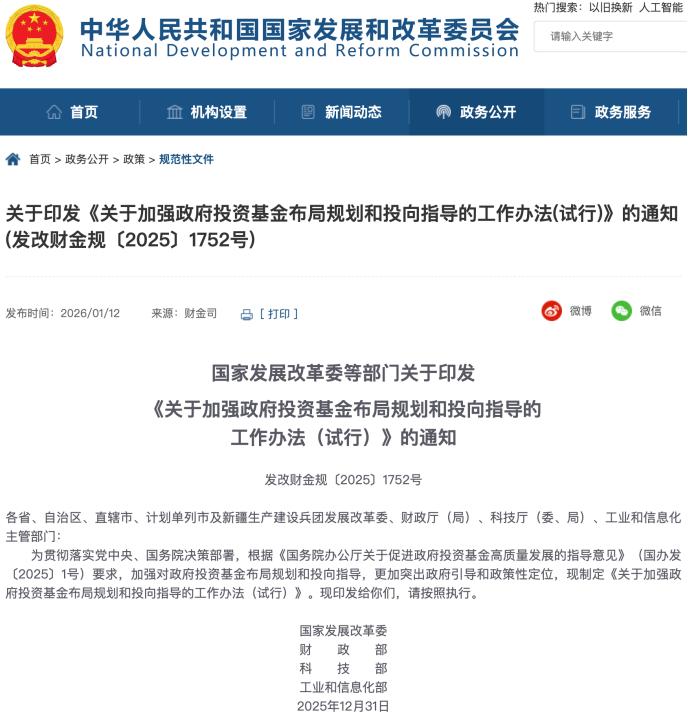
Core Viewpoint - The article discusses the newly released "Work Method" which systematically regulates the layout and investment direction of government investment funds for the first time at the national level, aiming to guide the development of trillion-level government investment funds in China [1][7]. Group 1: Policy Measures - The "Work Method" proposes 14 policy measures focusing on three aspects: where to invest, how to invest, and who manages the funds [2][3]. - It emphasizes optimizing fund allocation to support major strategies, key areas, and weak links in resource allocation, promoting deep integration of technological and industrial innovation, and nurturing emerging pillar industries [2]. Group 2: Investment Guidance - Funds must align with national major plans and encourage industries listed in the national industrial directory, avoiding investments in restricted, eliminated, or prohibited sectors [3]. - Provincial development and reform departments are tasked with creating local priority investment lists to optimize fund allocation and direction [3]. Group 3: Evaluation Indicators - The "Management Method" establishes three primary and thirteen secondary indicators for evaluating fund performance, with a focus on policy compliance (60% weight), optimization of productivity layout (30% weight), and policy execution capability (10% weight) [4][6]. - The evaluation will consider whether fund investments support the development of new productive forces, including emerging and future industries such as AI, quantum information, and advanced manufacturing [4][5]. Group 4: Regional Strategy Alignment - The evaluation also assesses the alignment of fund investments with national regional strategies, including support for various regional development initiatives like the Western Development and Northeast Revitalization [6]. - Funds that meet these regional strategy requirements will receive higher evaluation scores [6]. Group 5: Differentiated Development - The National Development and Reform Commission highlights the need for differentiated development of government investment funds, addressing issues like mismatched local resources and homogeneous investment directions [7][8]. - National funds are to focus on supporting the construction of a modern industrial system and overcoming key technological challenges, while local funds should align with local industry foundations and development realities [8].
利好来了!刚刚,四部门联合发布!
天天基金网· 2026-01-12 08:30
Core Viewpoint - The article discusses the release of a significant document by four government departments aimed at strengthening the planning and guidance of government investment funds, focusing on supporting emerging and future industries [2][4]. Group 1: Government Investment Fund Guidelines - The document titled "Work Method" outlines a systematic approach to the layout and investment direction of government investment funds for the first time at the national level [4]. - It emphasizes the need for funds to support major strategies and key areas, particularly in sectors where market resource allocation is weak, promoting deep integration of technological and industrial innovation [7]. - The guidelines specify that funds should align with national major plans and encourage investment in emerging industries such as new generation information technology, renewable energy, and high-end equipment [7][10]. Group 2: Investment Focus Areas - The investment focus includes nurturing emerging industries and future industries, with specific sectors identified such as artificial intelligence, quantum information, and bio-manufacturing [10][11]. - Traditional industry upgrades and digital economy development are also highlighted, with initiatives like "Artificial Intelligence+" and the promotion of smart manufacturing [11][12]. - The guidelines require local funds to choose investment directions based on regional industrial foundations and development realities, supporting industrial upgrades and innovation capabilities [8][10]. Group 3: Evaluation and Management - The "Management Method" establishes a comprehensive evaluation system for fund direction, combining quantitative and qualitative assessments [8][10]. - It includes three primary indicators: policy compliance (60% weight), optimization of productivity layout (30% weight), and policy execution capability (10% weight) [10][12]. - The evaluation aims to ensure that funds effectively support national development goals and adhere to regional strategic initiatives [12].

利好来了,“国家队”投向明确,四部门联合发布
Zheng Quan Shi Bao· 2026-01-12 06:56
Core Viewpoint - The National Development and Reform Commission and three other departments have jointly issued guidelines to strengthen the planning and investment direction of government investment funds, marking the first systematic regulation at the national level regarding the layout and investment focus of these funds [3][6]. Group 1: Investment Focus and Areas - The guidelines emphasize that investment funds should support the development of new productive forces, focusing on emerging industries such as new generation information technology, new energy, new materials, high-end equipment, new energy vehicles, green environmental protection, civil aviation, and marine engineering equipment [6][9]. - Future industries highlighted include the metaverse, brain-computer interfaces, quantum information, humanoid robots, generative artificial intelligence, biomanufacturing, biological breeding, future displays, future networks, and new energy storage [9][10]. Group 2: Policy Measures and Implementation - The guidelines propose 14 policy measures focusing on three main aspects: where to invest, how to invest, and who manages the funds [6][7]. - It requires funds to support major strategies and key areas, addressing weak links in resource allocation, and promoting deep integration of technological and industrial innovation [6][7]. - Local funds are instructed to align their investment directions with local industrial foundations and development realities, supporting industrial upgrades and the incubation of small and medium-sized enterprises [7][10]. Group 3: Evaluation and Management - The newly established evaluation management method includes three primary indicators: policy compliance (60% weight), optimization of productive force layout (30% weight), and policy execution capability (10% weight) [9][12]. - The policy compliance indicator assesses the fund's role in supporting new productive forces, technological innovation, and green development, among other areas [9][12]. - The optimization of productive force layout indicator evaluates the fund's alignment with national regional strategies and effective utilization of production capacity [12].
工信部发声,建议探索推进智能体互联网建设
2 1 Shi Ji Jing Ji Bao Dao· 2026-01-07 14:06
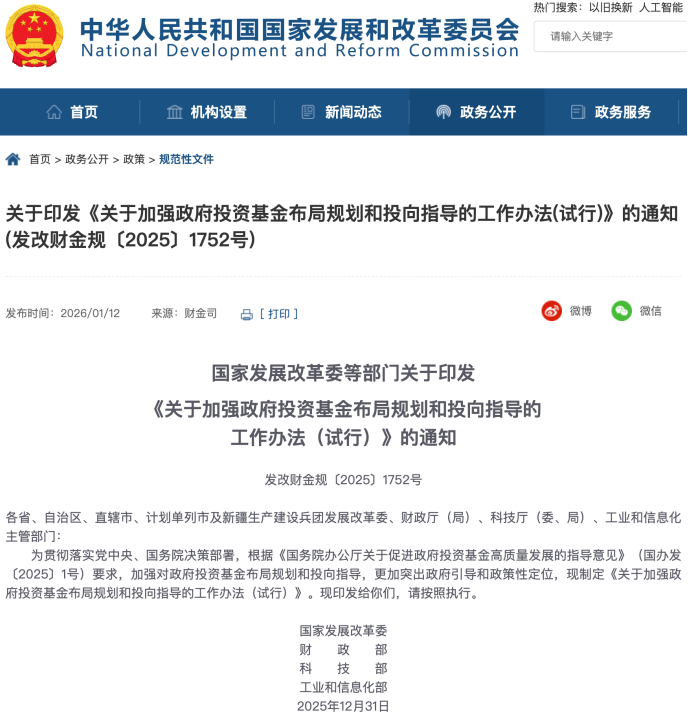
Core Insights - The conference emphasized the importance of the internet as a foundational and strategic industry for modernization, urging the need to adapt to changing circumstances and seize opportunities in artificial intelligence development [2] Group 1: Recommendations for Development - Accelerate the construction of a modern infrastructure system, focusing on the evolution of network infrastructure, including the deployment of 5G, gigabit optical networks, and IPv6, while maintaining a leading edge in the research and development of 5G-A and 6G technologies [2] - Promote deep integration of technology and industry innovation, encouraging original and disruptive technological advancements in the internet sector, particularly in artificial intelligence and quantum information [2][3] - Implement the "Artificial Intelligence +" initiative to deepen the integration of artificial intelligence with the industrial internet, fostering a wider range of intelligent service applications [3] Group 2: Smart Internet Development - The concept of the "smart body internet" was introduced, which consists of autonomous intelligent agents that can discover, communicate, and collaborate without direct human intervention [5] - By 2025, the diversity of domestic intelligent agent products is expected to increase, enhancing capabilities across various fields such as industrial manufacturing, finance, and healthcare [5] Group 3: Internet Ecosystem Governance - Continuous optimization of the internet ecosystem governance system is essential, focusing on the integration of the real economy and digital economy, and establishing a modern regulatory framework that aligns with digital development [3]
政策支持扩内需 “人工智能+消费”模式兴起
Zhong Guo Jing Ying Bao· 2025-12-04 05:14
Core Insights - The implementation plan by six departments aims to enhance the adaptability of supply and demand in consumer goods, focusing on new fields and the integration of artificial intelligence in consumption scenarios [1][2][5] Group 1: Policy and Economic Context - The "14th Five-Year Plan" emphasizes domestic demand as a key driver for economic growth, with a focus on integrating AI into consumer sectors [1][5] - The plan encourages innovation in products and services through AI, aiming to create a digital ecosystem across the entire industry chain [1][3] Group 2: AI and Consumer Innovation - The application of AI in consumer goods is expected to lead to the development of smart home robots, intelligent appliances, and AI-enabled devices, enhancing user experience and driving consumption [2][3] - AI's role in product innovation includes features like intelligent interaction and autonomous learning, which can improve consumer engagement and satisfaction [3][8] Group 3: Market Trends and Consumer Behavior - The integration of AI with virtual and augmented reality is creating immersive shopping experiences, such as virtual fitting rooms and travel, which stimulate new consumer demands [3][7] - The shift towards service-oriented and quality-focused consumption is being accelerated by technological advancements, reshaping consumer behavior and market dynamics [4][6] Group 4: Financial and Institutional Support - Financial institutions are encouraged to support AI-driven consumer projects through loans and funding, facilitating the growth of AI applications in the consumer sector [3][5] - Policies such as tax incentives and subsidies are suggested to promote AI research and development, further driving innovation in consumer products [3][5] Group 5: Future Directions and Recommendations - The focus should be on creating a collaborative environment between supply and demand, with an emphasis on new economic sectors like drone logistics and personalized services [5][6] - Establishing a supportive public policy framework is crucial for the successful integration of AI in consumer scenarios, fostering a high-quality smart consumption ecosystem [7][8]
"人工智能+"迎重磅催化!机构盯上22只高增长潜力股
Zheng Quan Shi Bao· 2025-11-29 04:44
Group 1 - Artificial intelligence (AI) has become an essential element across various industries, driving significant transformations and promoting high-quality economic development [1] - The "AI+" initiative is being accelerated by multiple policy measures in China, with a focus on developing new intelligent terminals and applications [1] - By 2027, China aims to establish three trillion-level consumption sectors and ten hundred-billion-level consumption hotspots, encouraging the development of AI-enabled products [1] Group 2 - The AI sector is projected to contribute over one hundred trillion yuan to the global economy by 2030, marking it as a key growth driver [2] - The intelligent agent market is expected to reach 3.3 trillion yuan by 2028, with China's AI terminal market sales projected to reach 1.48 trillion yuan by 2030, reflecting a compound annual growth rate of 37.33% from 2024 to 2030 [2] Group 3 - There are over 260 AI-related concept stocks in the A-share market, with 17 stocks having doubled in value this year [3] - Among AI application concept stocks, 80 have reported a net profit growth of over 20% year-on-year in the first three quarters, with 22 stocks expected to maintain a net profit growth rate exceeding 20% from 2025 to 2027 [3] - Many of the high-growth potential AI application stocks have significant upside potential, with 15 stocks showing an upside of over 20% [3] Group 4 - Wen Tai Technology has an upside potential of 62.57%, with a net profit of 1.513 billion yuan in the first three quarters, reflecting a year-on-year growth of 265.09% [4] - Yu Chip Technology has an upside potential of 56.36%, achieving a net profit of 152 million yuan, a year-on-year increase of 113.85% [4] - Yutong Optical has an upside potential of 50.79%, with a net profit of 188 million yuan, growing by 40.99% year-on-year [4]



“AI+消费”成新风口 从产品创新到场景拓展全面突破
Zheng Quan Ri Bao Wang· 2025-11-29 02:49
Core Insights - The user base for generative artificial intelligence products in China has reached 515 million as of the first half of this year, with applications continuously expanding and new AI terminal products emerging [1][2] - The Ministry of Industry and Information Technology aims to drive innovation in product and scenario development to accelerate the integration of AI technology in the consumer goods sector [1][3] Group 1: Implementation Plan - The "Implementation Plan" emphasizes the promotion of generative AI and 3D digital design tools across all sectors of consumer goods, encouraging the development of various AI terminals such as home service robots and smart appliances [2][3] - The plan supports the establishment of experience centers for smart homes, age-friendly products, and customized clothing to enhance multi-scenario experiences and value-added services [2][3] Group 2: Policy Focus - The policy focuses on leveraging AI technology to drive transformation and upgrades in the consumer goods sector, with a dual emphasis on product innovation and scenario innovation [3][4] - The long-term vision includes the integration of AI with various sectors, as outlined in the 15th Five-Year Plan, aiming to empower multiple industries and enhance societal governance [3][4] Group 3: Market Trends - The rapid development of generative AI products in China is characterized by a large user base and expanding application scenarios, indicating a significant market opportunity [2][3] - The strategic layout of "AI + Consumption" is expected to reshape the consumption ecosystem, ushering in a new era of smarter, more convenient, and personalized consumer experiences [4]