红利低波风格

Search documents
最低费率一档,可T+0交易的港股通红利低波ETF基金(159118)今日上市
Mei Ri Jing Ji Xin Wen· 2025-11-27 03:16
Core Viewpoint - The newly listed Hong Kong Stock Connect Low Volatility Dividend ETF (159118) aims to provide investors with a better investment option focusing on high dividend yield and low volatility stocks [1] Group 1: Fund Overview - The ETF closely tracks the S&P Hong Kong Stock Connect Low Volatility Dividend Index, which balances industry coverage and has a relatively even distribution across sectors [1] - The top three sectors represented in the index are Real Estate (16%), Utilities (15%), and Banks (14%) [1] - The fund has a market capitalization bias towards large-cap stocks, with a price-to-earnings (PE) ratio of less than 9 [1] Group 2: Historical Performance - The historical performance of the S&P Hong Kong Stock Connect Low Volatility Dividend Index is notable, with a total return index (including dividends) showing a cumulative increase of 94.95% from 2021 to October 22, 2025, translating to an annualized return exceeding 16% [1] - This performance significantly outpaces the Hang Seng Index and other dividend-focused indices [1] Group 3: Risk and Return Metrics - According to Huatai Securities, the Low Volatility Dividend style index has strong metrics in terms of return, risk, and dividend yield, with the S&P Hong Kong Stock Connect Low Volatility Dividend Index achieving the highest annualized return this year [1] - The Sharpe ratio and Calmar ratio median for the Low Volatility Dividend style index rank among the top in its category [1]
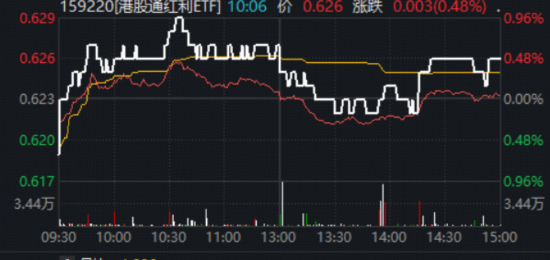
趁调整抢筹?连续第4周获净流入,港股通红利ETF(159220)场内收涨0.48%
Xin Lang Ji Jin· 2025-11-19 10:10
Core Viewpoint - The A-share market showed narrow fluctuations on November 19, while the Hang Seng Index slightly declined by 0.38%. High dividend stocks became the focus in both A and H markets, with the Hong Kong Dividend ETF (159220) rising by 0.48% despite market adjustments, indicating strong buying interest from investors [1][2]. Group 1: Market Performance - The Hong Kong Dividend ETF (159220) traded at a premium of 0.43% at closing, reflecting a robust demand for high dividend assets [1]. - Southbound funds have significantly increased their positions in Hong Kong stocks, with net inflows reaching nearly 86 billion HKD in November alone, and over 1.3 trillion HKD year-to-date [2][3]. Group 2: Index and Fund Characteristics - The S&P Hong Kong Stock Connect Low Volatility Dividend Index rose by 0.20%, with major contributors being the "three oil giants" (Sinopec, PetroChina, and CNOOC) and sectors like non-ferrous metals and transportation [3]. - The Hong Kong Dividend ETF (159220) tracks the S&P Hong Kong Stock Connect Low Volatility Dividend Index, which selects 50 stocks based on high dividend yield and low volatility, with a dividend yield of 5.54% as of October 2025 [5]. Group 3: Investment Insights - The index has shown strong performance metrics, with the highest annualized return among dividend style indices and a favorable risk-return profile, evidenced by a maximum drawdown recovery time of only 21 days [5]. - The index's structure includes limits on individual stock and industry weightings, enhancing risk diversification and making it attractive for investors focused on sustainable earnings and dividends [5].

银行板块A股市值站上14万亿元 还能涨多久?
Zhong Guo Jing Ying Bao· 2025-05-15 09:56
Core Viewpoint - The A-share banking sector has reached a total market value exceeding 14 trillion yuan, driven by factors such as declining risk-free interest rates, policy guidance for insurance funds to enter the market, and the high-quality development of public funds [1][2]. Group 1: Market Performance - As of May 14, the banking index has recorded a cumulative increase of over 9.49% in 2025 [1]. - Several banks, including Ningbo Bank and Zhengzhou Bank, have seen their stock prices rise significantly, with many banks reaching historical highs [1]. - Insurance funds have been actively increasing their holdings in bank stocks, with a total of 278.21 billion shares valued at 265.78 billion yuan, indicating strong long-term investment confidence [2]. Group 2: Policy Impact - Recent financial policies announced on May 7, including a comprehensive 0.5% reserve requirement cut and a 10 basis point reduction in policy rates, are expected to further lower risk-free interest rates, enhancing the attractiveness of banks as high-dividend defensive assets [1][2]. - The introduction of new regulations for public funds mandates a 10% annual increase in A-share holdings over the next three years, which is likely to lead to increased investment in bank stocks [2][3]. Group 3: Long-term Outlook - Analysts believe that the banking sector's dividend stability and the supportive growth policies will drive long-term investment value, with expectations of stable revenue and net profit growth in 2025 [4]. - The potential for economic recovery, influenced by international trade negotiations, may further enhance the market environment for banks, providing greater opportunities for them to support the real economy [5].