标普港股通低波红利指数

Search documents
红利风向标 | 现金流策略表现突出,关注成色优质企业
Xin Lang Cai Jing· 2026-02-13 01:25
Group 1 - The latest dividend yield for the S&P A-Share Dividend ETF is 4.61% [1] - The S&P A-Share Dividend ETF has shown a one-year return of 4.93% and a year-to-date volatility of 11.07% [1] - The Hong Kong Stock Connect Low Volatility Dividend ETF has a dividend yield of 5.24% [1] Group 2 - The A500 Low Volatility Dividend ETF has a one-year return of 0.67% and a year-to-date volatility of 8.65% [2] - The CSI 800 Low Volatility Dividend ETF has shown a one-year return of 3.78% [2] - The Cash Flow ETF tracking the CSI 300 Free Cash Flow Index has a one-year return of 20.87% and a year-to-date volatility of 9.96% [3][7]


红利风向标 | 红利风格逆市走强,波动中或可关注“哑铃策略”
Xin Lang Cai Jing· 2026-01-16 01:08
Group 1 - The latest dividend yield for the S&P A-share Dividend ETF is 4.76% as of January 15, 2026 [1][5] - The S&P China A-share Dividend Opportunity Index has shown a one-year return of 21.18% [1][5] - The Shanghai Composite Index has a one-year return of 10.58% for comparison [1][5] Group 2 - The latest dividend yield for the Hong Kong Stock Connect Low Volatility Dividend ETF is 5.6% [1][5] - The index tracking the Hong Kong Stock Connect Low Volatility Dividend has a one-year return of 27.63% [2][6] - The annualized volatility for the Hong Kong Stock Connect Low Volatility Dividend ETF is 11.84% [2][6] Group 3 - The A500 Low Volatility Dividend ETF has a one-year return of 8.45% [2][6] - The annualized volatility for the A500 Low Volatility Dividend ETF is -0.47% [2][6] - The index tracking the China 800 Low Volatility Dividend has a one-year return of 8.31% [2][6]

红利风向标 | 港股红利、现金流策略展现“抗震韧性”
Xin Lang Cai Jing· 2026-01-14 01:36
Core Viewpoint - The report highlights the performance of various dividend-focused ETFs, showcasing their recent returns and dividend yields, indicating potential investment opportunities in the dividend space [1][5][6]. Group 1: ETF Performance - The Hwabao S&P A-Share Dividend ETF (562060) has a latest dividend yield of 4.76% and has shown a one-year return of 24.06% with an annualized volatility of 10.79% [1][5]. - The Hwabao Hong Kong Stock Connect Low Volatility Dividend ETF (159220) has a latest dividend yield of 5.6% and a one-year return of 28.35% with an annualized volatility of 11.77% [1][6]. - The A500 Low Volatility Dividend ETF (159296) has reported a one-year return of 7.46% and an annualized volatility of 8.40% [2][6]. - The 800 Low Volatility Dividend ETF (159355) has a one-year return of 8.30% and an annualized volatility of 8.30% [2][6]. Group 2: Comparative Analysis - The performance of the ETFs is compared against the Shanghai Composite Index, which has shown a one-year return of 30.94% and an annualized volatility of 10.63% [1][2][6]. - The ETFs have varying performance metrics over different time frames, with some showing positive returns in the short term while others have performed better over the longer term [1][5][6].

1月9日港股红利指数ETF(513630)份额减少200.00万份
Xin Lang Cai Jing· 2026-01-12 01:11
Group 1 - The Hong Kong Dividend Index ETF (513630) increased by 0.56% on January 9, with a trading volume of 339 million yuan [1] - The fund's shares decreased by 2 million to a total of 10.162 billion shares over the last 20 trading days, with a total reduction of 25.4 million shares [1] - The latest net asset value of the fund is 16.528 billion yuan [1] Group 2 - The performance benchmark for the Hong Kong Dividend Index ETF is the S&P Hong Kong Stock Connect Low Volatility Dividend Index [1] - The fund is managed by Morgan Fund Management (China) Co., Ltd., with managers Wei Zhihao and Hu Di [1] - Since its establishment on November 23, 2023, the fund has returned 62.84%, while the return over the past month is -0.24% [1]
一键布局港股通+红利+低波
量化藏经阁· 2026-01-12 00:08
Group 1 - The core viewpoint of the article emphasizes that in a declining economic growth environment and a low-interest-rate era, dividend strategies remain effective as investors seek more certain assets [2][35] - The article highlights that the policy support is enhancing the attractiveness of dividend assets, with a notable increase in dividend payouts from listed companies, particularly since 2024 [9][10][35] - The S&P Hong Kong Low Volatility Dividend Index (SPAHLVCP.SPI) is presented as having better investment value compared to A-shares, with a 12-month dividend yield of 5.6% and a PE ratio of 5.7 times as of December 31, 2025 [14][31][36] Group 2 - The S&P Hong Kong Low Volatility Dividend Index was launched on February 20, 2017, and consists of 50 low-volatility stocks selected from 75 high-dividend securities that meet the Hong Kong Stock Connect eligibility criteria [21][36] - The index is primarily composed of large-cap stocks, with a balanced distribution across sectors such as finance, real estate, and energy, and it has a historical performance that outperforms the Hang Seng Index and other dividend indices [22][33][36] - The index has shown a cumulative increase of 99.41% since 2021, with an annualized return of approximately 14.8%, indicating strong long-term performance [18][33][36]

标普港股通低波红利指数投资价值析:键布局港股通+红利+低波
Guoxin Securities· 2026-01-10 08:28
Group 1 - The report emphasizes that in a declining economic growth environment, dividend strategies remain effective as investors seek more certain assets, benefiting dividend strategies which have bond-like attributes during low interest periods [1][9][44] - Policy support is enhancing the attractiveness of dividend assets, with increasing dividend payouts from listed companies, particularly notable since 2024, indicating a trend towards greater dividend distributions [1][17][20] - The S&P Hong Kong Low Volatility High Dividend Index (SPAHLVCP.SPI) offers better investment value compared to A-shares, with a 12-month dividend yield of 5.6% and a PE ratio of 5.7, showcasing its comparative advantage in valuation and yield [1][23][39] Group 2 - The S&P Hong Kong Low Volatility High Dividend Index was launched on February 20, 2017, and includes stocks from the Hang Seng Composite Index that meet specific dividend yield and volatility criteria [2][27][45] - The index is primarily composed of large-cap stocks, with a balanced distribution across sectors such as finance, real estate, and energy, ensuring diversification and stability [2][29][31] - As of December 31, 2025, the index's historical performance is strong, with a cumulative increase of 99.41% since 2021 and an annualized return of approximately 14.8%, outperforming the Hang Seng Index and other dividend indices [2][41][45]
恒生科技没跑赢港股红利!红利资产最强的窗口期,小白怎么选择指数?
Jin Rong Jie· 2025-12-09 11:13
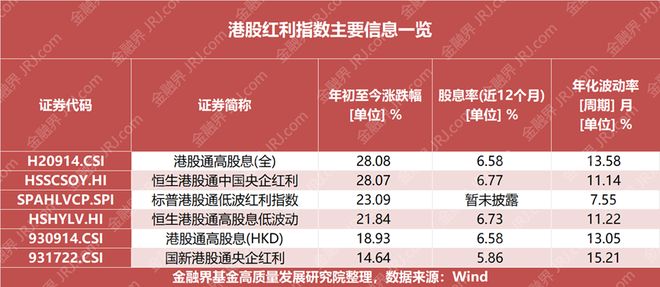
Group 1 - The core viewpoint of the articles highlights the increasing interest in dividend assets as they outperform growth sectors amid market volatility, with the Hong Kong High Dividend Index showing a notable performance compared to the Hang Seng Technology Index [1] - As of December 8, the Hang Seng Technology Index has risen by 26.73% over the past year, while the Hong Kong High Dividend Index (total return) has increased by 28.08%, indicating a slight outperformance [1] - The volatility of the Hong Kong High Dividend Index is significantly lower at 13.58%, compared to the Hang Seng Technology Index's volatility of 28.21% [1] Group 2 - According to Guangfa Securities, the Hong Kong dividend assets are entering a strong "calendar effect" window from December to mid-January, with a historical increase probability of 90.9% during this period since 2014, and a median increase of 3.4% [1] - The excess return probability of the Hong Kong High Dividend Index compared to the CSI 300 and Hang Seng Index also exceeds 80% [1] Group 3 - The Hang Seng Hong Kong Stock Connect China Central Enterprise Dividend Index has been one of the best performers this year, with a year-to-date increase of 28.07%, closely following the Hong Kong High Dividend Index [3] - This index selects high-dividend companies within the Stock Connect range, primarily those with state-owned enterprises as the largest shareholders, while applying multiple quality filters such as trading volume and volatility [3] - The S&P Hong Kong Stock Connect Low Volatility Dividend Index has a year-to-date volatility of only 7.55%, significantly lower than other indices, which generally exceed 11% [3]
年底资产再平衡,聚焦港股通红利低波ETF基金(159118)配置机会
Mei Ri Jing Ji Xin Wen· 2025-12-02 02:50
Core Viewpoint - The A-share market opened slightly lower, with the Shanghai Composite Index down 0.14%, the Shenzhen Component Index down 0.13%, and the ChiNext Index down 0.04%. The Hong Kong dividend low-volatility ETF (159118) experienced fluctuations and rose approximately 0.4%, with leading stocks including China National Pharmaceutical Group, China Pacific Insurance, and Hengan International [1] Group 1: Market Analysis - GF Securities analysis indicates that the strong year-end calendar effect on Hong Kong dividends is primarily due to public funds and other relative return-seeking capital rebalancing their assets during this critical window. To lock in annual returns, some institutions may sell high-valuation, volatile growth stocks in favor of high-dividend, high-safety-margin Hong Kong dividend sectors [1] - The historical long-term performance of the S&P Hong Kong Stock Connect Low Volatility Dividend Index is notable, with a cumulative increase of 94.95% since 2021, achieving an annualized return exceeding 16%, significantly outperforming the Hang Seng Index and other dividend-related indices [1] Group 2: ETF Fund Characteristics - The Hong Kong dividend low-volatility ETF (159118) closely tracks the S&P Hong Kong Stock Connect Low Volatility Dividend Index, with component stocks leaning towards large-cap value styles, providing investors with low fees (management and custody fees only 0.2%) and high efficiency (T+0 trading) for easy access to Hong Kong stocks, dividends, and low volatility [1] - Additionally, the Hong Kong dividend low-volatility ETF fund can conduct quarterly evaluations and profit distributions, with arrangements for profit distribution if the fund meets dividend conditions [1]
最低费率一档,可T+0交易的港股通红利低波ETF基金(159118)今日上市
Mei Ri Jing Ji Xin Wen· 2025-11-27 03:16
Core Viewpoint - The newly listed Hong Kong Stock Connect Low Volatility Dividend ETF (159118) aims to provide investors with a better investment option focusing on high dividend yield and low volatility stocks [1] Group 1: Fund Overview - The ETF closely tracks the S&P Hong Kong Stock Connect Low Volatility Dividend Index, which balances industry coverage and has a relatively even distribution across sectors [1] - The top three sectors represented in the index are Real Estate (16%), Utilities (15%), and Banks (14%) [1] - The fund has a market capitalization bias towards large-cap stocks, with a price-to-earnings (PE) ratio of less than 9 [1] Group 2: Historical Performance - The historical performance of the S&P Hong Kong Stock Connect Low Volatility Dividend Index is notable, with a total return index (including dividends) showing a cumulative increase of 94.95% from 2021 to October 22, 2025, translating to an annualized return exceeding 16% [1] - This performance significantly outpaces the Hang Seng Index and other dividend-focused indices [1] Group 3: Risk and Return Metrics - According to Huatai Securities, the Low Volatility Dividend style index has strong metrics in terms of return, risk, and dividend yield, with the S&P Hong Kong Stock Connect Low Volatility Dividend Index achieving the highest annualized return this year [1] - The Sharpe ratio and Calmar ratio median for the Low Volatility Dividend style index rank among the top in its category [1]
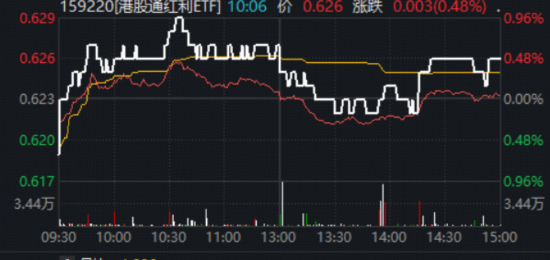
趁调整抢筹?连续第4周获净流入,港股通红利ETF(159220)场内收涨0.48%
Xin Lang Ji Jin· 2025-11-19 10:10
Core Viewpoint - The A-share market showed narrow fluctuations on November 19, while the Hang Seng Index slightly declined by 0.38%. High dividend stocks became the focus in both A and H markets, with the Hong Kong Dividend ETF (159220) rising by 0.48% despite market adjustments, indicating strong buying interest from investors [1][2]. Group 1: Market Performance - The Hong Kong Dividend ETF (159220) traded at a premium of 0.43% at closing, reflecting a robust demand for high dividend assets [1]. - Southbound funds have significantly increased their positions in Hong Kong stocks, with net inflows reaching nearly 86 billion HKD in November alone, and over 1.3 trillion HKD year-to-date [2][3]. Group 2: Index and Fund Characteristics - The S&P Hong Kong Stock Connect Low Volatility Dividend Index rose by 0.20%, with major contributors being the "three oil giants" (Sinopec, PetroChina, and CNOOC) and sectors like non-ferrous metals and transportation [3]. - The Hong Kong Dividend ETF (159220) tracks the S&P Hong Kong Stock Connect Low Volatility Dividend Index, which selects 50 stocks based on high dividend yield and low volatility, with a dividend yield of 5.54% as of October 2025 [5]. Group 3: Investment Insights - The index has shown strong performance metrics, with the highest annualized return among dividend style indices and a favorable risk-return profile, evidenced by a maximum drawdown recovery time of only 21 days [5]. - The index's structure includes limits on individual stock and industry weightings, enhancing risk diversification and making it attractive for investors focused on sustainable earnings and dividends [5].