纤维电子系统集成

Search documents
我国科学家成功研制“纤维芯片”
Xin Hua She· 2026-01-22 09:40
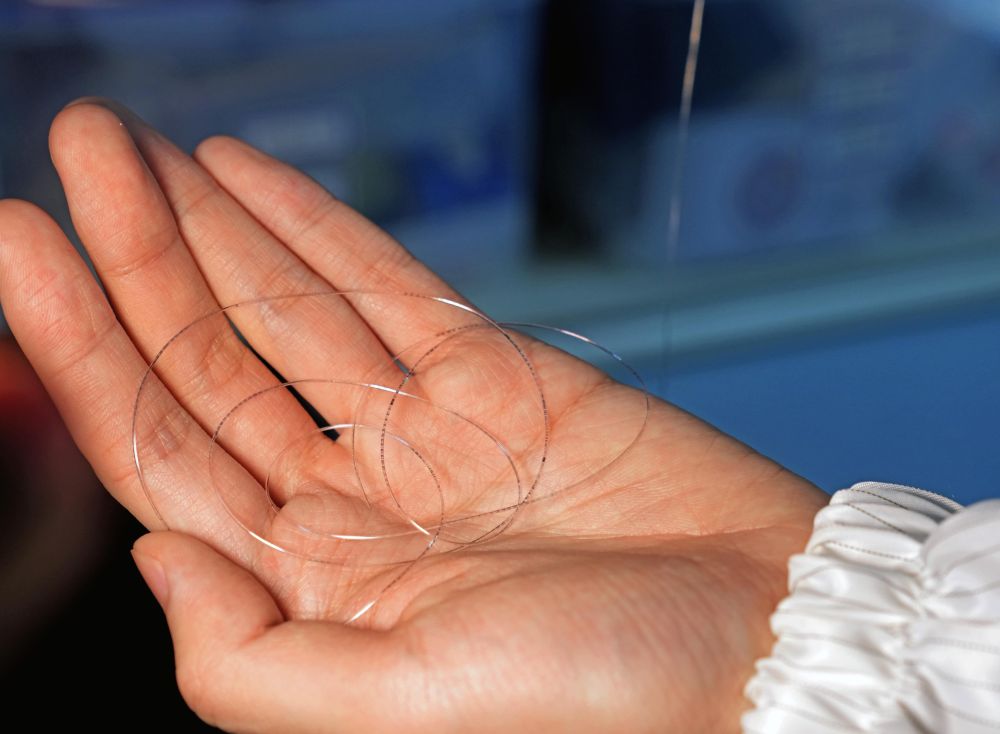
Core Viewpoint - Fudan University researchers have successfully developed a new architecture for large-scale integrated circuit fabrication within soft, elastic polymer fibers, transforming the concept of "fiber chips" into reality [1][2]. Group 1: Research and Development - The research team, led by Peng Huisheng and Chen Peining, innovatively designed a multi-layer stacked architecture that constructs integrated circuits within the fiber, maximizing internal space utilization [2]. - The team has established a fabrication route that allows for direct photolithography of high-density integrated circuits on elastic polymers [2]. Group 2: Technical Achievements - Initial laboratory results show that the fabricated "fiber chips" can achieve an integration density of 100,000 electronic components (such as transistors) per centimeter [4]. - The efficient interconnection of transistors and other electronic components enables the realization of both digital and analog circuit functions [4]. Group 3: Industry Implications - The new fabrication route not only imparts information processing capabilities to fibers while maintaining their softness but also opens new pathways for fiber electronic system integration [7]. - This advancement is expected to provide new insights for the development of the integrated circuit field [7].

我国芯片突破关键难题!弯折变形后仍可使用
Ke Ji Ri Bao· 2026-01-22 09:02
Core Insights - The development of flexible electronics has been hindered by the rigidity of chips, which are essential components. A team from Fudan University has successfully created a new type of "fiber chip" by integrating large-scale circuits within elastic polymer fibers, providing a new effective pathway to address the flexibility challenge [1]. Group 1 - The design maximizes the internal space of the fiber, achieving high-density integration within a one-dimensional constrained size [1]. - The team developed a fabrication route compatible with current photolithography processes, utilizing plasma etching to achieve a surface roughness below 1 nanometer, meeting commercial photolithography requirements [3]. - A dense polystyrene film layer is deposited on the elastic polymer surface, acting as a "flexible armor" that protects the circuit from solvents used in photolithography and buffers strain, ensuring stability of the circuit structure and performance after repeated bending and stretching [3]. Group 2 - This breakthrough is expected to provide new pathways for the integration of fiber electronic systems, facilitating a transition from "embedding" to "weaving," which could revolutionize emerging fields such as brain-machine interfaces, electronic textiles, and virtual reality [3].
弯折、拉伸都不怕!我国科学家实现芯片领域新突破
Huan Qiu Wang Zi Xun· 2026-01-22 05:59
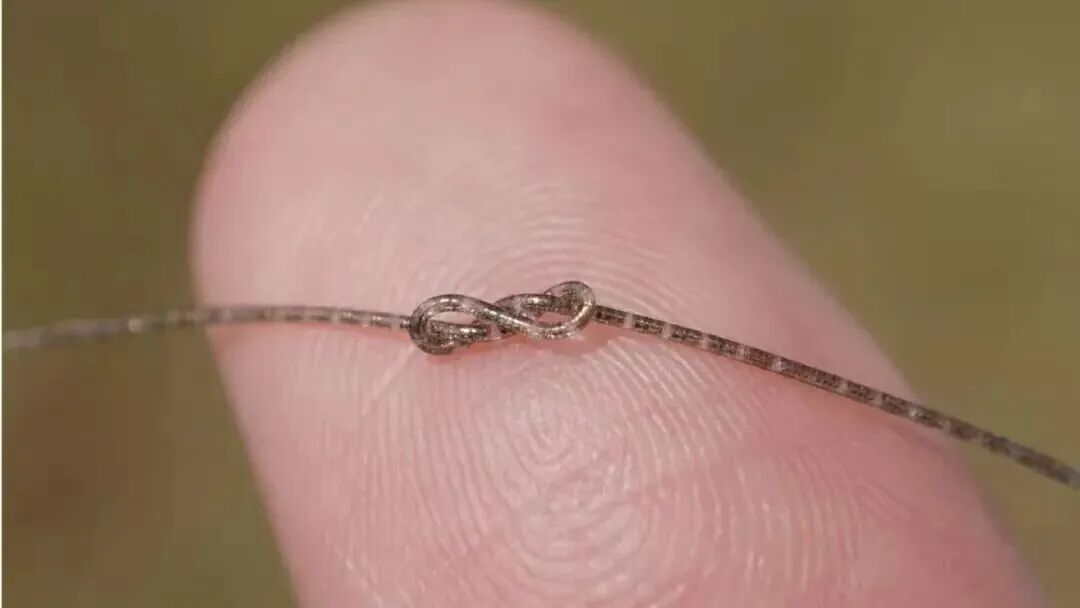
Core Insights - The research team from Fudan University has developed a new "fiber chip" by integrating large-scale integrated circuits within elastic polymer fibers, addressing the long-standing challenge of flexible electronics [1] Group 1: Technological Advancements - The design maximizes the internal space of the fiber, achieving high-density integration within a one-dimensional constrained size [1] - The team has created a preparation route compatible with current photolithography processes, utilizing plasma etching to achieve a surface roughness below 1 nanometer, meeting commercial photolithography standards [1] - A dense poly-p-xylene film layer is deposited on the elastic polymer surface, providing a "flexible armor" for the circuit, which protects against solvent erosion and buffers strain during bending and stretching [1] Group 2: Potential Applications - This breakthrough is expected to provide new pathways for the integration of fiber electronic systems, facilitating a shift from "embedding" to "weaving" [1] - The advancements could significantly impact emerging fields such as brain-machine interfaces, electronic textiles, and virtual reality [1]
中国学者成功开发“纤维芯片”:丝线般细软、为纤维电子系统集成提供新路径
Zhong Guo Xin Wen Wang· 2026-01-22 05:13
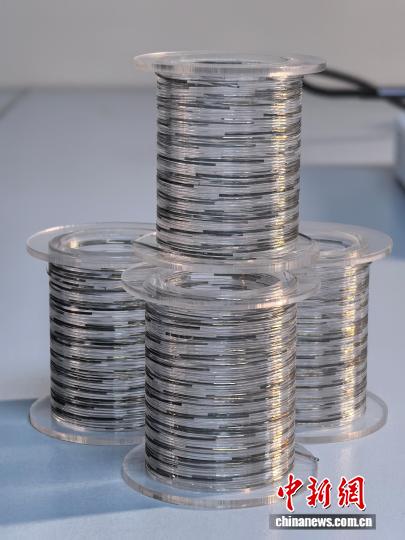
Core Viewpoint - The research team from Fudan University has developed a "fiber chip" that is as thin and flexible as a silk thread, providing a new pathway for integrating fiber electronic systems [1][3]. Group 1: Development and Features - The "fiber chip" achieves an integration density of 100,000 transistors per centimeter, enabling digital and analog circuit operations [3]. - It exhibits superior flexibility, capable of withstanding bending, stretching, and twisting, while maintaining stable performance even after washing, exposure to extreme temperatures, and being crushed by a truck [3]. - The team utilized a multi-layer stacking architecture to maximize the internal space of the fiber, allowing for significant transistor integration [3][5]. Group 2: Scalability and Applications - The fabrication method developed is compatible with existing mature photolithography processes, enabling scalable production of the "fiber chip" [5]. - The "fiber chip" opens new applications in brain-machine interfaces, electronic textiles, and virtual reality, integrating power supply, sensing, display, and signal processing functions into a single fiber [5][7]. - In brain-machine interfaces, the technology allows for a closed-loop system integrated within a fiber as thin as a hair, eliminating the need for external signal processing modules [5]. - The "fiber chip" can facilitate the creation of fully flexible electronic textile systems, which can directly weave into fabrics without external processors, enhancing wearability [5][7]. - In virtual reality, the smart tactile gloves utilizing the "fiber chip" can accurately simulate different tactile sensations, improving user interaction with virtual environments [7].
“纤维芯片”来了
财联社· 2026-01-22 03:26
Core Viewpoint - The development of "fiber chips" by Fudan University addresses the long-standing challenge of integrating flexible electronics, providing a new pathway for the "flexibilization" of smart devices [1][5]. Group 1: Innovation in Chip Design - Traditional chip manufacturing relies on flat, stable silicon wafers, while the Fudan team proposes a "multi-layer stacked architecture" that allows for high-density integration within the confines of a fiber [3][4]. - The design metaphorically compares the process to embedding a detailed circuit diagram into a thin line, maximizing space utilization within the fiber [3]. Group 2: Manufacturing Challenges and Solutions - Creating high-precision circuits in soft, deformable fibers is likened to building skyscrapers in "soft mud," presenting significant manufacturing challenges [4]. - The team developed a preparation route compatible with existing photolithography processes, achieving a surface roughness of less than 1 nanometer on the elastic polymer, meeting commercial photolithography standards [4]. Group 3: Future Applications and Impact - The protective layer of polystyrene not only shields the circuit from solvents used in photolithography but also buffers the circuit layer against strain, ensuring stability after repeated bending and stretching [4]. - This innovative manufacturing method lays a solid foundation for scaling up production and application, potentially transforming fields such as brain-machine interfaces, electronic textiles, and virtual reality [5].