
终极避险资产

Search documents
黄金5000美元关口在望!市场已开始讨论6000、7000甚至10000!
Hua Er Jie Jian Wen· 2026-01-21 08:40
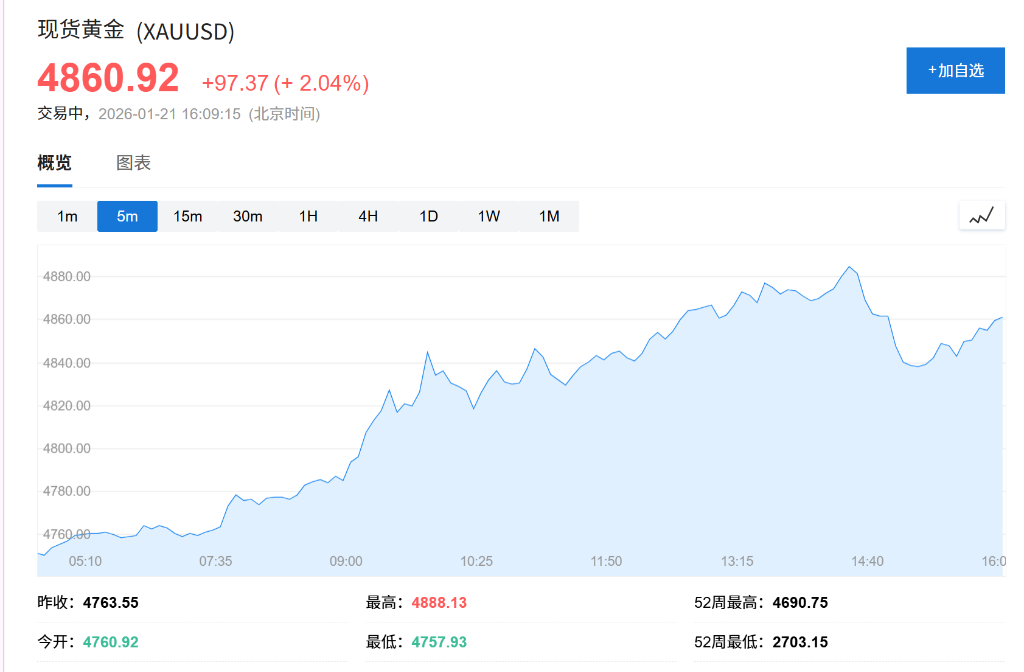
Core Viewpoint - Gold prices are surging towards historical highs, with the potential to reach $5,000 per ounce, driven by geopolitical tensions and trade protectionism concerns [1][3]. Group 1: Current Market Dynamics - Spot gold prices reached $4,880 per ounce, marking a daily increase of 2.46%, setting a new historical high [1]. - The recent surge in gold prices is attributed to renewed fears of a global trade war following U.S. tariff threats regarding Greenland [1]. - Analysts expect gold to maintain its status as a "safe-haven asset" amid ongoing geopolitical tensions and declining real interest rates [3]. Group 2: Future Price Predictions - Analysts are increasingly optimistic, with expectations for gold prices to exceed $5,000 this year, and some forecasts suggesting potential highs of $7,150 to $10,000 per ounce in the coming years [4][5]. - A survey by LBMA indicates that 42% of respondents believe gold will rebound to the $5,000-$6,000 range, while 10% predict prices above $6,000 [5]. Group 3: Geopolitical Influences - Geopolitical factors are seen as a defining element of the current gold market, with experts suggesting that the current cycle is not speculative but rather a long-term trend [6]. - The ongoing geopolitical tensions, including U.S. actions in Venezuela and control attempts over Greenland, are driving investors towards gold [6]. Group 4: Changing Demand Dynamics - There is a notable shift in the buyer demographic for gold, with private sector demand increasingly driving price increases since 2025, moving away from central bank purchases [8]. - Private investors, including wealth management firms and hedge funds, are diversifying their portfolios into gold through various channels such as ETFs [8].

1月13日金市晚评:今晚美CPI将来袭 黄金属性转向“体系风险对冲”
Jin Tou Wang· 2026-01-13 09:52
Core Viewpoint - The recent surge in gold prices is attributed to multiple factors, including geopolitical risks, economic data indicating a potential Federal Reserve rate cut, and increased demand from central banks and institutional investors [4][3]. Group 1: Market Dynamics - The CME Group announced adjustments to margin requirements for gold, silver, platinum, and palladium futures due to increased volatility and rising precious metal prices [2]. - Gold and silver prices reached historical highs recently, with silver up approximately 20% year-to-date [2]. - The market is interpreting the recent surge in gold and silver prices as a re-evaluation of the "creditworthiness" of the dollar and U.S. debt amid rising geopolitical tensions and investigations into the Federal Reserve [3]. Group 2: Economic Indicators - U.S. economic data shows a disappointing non-farm payroll increase of only 50,000 jobs in December, below expectations, and a manufacturing PMI at a 14-month low, reinforcing expectations for a Federal Reserve rate cut [4]. - Central banks globally continue to increase their gold holdings, providing solid support for gold prices [4]. Group 3: Technical Analysis - Gold prices are currently above the 5-week and 10-week moving averages, indicating a strong bullish trend, with short-term support levels between $4,540 and $4,550 per ounce [5]. - The Relative Strength Index (RSI) indicates overbought conditions, suggesting potential short-term pullback risks [5]. - In the medium to long term, the bullish trend for gold remains intact, with the possibility of prices reaching $5,100 if geopolitical risks escalate or if rate cuts exceed expectations [5].
韩国央行将重启购金?十二年观望态度或一朝改变!
Jin Shi Shu Ju· 2025-10-28 03:42
Core Viewpoint - The Bank of Korea (BOK) is signaling a potential shift towards increasing its gold reserves after a 12-year hiatus, amidst a global trend of central banks accumulating gold as a hedge against financial uncertainty [2][3]. Group 1: Current Status of Gold Reserves - The BOK has maintained its gold reserves at 104.4 tons since 2013, ranking 39th among global central banks [3]. - The BOK's ranking has declined from 32nd in 2013 to 39th, and potentially to 41st when including the IMF and ECB [3]. - A recent survey indicated that 95% of central banks expect an increase in gold reserves over the next 12 months, contrasting with the BOK's cautious stance [3]. Group 2: Reasons for Previous Inaction - The BOK refrained from purchasing gold due to higher returns from risk assets like stocks, with the S&P 500 rising 158% compared to gold's 71% increase over the same period [4]. - A decline in foreign exchange reserves from a peak of $469.2 billion in October 2021 to approximately $420 billion has limited the BOK's ability to diversify into gold [4]. - Past experiences of significant gold price volatility have contributed to a cautious approach, with gold prices dropping from $1,900 per ounce in 2011 to around $1,100 in 2015 [4]. Group 3: Potential Shift in Strategy - Market analysts warn that excessive caution may lead to missed opportunities, especially with predictions of rising gold prices due to potential interest rate cuts and a weakening dollar [7]. - The average gold price is forecasted to reach $4,450 per ounce next year, with a possibility of exceeding $4,800 by year-end [7]. - The BOK's gold reserves constitute only 2.8% of its foreign exchange reserves, significantly lower than Japan and China, indicating a lack of safe assets to buffer against economic uncertainties [7]. Group 4: Political and Market Pressure - There is increasing political pressure for the BOK to enhance its gold reserves, with calls to recognize gold as a strategic asset for maintaining monetary sovereignty [8]. - Emerging market central banks are actively buying gold during price dips, providing strong support for gold prices [8].