终端电气化

Search documents
读懂省级“十五五”规划建议中的“双碳”关键词
Zhong Guo Neng Yuan Wang· 2026-02-14 00:39
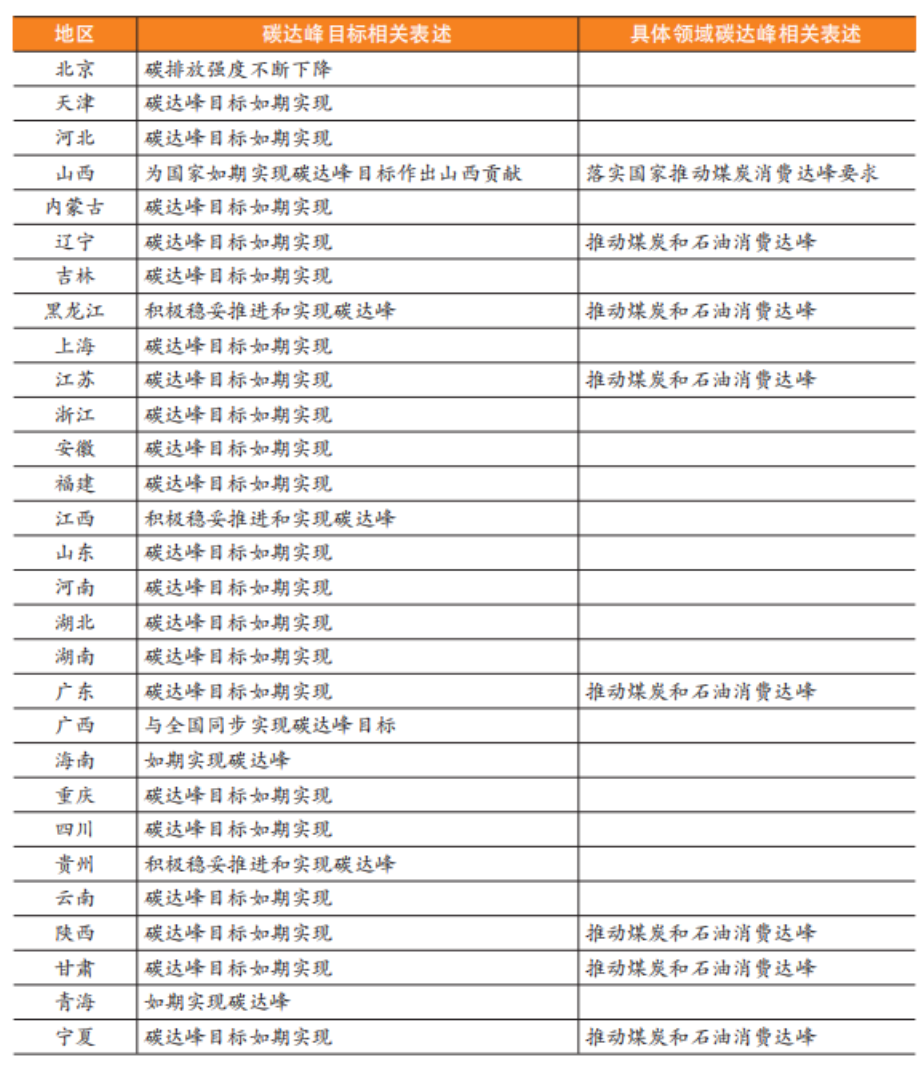
Core Insights - The article emphasizes the alignment of provincial "14th Five-Year" plans with national carbon neutrality goals, highlighting the importance of achieving carbon peak and dual control of carbon emissions as key objectives for local governments [1][2][7] Group 1: Carbon Peak and Dual Control - The "14th Five-Year" period is identified as a critical phase for China to achieve its carbon peak, with 28 provinces mentioning "carbon peak" in their plans [2] - The national strategy includes a shift from energy consumption dual control to carbon emissions dual control, with all 30 provinces committing to implement this system [2] Group 2: Non-CO2 Greenhouse Gas Emissions - There is an increased focus on controlling non-CO2 greenhouse gas emissions, with local plans reflecting a commitment to reduce these emissions in line with national targets for 2035 [3] Group 3: New Energy System Development - The establishment of a new energy system is highlighted as a priority, with all provinces outlining plans to enhance clean and low-carbon energy sources [4] - The national plan advocates for a diversified energy supply, emphasizing the development of solar and wind energy, with 28 provinces mentioning solar energy and 26 focusing on wind energy [4] Group 4: Clean and Efficient Use of Fossil Fuels - The clean and efficient use of fossil fuels is crucial for optimizing energy structure, with various provinces outlining measures to upgrade coal power and reduce coal consumption [5][9] - Specific initiatives include promoting carbon capture technologies and transitioning coal power from a primary energy source to a supportive role [5][9] Group 5: Green and Low-Carbon Energy Consumption - Enhancing electrification across sectors is a key strategy for promoting green energy consumption, with 18 provinces advocating for increased electrification levels [6][11] - Local plans include commitments to improve energy consumption efficiency and promote renewable energy usage in high-energy-consuming industries [6][11]

中国石油经研院上调全球石油需求峰值预期 预计达峰时点将推迟
Xin Hua Cai Jing· 2025-12-12 09:37
Group 1 - The 2025 International Energy Development Summit Forum was held in Beijing, where the "2060 World and China Energy Outlook Report (2025 Edition)" was released, predicting that global oil demand will peak in 2040, delayed by 10 years compared to previous forecasts, reaching approximately 4.8 billion tons, an increase of 5.2% from earlier estimates [2] - The report indicates that global energy demand will continue to grow, reaching between 20.2 billion and 21.3 billion tons of standard oil by 2060, representing a growth of 30% to 37% from 2025 levels [2] - The report highlights that fossil energy demand will exceed 800 million tons of standard oil by 2060, accounting for about 40% of primary energy [2] Group 2 - In China, the report forecasts that primary energy demand will peak at 5 billion tons of standard oil by 2035, an upward revision of 10 million tons from previous estimates, with a growth of approximately 20% by 2025 [3] - By 2060, China's energy demand is expected to remain above 4.5 billion tons of standard oil [3] - The report anticipates a shift in China's energy structure over the next decade, characterized by a reduction in coal, stable oil and gas, and an increase in non-fossil energy sources [4] Group 3 - The report predicts that by 2050, chemical oil demand will peak at 29 million tons, accounting for over 50% of total oil demand, with natural gas playing a crucial role in replacing coal and supporting new power systems [4] - It is expected that by 2035 to 2040, natural gas demand will reach approximately 620 to 650 billion cubic meters [4] - The report emphasizes the importance of renewable energy sources such as hydrogen, ammonia, and biofuels in the low-carbon transition of the oil and gas industry [4] Group 4 - The rapid development of electrification in China is highlighted, with electricity demand projected to exceed 20 trillion kilowatt-hours by 2060, doubling from 2025 levels, and the electrification rate expected to reach 62% [5] - Traditional energy companies are accelerating technological innovation and green transformation while ensuring energy security [5] - The forum focused on creating a fair, safe, and intelligent global energy ecosystem, with several flagship reports released, including the "2060 World and China Energy Outlook Report (2025 Edition)" [5]