经济周期错位

Search documents
外汇商品 | 加美货币政策周期的协调与分化
Sou Hu Cai Jing· 2025-11-18 00:29
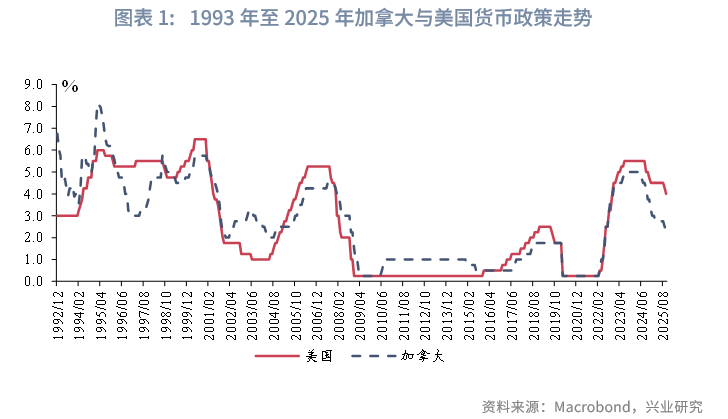
Core Viewpoint - The monetary policy of Canada is significantly influenced by external financial conditions and trade cycles, particularly those of the United States, leading to a historical pattern of synchronization and occasional divergence in policy rates between the two countries [1][2][3]. Summary by Sections 1. Policy Cycle Divergence Drivers - The divergence in monetary policy between Canada and the U.S. can be categorized into two main drivers: changes in global demand for Canadian goods, particularly influenced by commodity prices, and fluctuations in global demand for the U.S. dollar, which can lead to capital flight and affect exchange rates [4][5][6]. 2. Current Policy Cycle Analysis and Future Outlook - Currently, both Canada and the U.S. are in a new round of interest rate cuts, with macroeconomic challenges being highly similar. However, Canada has shown a tendency towards more aggressive easing due to weaker economic performance and housing market pressures [24][25]. - The Bank of Canada (BoC) initiated its rate cuts in June 2024, ahead of the U.S. Federal Reserve, reflecting its assessment of domestic economic conditions and inflation trends [25][26]. - The BoC's policy adjustments are expected to remain closely aligned with the Federal Reserve's actions, particularly in response to external pressures such as exchange rate fluctuations and commodity price movements [29][30]. 3. Historical Context of Policy Coordination - Historical analysis shows that Canada and the U.S. have experienced periods of both high coordination and significant divergence in monetary policy, influenced by various economic conditions and external shocks [16][18][19]. - The coordination phases have typically seen Canada adjusting its policy rates in a manner that is consistent with U.S. movements, albeit often with smaller adjustments [18][19]. 4. Future Projections - Looking ahead to 2026, the BoC's capacity for further rate cuts may be limited, as current rates are near the lower bound of the neutral range. The bank's decisions will likely be heavily influenced by the Federal Reserve's policy trajectory [29][30][31].

谢治宇:全球开始处在一个前所未有的全新周期中 以人民币为代表的资产仍有上升空间
Xin Lang Ji Jin· 2025-09-22 07:26
Core Insights - The event "Investment for Good" focused on ESG and charitable asset management, highlighting the evolving landscape of investment strategies in response to global economic changes [1] Group 1: Economic Cycles and Asset Classes - The current economic environment is characterized by a shift from a US-centric globalization cycle to a more diversified approach, influenced by de-globalization and varying monetary policies across developed nations [3] - The long-term risk-return profile for investments has declined due to prolonged monetary easing in the US and increased demand for long-term government bonds in China, complicating the achievement of return targets [4] - There is a notable correlation between stock and bond market volatility, driven by excessive liquidity, prompting a strategy shift towards alternative assets like gold [4] Group 2: Asset Class Outlook - Short-term prospects for US dollar assets appear positive due to potential economic soft landing, but long-term attractiveness may diminish due to rising credit risks and increasing dollar monetization [5] - The Chinese yuan is expected to face short-term appreciation pressure, supported by improving growth dynamics and foreign capital inflows, while long-term trends suggest a gradual upward trajectory [5] - Commodity outlook indicates that oil prices are likely to remain within a certain range, while gold is viewed as a strong hedge against portfolio risk due to its low correlation with the dollar [6]