结构失衡

Search documents
理财的,注意这两个风险!
Sou Hu Cai Jing· 2025-12-15 04:17
Group 1: Silver Fund Premium - The only silver fund in China has reached a historical high premium of 12%, indicating that investors are buying at a price higher than the actual asset value [9][10] - The fund manager has issued multiple warnings about the risks of blindly purchasing high-premium fund shares, suggesting potential significant losses for investors [7][10] - Investors in the silver fund need the silver price to increase by at least 12% to make a profit, or find someone willing to buy at a higher price, otherwise, they face compounded losses [10] Group 2: Yield Curve Steepening - The yield curve is becoming steeper, meaning that long-term interest rates are rising faster than short-term rates, which poses risks for long-term bond fund investors [11][16] - The recent steepening of the yield curve is attributed to an increase in long-term debt issuance and a shift in investment focus towards the stock market, leading to a gradual rise in interest rates [18] - The current economic policy outlook suggests that the steepening trend in the yield curve may continue, indicating a potential for long-term interest rates to rise further [18] Group 3: Market Imbalances - Both the silver fund and the bond market reflect structural imbalances that could lead to value corrections, highlighting the importance of understanding the underlying causes of market distortions [20] - The silver fund's popularity is influenced by external factors such as trade conflicts, while the bond market's previous low rates were a result of supply shortages during an asset scarcity period [20] - Investors are advised to be cautious of potential pricing bubbles driven by market distortions, especially when many retail investors are involved [20]


业绩失速,投诉频发!炊具大王苏泊尔要“熄火”?
Shang Hai Zheng Quan Bao· 2025-10-27 01:21
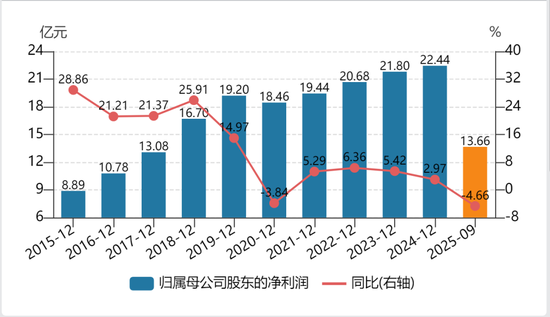
Core Viewpoint - Supor's performance has shown a significant decline in the third quarter of 2025, with both revenue and net profit decreasing, indicating a long-term structural imbalance in the company's market and management strategies [1][2]. Performance Decline - In Q3 2025, Supor reported revenue of 5.42 billion yuan, a year-on-year decrease of 2.30%, and a net profit of 426 million yuan, down 13.42%, with the profit decline outpacing revenue [1][3]. - For the first three quarters of 2025, the company's revenue saw a slight increase of 2.33%, while net profit decreased by 4.66% compared to the previous year [1][3]. Revenue and Profit Trends - The decline in net profit growth has been a gradual process, with a peak growth of 25.91% in 2018, dropping to 14.97% in 2019, and turning negative in 2020 [3][5]. - By 2024, net profit growth was nearly flat at 2.97%, and in 2025, it turned into a decline of 4.66% for the first three quarters [3][5]. Accounts Receivable Increase - As of Q3 2025, accounts receivable rose to 3.133 billion yuan, a 16.47% increase from the end of 2024, indicating potential risks related to bad debts [7][8]. Structural Imbalance - Supor's domestic sales, which account for 66.55% of total revenue, have stagnated, with growth rates dropping from 10.8% in 2021 to -1.21% in 2024 [8]. - The company's reliance on external sales, particularly from Groupe SEB, has led to significant revenue volatility, with exports declining by approximately 11% in 2025 [8][9]. Management Turmoil - The company has experienced management instability, with the resignation of key executives and a lack of a confirmed general manager since early 2025 [9][10]. - High-level executives have engaged in stock sell-offs shortly after receiving dividends, raising concerns among investors [9][10]. Research and Development Shortcomings - Supor's R&D investment has remained low, averaging around 2% of revenue, which is below industry standards [11][12]. - In contrast, competitors have significantly higher R&D investment ratios, indicating a potential disadvantage in innovation [11][12]. Consumer Complaints - Supor has faced a high volume of consumer complaints, with over 8,000 reported issues related to product safety and service quality, significantly higher than competitors [16][19]. - Recent data shows a 33.33% increase in public complaints within a month, highlighting ongoing consumer dissatisfaction [19].