业绩失速

Search documents
雀巢寒了谁的心?
创业家· 2026-01-15 11:16
Core Viewpoint - Nestlé is currently facing a trust crisis due to product recalls and issues with its distribution network, which have led to significant concerns among consumers and partners [4][8][19]. Group 1: Product Recall Crisis - Recently, Nestlé recalled multiple batches of infant formula in 45 countries due to potential contamination with Bacillus cereus, raising quality control concerns [5][10]. - The recall affects a product batch that constitutes less than 0.5% of the company's annual sales, indicating that the financial impact may be limited [13]. - Despite Nestlé's assurances that no adverse health reports have been received, consumer anxiety remains high, particularly among parents [14][15]. Group 2: Distribution Network Issues - Prior to the recall, Nestlé faced a crisis in its distribution channels, with reports of significant unpaid subsidies to distributors, some exceeding 19 million yuan [8][21]. - The company's distribution model, which requires distributors to purchase at higher prices and rely on rebates, has led to financial strain and dissatisfaction among partners [22][23]. - Many distributors have reported long-standing unpaid amounts, indicating deeper issues within Nestlé's operational management [26][28]. Group 3: Performance Decline - In 2025, Nestlé China experienced a 6.4% decline in sales, with the need for internal restructuring becoming increasingly urgent [36][40]. - The company is attempting to shift its strategy from pushing distribution to pulling consumer demand, but this transition is complex and time-consuming [39]. - Nestlé's market share in key segments like infant formula and pet food is lagging behind competitors, highlighting the need for significant improvements in product offerings and market strategy [42].

康得新百亿财务造假案余波未了,北京银行两度卷入相关诉讼
Nan Fang Du Shi Bao· 2025-12-08 08:48
Core Viewpoint - Beijing Bank is facing significant legal challenges, including a recent lawsuit related to false statements by Kangde Xin, with potential claims exceeding 4.139 billion yuan, while also dealing with regulatory fines totaling over 36 million yuan this year [2][4][5]. Legal Issues - On December 4, Beijing Bank received a lawsuit notification from the Suzhou Intermediate People's Court, making it a defendant in a case involving Kangde Xin's false statements [2][5]. - The lawsuit includes 40 defendants, with Kangde Xin as the primary defendant, and seeks compensation for investment losses due to false statements [4]. - This is not the first time Beijing Bank has been involved in litigation related to Kangde Xin, as it was previously named in a lawsuit seeking over 5.1 billion yuan in damages [4]. Financial Impact - Beijing Bank has stated that it is not the primary responsible party in the current lawsuit and has assessed that the case will not materially impact its profits [5]. - The bank's financial performance has shown a decline, with a 1.08% year-on-year decrease in revenue for the first three quarters of 2025, while net profit saw a slight increase of 0.26% [6][7]. Regulatory Challenges - The bank has faced multiple regulatory penalties this year, totaling over 36 million yuan, due to various compliance failures [5][6]. - Specific violations include issues with account management and transactions with unidentified clients, leading to significant fines from regulatory authorities [6]. Market Position - As of mid-2025, Beijing Bank's asset size has been surpassed by Jiangsu Bank, marking a shift in the competitive landscape among city commercial banks [7]. - The bank is focusing on strategic areas such as pension finance and green finance, aiming to enhance its market position despite current challenges [7].


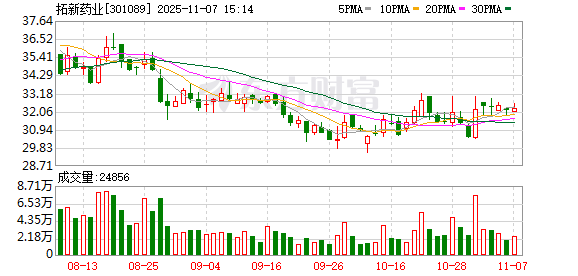
拓新药业:业绩失速,前三季度营收及净利润均创同期新低,上市4年来股价回撤超八成,重要股东及高管密集减持
Zheng Quan Shi Bao Wang· 2025-11-07 07:14
Core Viewpoint - The company has experienced a continuous decline in revenue and an increase in losses since its IPO, failing to leverage the capital market for growth, with current revenue levels even lower than pre-IPO figures [2][3]. Financial Performance - For the first three quarters, the company's revenue was 272 million yuan, a year-on-year decrease of 16.64%, with a loss of 30.16 million yuan, which has further expanded [2]. - In Q3 alone, revenue was 89.65 million yuan, down 16.21% year-on-year, marking the third consecutive quarter of revenue decline, and the net profit loss was 11.88 million yuan, continuing a six-quarter streak of losses [2]. - Historical performance shows a significant increase in revenue in the year following the IPO, but since then, revenue growth has slowed, with a projected near halving of revenue in 2024 compared to previous years [2][3]. Market Dynamics - The decline in performance is attributed to changes in market demand for antiviral raw materials, leading to a significant drop in sales, compounded by increased competition causing price declines and higher provisions for price reductions [2][3]. Strategic Investments - The company has increased its investment in new product development, resulting in higher R&D expenses, while new subsidiaries are in critical phases of product reserve and capacity ramp-up, leading to increased operational costs [3]. Stock Performance - The company's stock price peaked at 230 yuan per share post-IPO but has since fallen over 80%, with the latest closing price at 32.12 yuan per share [3]. - The stock experienced a cumulative decline of over 10% in 2022, followed by significant drops of 24.58% and 47.47% in 2023 and 2024, respectively, although there has been a slight increase in stock price this year [3]. Shareholder Activity - There have been over 60 recorded instances of share reductions by major shareholders and executives since the company went public, indicating a lack of confidence in the company's future [4]. - The controlling shareholder and actual controller have reduced their holdings by 312,210 shares, representing 2.47% of the total share capital [4]. - Notable shareholders have also reduced their stakes significantly, with some falling below 5% ownership, reflecting ongoing divestment trends [5].
业绩失速,投诉频发!炊具大王要“熄火”?
Shang Hai Zheng Quan Bao· 2025-10-27 01:29
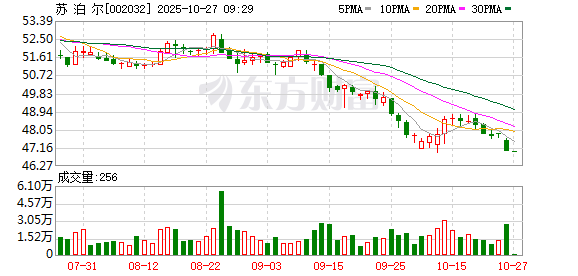
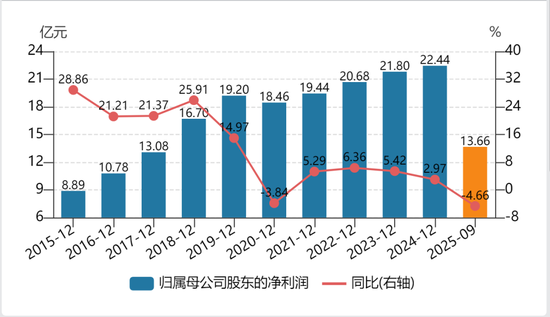
Core Viewpoint - Supor's performance has shown a significant "loss of momentum," with a notable decline in both revenue and net profit in the third quarter of 2025, indicating ongoing operational challenges [2][4]. Financial Performance - In Q3 2025, Supor achieved revenue of 5.42 billion yuan, a year-on-year decrease of 2.30%, and a net profit of 426 million yuan, down 13.42%, with the decline in net profit outpacing revenue [2][4]. - For the first three quarters of 2025, the company's revenue saw a slight increase of 2.33% year-on-year, while net profit decreased by 4.66% [2][4]. - The decline in net profit has been a gradual trend, with the growth rate dropping from 25.91% in 2018 to a near-zero growth of 2.97% in 2024, and a significant decline in 2025 [5][11]. Sales and Accounts Receivable - Accounts receivable rose sharply to 3.133 billion yuan by the end of Q3 2025, a 16.47% increase from the end of 2024 [8][11]. - The increase in accounts receivable raises concerns about potential bad debt risks due to prolonged collection periods [9]. Market Structure and Management Issues - Supor's internal sales growth has stagnated, with growth rates dropping from 10.8% in 2021 to -1.21% in 2024, while external sales face high dependency and volatility [11]. - The management team has experienced instability, with the resignation of key executives and subsequent share reductions by management after dividend payouts, raising market concerns [12][13]. Research and Development - Supor's R&D investment has been consistently low, averaging around 2% of revenue, which is below industry standards [15][16]. - In contrast, the company's sales expenses have been significantly higher than R&D expenditures, indicating a focus on marketing over innovation [17]. Consumer Complaints - Supor has faced a high volume of consumer complaints, with over 8,000 reported issues related to product safety and service quality, significantly higher than competitors [20][24]. - Recent data shows a 33.33% increase in public complaints within a month, highlighting ongoing consumer dissatisfaction [24].

业绩失速,投诉频发!炊具大王苏泊尔要“熄火”?
Shang Hai Zheng Quan Bao· 2025-10-27 01:21
Core Viewpoint - Supor's performance has shown a significant decline in the third quarter of 2025, with both revenue and net profit decreasing, indicating a long-term structural imbalance in the company's market and management strategies [1][2]. Performance Decline - In Q3 2025, Supor reported revenue of 5.42 billion yuan, a year-on-year decrease of 2.30%, and a net profit of 426 million yuan, down 13.42%, with the profit decline outpacing revenue [1][3]. - For the first three quarters of 2025, the company's revenue saw a slight increase of 2.33%, while net profit decreased by 4.66% compared to the previous year [1][3]. Revenue and Profit Trends - The decline in net profit growth has been a gradual process, with a peak growth of 25.91% in 2018, dropping to 14.97% in 2019, and turning negative in 2020 [3][5]. - By 2024, net profit growth was nearly flat at 2.97%, and in 2025, it turned into a decline of 4.66% for the first three quarters [3][5]. Accounts Receivable Increase - As of Q3 2025, accounts receivable rose to 3.133 billion yuan, a 16.47% increase from the end of 2024, indicating potential risks related to bad debts [7][8]. Structural Imbalance - Supor's domestic sales, which account for 66.55% of total revenue, have stagnated, with growth rates dropping from 10.8% in 2021 to -1.21% in 2024 [8]. - The company's reliance on external sales, particularly from Groupe SEB, has led to significant revenue volatility, with exports declining by approximately 11% in 2025 [8][9]. Management Turmoil - The company has experienced management instability, with the resignation of key executives and a lack of a confirmed general manager since early 2025 [9][10]. - High-level executives have engaged in stock sell-offs shortly after receiving dividends, raising concerns among investors [9][10]. Research and Development Shortcomings - Supor's R&D investment has remained low, averaging around 2% of revenue, which is below industry standards [11][12]. - In contrast, competitors have significantly higher R&D investment ratios, indicating a potential disadvantage in innovation [11][12]. Consumer Complaints - Supor has faced a high volume of consumer complaints, with over 8,000 reported issues related to product safety and service quality, significantly higher than competitors [16][19]. - Recent data shows a 33.33% increase in public complaints within a month, highlighting ongoing consumer dissatisfaction [19].
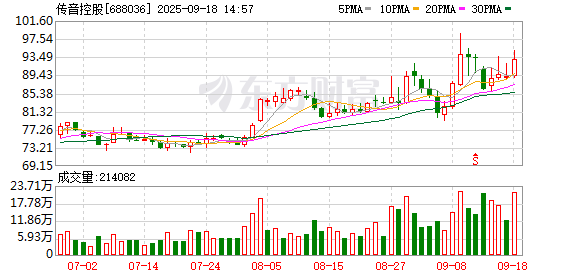
业绩“失速”下的“非洲手机之王”:控股股东拟套现18.66亿,38人共享 “财富盛宴”
Guo Ji Jin Rong Bao· 2025-09-18 06:57
Core Viewpoint - Transsion Holdings' controlling shareholder, Transsion Investment, successfully completed a share transfer, selling 22.807 million shares at a price of 81.81 CNY per share, raising approximately 1.866 billion CNY, which represents a discount of about 8.36% compared to the closing price on September 17 [1][2] Group 1: Share Transfer Details - Transsion Investment's shareholding was diluted to 49.15% prior to the transfer due to stock incentive plans, and after the transfer, it decreased to 47.15%, maintaining control over the company [1] - The share transfer involved 426 institutional investors, with 31 valid bids received, and 20 institutions allocated shares, including major players like Xingzheng Global Fund, which invested 832 million CNY [1][2] Group 2: Financial Performance - Transsion Holdings reported a significant decline in financial performance for the first half of 2025, with revenue of approximately 29.077 billion CNY, down 15.86% year-on-year, and net profit of about 1.213 billion CNY, down 57.48% [5][6] - The company has distributed substantial dividends, totaling 13.23 billion CNY since its IPO in 2019, with a cash dividend of 9.12 billion CNY in the first half of 2025, representing 75.22% of its net profit [5] Group 3: Market Position and Competition - Transsion Holdings, known as the "King of African Mobile Phones," has seen its market growth slow down, particularly in Africa, where revenue growth was only 2.97% last year compared to 6.74% in 2023 [6] - Despite still holding a 51% market share in Africa with 9.7 million units shipped in Q2 2025, the company's growth rate has significantly lagged behind competitors like Xiaomi and Honor, which reported growth rates of 32% and 161%, respectively [6]