统一行政权理论

Search documents
特朗普“治国”,靠它
Xin Lang Cai Jing· 2025-12-25 07:24
Core Viewpoint - The article discusses the unprecedented use of executive orders by Trump during his second term, highlighting the implications for American democracy and the balance of power among the branches of government [1][6][24]. Group 1: Executive Orders - Trump signed 220 executive orders within a year, significantly surpassing previous presidents, indicating a shift towards "governing by executive order" [1][6]. - In his first year, Trump issued over 40 executive orders on his first day and more than 200 in total, compared to 77 by Biden and 40 by Obama in their first years [16][21]. - A significant portion of Trump's executive orders invoked "emergency powers," with 30 out of 150 orders relying on such authority, a rate higher than any recent president [19][21]. Group 2: Legislative and Judicial Response - The U.S. Congress has shown minimal intervention, leading to a perception of weakened checks and balances, while the Supreme Court's independence has been questioned due to frequent government requests for intervention in major lawsuits [1][6][24]. - Over 20% of Trump's executive orders faced legal challenges, reflecting ongoing conflicts between the executive and judicial branches [6][23]. - Trump's administration often appealed judicial decisions, betting on the Supreme Court's support for its positions [6][23]. Group 3: Public Reaction and Protests - There have been widespread protests against Trump's policies, with themes like "no king" and calls to uphold the Constitution, indicating significant public dissent against perceived overreach [8][23]. - Protesters have criticized Congress for its inaction, expressing frustration over the lack of checks on Trump's administration [23][24]. Group 4: Implications for Governance - The article highlights a "legislative vacuum" due to increasing partisan divides, which has led to a failure of Congress to effectively govern [24][26]. - Trump's approach to governance through executive orders is seen as a challenge to the traditional understanding of the "unitary executive theory," raising concerns about the future expansion of presidential power [26][29].

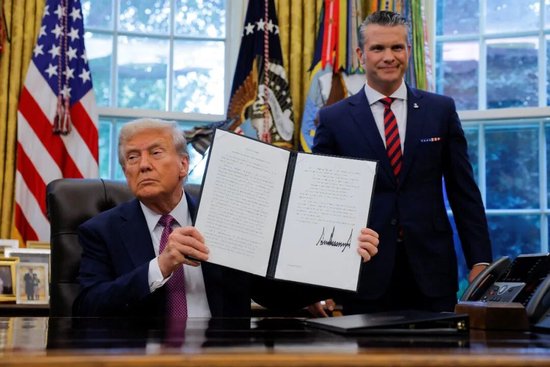
列国鉴·年终观察丨特朗普“行政令治国”冲击美式“三权分立”
Xin Hua She· 2025-12-25 01:20
Core Viewpoint - The article discusses the unprecedented use of executive orders by former President Trump, highlighting the implications for American democracy and the balance of power among government branches [1][6][11]. Group 1: Executive Orders - Trump signed 220 executive orders in nearly a year, significantly surpassing previous presidents [1][3]. - In his first year, Trump issued over 200 executive orders, while Biden signed 77 and Obama only 40 [3]. - Many of Trump's orders invoked "emergency powers" and emphasized national security, such as declaring a "national emergency" at the southern border [3][4]. Group 2: Judicial and Legislative Response - Trump's extensive use of executive orders has led to numerous judicial challenges, with over 20% of these orders facing lawsuits [7]. - The U.S. Congress has shown a lack of intervention, leading to a perception of diminished checks and balances [1][11]. - Trump's administration often appealed judicial decisions, relying on the Supreme Court to support its stance [8]. Group 3: Public Reaction and Protests - There have been widespread protests against Trump's policies, with slogans like "stop illegal deportations" and "constitutional crisis" appearing during demonstrations [10][12]. - Public sentiment reflects dissatisfaction with Congress's inaction, particularly regarding Trump's controversial policies [10]. Group 4: Implications for Governance - The article notes a "legislative vacuum" due to increasing partisan divides, which has weakened Congress's governance capabilities [11]. - Observers express concern that Trump's expansion of executive power could set a precedent for future administrations, potentially undermining the foundational principles of the U.S. government [13][14].
特朗普“行政令治国”冲击美式“三权分立”
Xin Lang Cai Jing· 2025-12-24 18:49
Core Viewpoint - The article discusses the unprecedented use of executive orders by Trump during his second term, highlighting the implications for the balance of power in the U.S. government and the resulting societal divisions and legal challenges [1][5][7]. Group 1: Executive Orders and Their Impact - Trump signed 220 executive orders within a year, significantly more than previous presidents, indicating a shift towards "governing by executive order" [1][3]. - The use of emergency powers has been a hallmark of Trump's administration, with 30 out of 150 executive orders invoking some form of emergency authority, a rate higher than any recent president [4][5]. - The emphasis on "national security" and "emergency" has allowed Trump to bypass traditional legislative processes, leading to rapid policy implementation [3][4]. Group 2: Judicial and Public Response - Over 20% of Trump's executive orders have faced legal challenges, reflecting ongoing conflicts between the executive and judicial branches [5][6]. - Public protests against Trump's policies have emerged, with slogans highlighting concerns over constitutional rights and the perceived overreach of executive power [6][7]. - The lack of congressional action has been criticized, with many citizens expressing disappointment in the Republican-controlled Congress for not countering Trump's initiatives [6][7]. Group 3: Theoretical Implications - The article notes that Trump's approach challenges the traditional understanding of the "unitary executive" theory, which posits that the president has broad authority over the executive branch [7]. - Observers warn that the expansion of presidential power under Trump could set a precedent for future administrations, potentially undermining the foundational principles of the U.S. system of checks and balances [7][8].
特朗普提名的劳工统计局局长新人选,为何引发美经济学界质疑?
Di Yi Cai Jing· 2025-08-12 07:47
Core Viewpoint - The nomination of E. J. Antoni as the new head of the Bureau of Labor Statistics (BLS) by President Trump has sparked significant criticism from economists and former officials regarding his qualifications and the potential implications for employment data accuracy [1][6][7]. Group 1: Nomination and Background - President Trump announced the nomination of E. J. Antoni, chief economist at the conservative Heritage Foundation, to lead the BLS, following the dismissal of the previous director amid allegations of data manipulation [1][3]. - Antoni has been a vocal critic of the BLS, previously questioning the reliability of its reports and labeling the Consumer Price Index (CPI) under the Biden administration as "false" [4][5]. Group 2: Economic Data Concerns - The recent employment report from BLS showed only 73,000 new jobs added in July, significantly below market expectations, and included a downward revision of 258,000 jobs for May and June [5]. - Critics argue that if BLS begins to release stronger employment data under Antoni, it could mislead macroeconomic researchers about the actual state of the economy, potentially impacting monetary policy decisions [1][6]. Group 3: Criticism of Antoni's Qualifications - Economists have raised concerns about Antoni's lack of relevant experience and expertise, with some noting that his academic background is not highly regarded and his published work is minimal compared to his predecessors [6][7]. - Prominent economists have publicly criticized the nomination, stating that Antoni's extreme partisanship and lack of technical knowledge could undermine the nonpartisan tradition of the BLS [7][8].