
综合赔付率

Search documents
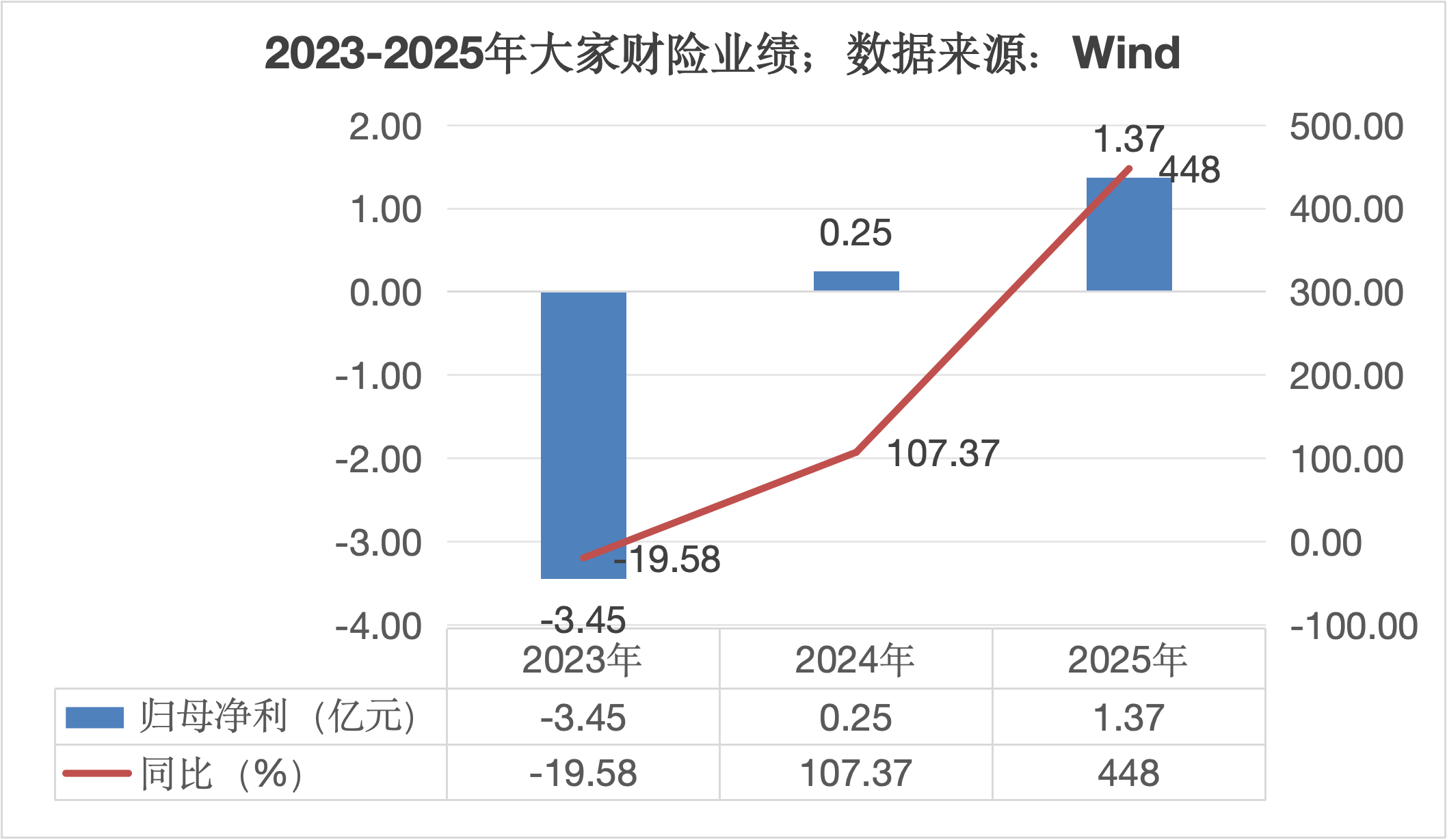
大家财险2025年保费破百亿,净利激增439%
Hua Er Jie Jian Wen· 2026-01-27 12:01
Core Insights - In 2025, Dajia Insurance achieved a significant milestone with total premiums reaching 10.648 billion yuan, marking a substantial recovery in profitability with a net profit of 137 million yuan, a 439% increase from 25.46 million yuan in 2024 [1][3] Group 1: Underwriting Performance - The company turned a profit in underwriting, reducing its combined cost ratio from 102.99% in 2024 to 99.83% in 2025, indicating a shift towards self-sustaining operations rather than relying solely on investment income [3] - The combined loss ratio improved from 62.75% to 61.03%, while the combined expense ratio was controlled at 38.81%, showcasing effective cost management amidst competitive pressures in the non-auto insurance sector [3] Group 2: Premium Growth - Dajia Insurance reported a total signed premium of 10.573 billion yuan in 2025, with auto insurance premiums accounting for 6.518 billion yuan, approximately 61.6% of the total, remaining a key revenue driver [5] - Non-auto insurance business also showed growth, with the top five non-auto insurance products generating a total premium of 1.823 billion yuan, reflecting significant year-on-year improvement [5] Group 3: Investment Performance - The financial investment yield for 2025 was 2.74%, an increase from 2.01% in 2024, but the overall investment return rate declined from 3.92% to 2.71%, indicating challenges in asset utilization efficiency [5] - Total assets reached 15.14 billion yuan, but the company needs to enhance the efficiency of fund utilization, especially given the slim profit margins from underwriting [5] Group 4: Cash Flow Situation - Although the net cash flow from operating activities turned positive in Q4 2025, the total net cash flow for the year was still negative at -190 million yuan, although this was an improvement from -790 million yuan in 2024 [6][7] - The ongoing negative cash flow indicates that the company's financial reserves are still in a recovery phase [7] Group 5: Future Outlook - 2025 is seen as a pivotal year for Dajia Insurance, crossing the survival threshold, but the management's challenge will be to effectively utilize nearly 3 billion yuan in net assets to achieve a dual-driven growth model in both investment and underwriting for 2026 [8]

河南:人身险公司退保率连续四年下降
Xin Lang Cai Jing· 2025-12-31 14:00
Core Insights - The banking and insurance sectors in Henan have shown significant growth during the "14th Five-Year Plan" period, effectively serving the real economy [1][2]. Banking Sector - Total assets of the banking and insurance industries in Henan reached nearly 15 trillion yuan, with total liabilities at 14.85 trillion yuan, marking a 50% increase compared to the end of the "13th Five-Year Plan" [1][2]. - The balance of deposits in both domestic and foreign currencies increased from 7.76 trillion yuan to 11.79 trillion yuan, reflecting a growth of 52.07% [1][2]. - The loan balance rose from 6.41 trillion yuan to 9.27 trillion yuan, representing a growth of 44.58% [1][2]. Insurance Sector - By the end of 2024, the insurance depth and density in Henan are projected to be 4.25% and 2761.43 yuan per person, respectively, with insurance density increasing by 9.49% compared to the end of the "13th Five-Year Plan" [1][2]. - The province's original insurance premium income for the year reached 270.586 billion yuan, with claims paid out amounting to 112.106 billion yuan, leading the central region [1][2]. - The total risk coverage provided by the insurance sector was 302.49 trillion yuan, nearly doubling since 2020 [1][2]. Risk Management in Insurance - The rate of policy surrenders in life insurance companies has decreased for four consecutive years [1][2]. - The comprehensive expense ratio for property insurance companies has decreased by 14.58 percentage points compared to the end of the "13th Five-Year Plan," while the comprehensive claims ratio has increased by 9.69 percentage points [1][2].
中国人寿、人保健康、太保产险、太平人寿等2025年上半年保险公司短期健康险的综合赔付率均超50%
Jing Ji Guan Cha Wang· 2025-09-24 09:00
Group 1 - The comprehensive payout ratio is an important indicator of the protection level of insurance products, with higher values indicating more compensation received by consumers [1] - Companies such as China Life, PICC Health, Taiping Property & Casualty, Taiping Life, PICC Life, and AXA Tianping have short-term health insurance comprehensive payout ratios exceeding 50% [1] - The median comprehensive payout ratio for short-term health insurance among 120 insurance companies is only 42.12%, with an average of 45% after excluding extreme values, which is considered low by industry professionals [2] Group 2 - Industry professionals suggest that a comprehensive payout ratio between 50% and 70% for short-term health insurance is more reasonable, as it ensures consumer experience and supports the stable operation of insurance companies [2]

平均赔付率45%,你买的短期健康险真的赔到了吗?
Jing Ji Guan Cha Bao· 2025-09-24 02:45
Core Viewpoint - The current state of short-term health insurance in China shows a low comprehensive claims ratio, indicating insufficient consumer protection and trust in insurance companies [2][3][8]. Group 1: Claims Ratio Analysis - The median comprehensive claims ratio for short-term health insurance among 120 insurance companies is only 42.12%, with an average of 45% after excluding extreme values [2][5]. - A claims ratio between 50% and 70% is considered reasonable for both consumer satisfaction and sustainable insurance company operations [4][10]. - The claims ratio for life insurance companies has increased from 38.83% in 2023 to 42.12% in the first half of 2025, while property insurance companies saw an increase from 38.70% to 42.30% [5]. Group 2: Company Performance - Few insurance companies achieve a claims ratio above 60%, with only 23 out of 120 companies falling within this range [5]. - Companies like China Life, Ping An Health, and Taikang Life have claims ratios above 50%, while others like Zhong An Insurance have a significantly lower ratio of 30.7% [8][9]. - Some companies report negative claims ratios due to low business volume, while others exceed 100% due to specific claims situations [6]. Group 3: Market Dynamics - The high operational costs associated with online customer acquisition and marketing are squeezing the claims payout space for insurance companies [9][14]. - The shift towards digital marketing has increased competition and customer acquisition costs, impacting the overall claims ratio [9][15]. - The importance of commercial health insurance is growing as basic medical insurance faces increasing financial pressure, highlighting the need for better integration and product offerings [11][12]. Group 4: Future Outlook - There is a recognized need to improve the claims ratio by at least 20 percentage points to enhance consumer experience and trust [13]. - Expanding the range of coverage and improving service efficiency are seen as critical paths to increasing the claims ratio and consumer satisfaction [15]. - Recent policy changes in Shanghai encouraging the use of personal medical accounts for group health insurance may open new avenues for growth in the commercial health insurance sector [15].
平均赔付率45%,你买的短期健康险真的赔到了吗?
经济观察报· 2025-09-24 02:30
Core Viewpoint - The comprehensive claim ratio of short-term health insurance in the industry is low, with a median of 42.12% and an average of 45%, indicating insufficient consumer protection and trust in insurance companies [1][3][4]. Summary by Sections Comprehensive Claim Ratio - The comprehensive claim ratio is a crucial indicator of insurance product protection, with a higher value indicating more payouts to consumers [4]. - The current ratio of around 45% is considered low, with industry professionals suggesting a more reasonable range of 50%-70% for better consumer experience and sustainable operations [4][11]. Trends Over Time - From 2023 to the first half of 2025, the median claim ratio for life insurance companies increased from 38.83% to 42.12%, while for property insurance companies, it rose from 38.70% to 42.30% [6]. - Among the insurers reporting data, 11 had negative claim ratios, and 9 exceeded 100%, with 44 companies falling between 0%-40% and 33 between 40%-60% [6]. Company Performance - Major insurers like China Life, Ping An Health, and others have claim ratios above 50%, while companies like Zhong An Insurance and Tai Kang Online have significantly lower ratios [11]. - The disparity in claim ratios among companies is influenced by their product focus, with those offering broader coverage typically having higher ratios [14]. Cost Structure and Profitability - Low claim ratios do not necessarily equate to high profits for insurance companies, as high operational costs can offset potential gains [13]. - The competitive landscape for acquiring customers, especially through digital channels, has led to increased costs, impacting claim ratios [13]. Market Dynamics - The importance of commercial health insurance is growing, especially with reforms in payment methods that open new opportunities for development [16]. - The current short-term health insurance products primarily cover out-of-pocket expenses after basic insurance reimbursements, often with high deductibles [16]. Future Outlook - There is a recognized need to improve the claim ratio by at least 20 percentage points to enhance consumer satisfaction and trust [16]. - Strategies to increase consumer engagement and expand coverage are being explored, including targeting sub-healthy and sick populations [18][19]. - Government initiatives to support group health insurance purchases may provide a significant boost to the commercial health insurance market [20].





平均赔付率45% 你买的短期健康险真的赔到了吗?
Jing Ji Guan Cha Bao· 2025-09-24 02:16
Core Viewpoint - The current state of short-term health insurance in China shows a low comprehensive claims ratio, indicating insufficient consumer protection and trust in insurance companies [2][3][8]. Claims Ratio Analysis - The median comprehensive claims ratio for short-term health insurance from 2023 to mid-2025 has increased from 38.83% to 42.12% for life insurance companies, and from 38.70% to 42.30% for property insurance companies [4]. - A total of 120 insurance companies reported a median claims ratio of 42.12%, with an average of 45% after excluding outliers [2][4]. - Only 19.1% of the companies reported a claims ratio between 60% and 100%, indicating that achieving a higher claims ratio is challenging [4]. Company Performance - Companies like China Life, Ping An Health, and Taikang Life have reported claims ratios above 50%, while others like ZhongAn Insurance and Taikang Online have much lower ratios, indicating a disparity in performance among insurers [8][9]. - Some companies reported negative claims ratios due to low business volume, while others exceeded 100% claims ratios, highlighting the variability in the market [5][8]. Market Dynamics - The low claims ratios are attributed to high operational costs, including online marketing and distribution expenses, which compress the space for actual claims payouts [9][10]. - The insurance market is seeing a shift towards digital marketing and the need for companies to adapt to changing consumer behaviors and expectations [9][14]. Future Outlook - There is a consensus among industry experts that the ideal claims ratio for short-term health insurance should be between 50% and 70% to ensure consumer satisfaction and company sustainability [3][12]. - The increasing pressure on basic medical insurance funds highlights the growing importance of commercial health insurance, especially with the implementation of new payment methods [10][11]. - Innovations in insurance products and expanding coverage to include more health-related services are seen as necessary steps for improving claims ratios and consumer trust [13][14].