
网络生态治理

Search documents
网信事业服务支撑保障“十五五”开局 市委网络安全和信息化委员会会议举行
Jie Fang Ri Bao· 2026-02-27 01:33
Group 1 - The meeting emphasized the importance of strengthening the network security defense and promoting high-quality development in the internet and information sector to support the successful start of the "14th Five-Year Plan" [1][2] - The meeting highlighted the need for a coordinated approach to internet governance, focusing on the integration of management, governance, and utilization of the internet [2] - There is a strong emphasis on enhancing the governance of the online ecosystem and promoting positive online content, while ensuring the correct political direction and ideological guidance [2][3] Group 2 - The meeting called for deepening the application of information technology to promote new productive forces and emphasized the importance of technological innovation in the internet sector [3] - It was noted that the development of the internet industry should be prioritized, particularly in strengthening the software and information services sector [3] - The meeting underscored the need to balance development and security, enhancing the capabilities for network security and modernizing the network security system [3]
以网信事业高质量发展新成效助力实现“十五五”良好开局!上海市委网信委会议举行
Di Yi Cai Jing· 2026-02-26 11:57
Group 1 - The meeting emphasized the need to strengthen the long-term mechanism for network ecological governance and enhance the role of information technology in driving development, aiming to solidify the network security defense [1][2] - It was highlighted that the network information sector must support and ensure a good start for the "14th Five-Year Plan," with a focus on leadership from the Party and a coordinated approach to governance [1][2] - The meeting called for the promotion of online positive energy, correct political direction, and the enhancement of quality content supply in the internet space to foster a prosperous new public culture [2] Group 2 - The meeting stressed the importance of deepening the application of information technology to promote new productive forces, emphasizing technological innovation and the development of key core technologies [2] - It was noted that the network security defense must be prioritized, with a focus on improving protective capabilities and modernizing the network security system [2] - The meeting reviewed the work situation for Shanghai's network information sector for 2025 and discussed key points for 2026, including the approval of measures to strengthen network ecological governance [3]
官方通报:医院网站被篡改为赌博色情网站,已注销
Xin Lang Cai Jing· 2026-02-25 12:51
Group 1 - The core viewpoint of the article emphasizes the efforts of the Puyang City Cyberspace Administration to enhance online ecological governance and maintain a clean and orderly online environment through a series of special actions [1][2][3] Group 2 - Case 1 highlights a hospital in Puyang that failed to fulfill its cybersecurity responsibilities, leading to its website being illegally altered into a gambling and pornography site. The hospital has since complied with the directive to cancel its idle domain [1] - Case 2 involves a social media account that falsely reported a fire incident in Puyang County, causing public panic. The local cyberspace department acted quickly to remove the misleading content [1] - Case 3 discusses an individual who spread false information regarding school fees in Fan County, disrupting online order. The individual was educated on the consequences and removed the harmful content [1] - Case 4 features a user who disseminated false information about fireworks regulations for 2026, resulting in negative social impact. Authorities mandated the user to clear the false content [2] - Case 5 addresses a video promoting vulgar wedding customs that incited gender conflict and spread negative values. The content was swiftly removed by the local cyberspace department [2] - Puyang City plans to continue strengthening collaborative regulation among internet-related departments to effectively address online chaos and promote a healthy online environment [2]
【光明时评】推动网络生态治理“硬约束”与“软自觉”深度融合
Xin Lang Cai Jing· 2026-02-12 20:33
Group 1 - The core viewpoint of the article emphasizes the importance of a structured and healthy online environment for minors, as highlighted by the recent release of the classification method for online information that may affect minors' physical and mental health by eight government departments in China [1][2][3] - The "14th Five-Year Plan" suggests a commitment to a comprehensive national security perspective and a path of socialist social governance, which includes the need for a vibrant and orderly online ecosystem [2] - The article discusses the necessity of integrating responsibilities across various levels and departments to effectively manage online content, utilizing education, administrative measures, and legal frameworks to address prominent issues in the online space [2][3] Group 2 - The article stresses the need for a legal framework to support a well-ordered online ecosystem, as emphasized by Xi Jinping's call for decisive action against online chaos that harms public interests [3] - It highlights the importance of a systematic approach to identify and address weaknesses in online governance, ensuring that measures are taken to eliminate the conditions that allow online chaos to thrive [3] - The term "possible" in the classification method reflects a nuanced understanding of the complexities of online information dissemination, allowing for targeted and practical regulatory measures for the protection of minors [3] Group 3 - Mainstream media is encouraged to take an active role in addressing social issues from the perspective of the public, responding to societal demands, and enhancing user engagement through authoritative reporting [4] - The article advocates for a combination of hard regulatory measures and soft self-discipline among online platforms and media to foster a responsible online environment, moving away from a "traffic-first" mentality [4] - It concludes that a healthy online ecosystem, characterized by both vibrancy and order, is essential for nurturing a positive cultural environment and supporting the broader goals of national rejuvenation [4]
浙江省委宣传部副部长、省委网信办主任赵磊:守正创新、辩证施策,全力推动网络生态治理工作迈上新台阶
Xin Lang Cai Jing· 2026-02-09 10:01
Core Viewpoint - The speech by General Secretary Xi Jinping emphasizes the importance of strengthening internet ecological governance as a crucial task for building a cyber power, which is vital for national development, security, and the interests of the people [2][3]. Summary by Relevant Sections Theoretical Insights - The speech highlights the need for a comprehensive approach to internet governance, emphasizing the importance of party leadership, people-centered policies, rule of law, and systematic thinking [1][2]. Mission and Direction - Internet ecological governance is positioned as a key task in national governance, requiring enhanced political and leadership responsibilities to form a cohesive governance framework under centralized leadership [2][3]. Strategic Blueprint - Xi Jinping outlines major tasks for internet ecological governance, including promoting positive voices, combating illegal activities, encouraging technological development, and enhancing international cooperation [2][3]. High-Quality Governance Framework - Zhejiang province is actively implementing the speech's directives, focusing on six major systems for comprehensive governance, including promoting mainstream values and enhancing regulatory measures [3][4]. Key Focus Areas - The province's efforts include: - Promoting positive online narratives through major campaigns, achieving over 1.2 billion views on specific topics [3]. - Strengthening regulatory oversight of internet platforms and conducting special actions to address issues like online rumors [4]. - Fostering social cooperation in governance through initiatives like the "Good Netizen" project and various forums [5][6]. - Establishing legal frameworks for combating false information and enhancing law enforcement capabilities [5][6]. - Advancing technological governance through the creation of a chief cybersecurity officer system and improving data security measures [7][8]. Future Directions - Zhejiang aims to further implement Xi Jinping's governance principles, focusing on creating a clean and positive online environment while balancing development and security [6][7].
持续呵护网络空间的“绿水青山”
Xin Lang Cai Jing· 2026-02-01 18:19
Core Viewpoint - The article emphasizes the importance of a healthy and orderly online environment for the prosperity and development of cyberspace, highlighting the need for continuous efforts in governance to combat misinformation and harmful content [1][3][5]. Group 1: Achievements in Cyber Governance - Since the 18th National Congress, significant progress has been made in China's cyber governance, including the introduction of laws such as the Cybersecurity Law and Data Security Law, and the implementation of initiatives like the "Qinglang" series [2]. - The governance approach is characterized by adherence to party leadership, prioritizing people's interests, and a commitment to innovation and legal safeguards [2]. Group 2: Challenges in Cyber Governance - Despite achievements, new challenges such as AI-generated rumors and hidden online violence continue to emerge, indicating that governance efforts must be persistent and adaptable [2][5]. - The complexity and recurrence of online issues necessitate a long-term commitment to governance strategies, requiring continuous learning and innovation [5][6]. Group 3: Collaborative Efforts for a Healthy Online Space - Creating a positive online environment requires collaboration among government, enterprises, social organizations, and netizens, forming a strong synergy for governance [4]. - The government should enhance legislation and regulation, while internet platforms must take social responsibility by improving content review and user management [4]. Group 4: Long-term Commitment to Cyber Governance - Establishing a clear and positive online space is a long-term and challenging task that requires sustained efforts and adaptability to new developments in technology and online applications [5][6]. - International cooperation and sharing of governance experiences are essential to address global cyber challenges and promote a community of shared future in cyberspace [5][6].
石经海:以法治思维构建网络犯罪防治体系
Xin Lang Cai Jing· 2026-01-31 15:24
Core Viewpoint - The increasing prevalence of cybercrime poses significant governance challenges in the digital age, necessitating a shift from reactive measures to a comprehensive prevention and control system, as outlined in the draft of the Cybercrime Prevention Law [1][2]. Group 1: Challenges and Legislative Needs - Cybercrime is characterized by "technology-driven, cross-border collaboration, and ecological symbiosis," which surpasses traditional legal boundaries, creating a chaotic management of online resources and a need for systematic regulation [1][2]. - Existing legal frameworks, such as the Criminal Law and Cybersecurity Law, focus on post-event punishment and lack stringent preventive measures, leading to a fragmented governance structure that necessitates specialized legislation [2]. Group 2: Comprehensive Governance Concepts - The Cybercrime Prevention Law aims to address the unique aspects of cybercrime, emphasizing source prevention, clear delineation of responsibilities, and cross-border cooperation [3][8]. - The draft law proposes a comprehensive management of online resources, including strict regulations on mobile phone cards and online accounts to reduce criminal opportunities [3][4]. Group 3: Ecological Governance Framework - The draft law establishes a full-chain governance framework targeting the entire criminal process, from upstream vulnerabilities to downstream financial settlements, addressing the "industrialization" of cybercrime [5][6]. - It aims to regulate high-risk areas and new forms of crime, including personal information black markets and virtual currency risks, creating a dual defense mechanism [6]. Group 4: Platform Responsibility - The draft law introduces a tiered responsibility system for platforms, requiring them to establish dedicated teams for crime prevention and to comply with specific obligations based on their service type [7]. - It mandates that service providers monitor and report suspicious activities, with penalties for non-compliance, thereby enhancing accountability [7]. Group 5: Cross-Border Governance - The draft law allows for the prosecution of foreign entities that harm domestic interests, addressing the challenges of cross-border cybercrime [8]. - It outlines a collaborative mechanism among various domestic departments and emphasizes international cooperation to combat cross-border offenses [8]. Group 6: Rights Protection - The draft law establishes a multi-dimensional rights protection mechanism for victims, including civil liability for damages and provisions for public interest litigation [9]. - Special attention is given to protecting minors, with specific penalties for violations against their rights [9]. Group 7: Systematic Cybersecurity Governance - The Cybercrime Prevention Law signifies a shift towards systematic and refined governance of cybercrime, aiming to balance crime prevention with the protection of legitimate rights and innovation [10]. - It emphasizes the need for a collaborative governance framework involving legal norms, administrative regulation, industry self-discipline, technical support, and social education to effectively address the complexities of cybercrime [10].
构筑清朗空间:网络生态治理的原则、价值与路径
Xin Lang Cai Jing· 2026-01-23 22:57
Core Viewpoint - The governance of the online ecosystem is a crucial task for building a strong digital nation, impacting national development, security, and the interests of the people [1] Group 1: Basic Principles of Online Ecosystem Governance - The governance must unify the leadership of the Party and a people-centered approach, ensuring that governance work is politically stable and responsive to the needs of internet users [1] - Governance should combine rule of law and technological empowerment, enhancing the legal framework while utilizing advanced technologies like big data and AI for effective governance [2] - A systematic approach is necessary, coordinating various relationships and implementing precise strategies for different types of online behaviors [2] Group 2: Core Values of Online Ecosystem Governance - Security value is fundamental, focusing on political, ideological, data, and social security to create a safe online environment [3] - Order value aims to establish a clear and orderly digital space, addressing misinformation and ensuring fair competition [4] - Vitality value emphasizes the need for innovation and cultural prosperity, allowing for the growth of new technologies and cultural products [5] - Justice value seeks to promote digital inclusivity and protect rights, ensuring equitable access to digital resources and legal protections for users [5] Group 3: Practical Paths for Online Ecosystem Governance - Strengthening the legal system is essential, with a focus on refining laws related to cybersecurity, data protection, and personal information [6] - Enhancing technological governance involves building monitoring platforms and developing advanced tools for risk detection and management [6] - Platforms must be held accountable, ensuring they have clear rules and adequate resources for content management and user protection [6] - International cooperation is vital for establishing global governance frameworks and enhancing collaboration in combating cybercrime [7] - Promoting online civility and consensus through education and cultural initiatives is necessary to foster a positive online environment [7]
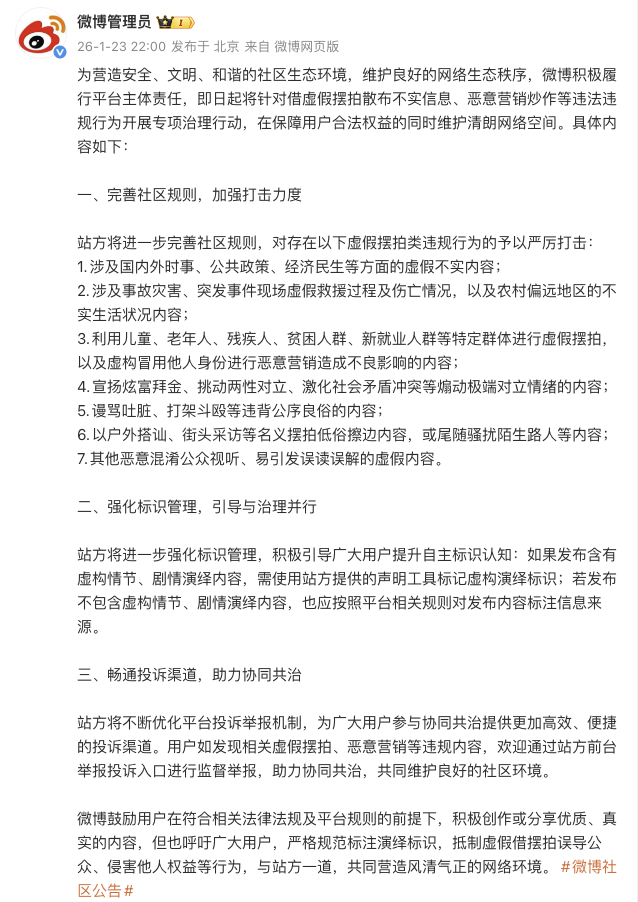
微博:针对借虚假摆拍散布不实信息、恶意营销炒作等违法违规行为开展专项治理行动
Xin Lang Cai Jing· 2026-01-23 14:47
Core Viewpoint - Weibo has announced a special governance action to combat the spread of false information and malicious marketing practices, aiming to create a safe and harmonious community environment while maintaining a clear online space [1][2]. Group 1: Strengthening Community Rules - Weibo will enhance community rules and increase the crackdown on various types of false content, including misinformation related to current events, public policies, and economic issues [2] - The platform will target false narratives surrounding accidents, disasters, and the living conditions of vulnerable groups [2] - Content that promotes extreme social divisions, such as wealth flaunting or inciting gender conflicts, will also be strictly addressed [2] - Weibo will take action against content that violates public morals, including abusive language and violent behavior [2] - The platform will prohibit lowbrow content disguised as street interviews or outdoor interactions, as well as any misleading content that confuses the public [2] Group 2: Enhancing Identification Management - Weibo will strengthen identification management and encourage users to improve their awareness of content labeling [3] - Users must use the platform's provided tools to mark fictional or dramatized content, and properly cite sources for non-fictional content [3] Group 3: Improving Complaint Channels - Weibo will optimize its complaint and reporting mechanisms to facilitate user participation in governance [4] - Users are encouraged to report any violations related to false content or malicious marketing through the platform's reporting channels [4] - The platform calls for users to create and share quality, truthful content while adhering to labeling regulations to help maintain a positive online environment [4]


护人民群众安居乐业!中央政法工作会议作出部署
Xin Lang Cai Jing· 2026-01-19 21:14
Group 1 - The central government emphasizes the importance of public safety as a fundamental aspect of people's livelihood, aiming for a national public security satisfaction rate of 98.23% by 2025, maintaining above 98% for six consecutive years [1] - The meeting highlights the need for strict law enforcement against severe violent crimes, including murder and extreme personal violence, as well as ongoing efforts to combat organized crime and telecommunications fraud [2] - The government plans to enhance the legal framework to protect the market economy, focusing on strict enforcement against illegal fundraising and financial fraud, while ensuring fair and just judicial processes [3] Group 2 - The meeting outlines a commitment to prevent and address juvenile delinquency, with a goal of reducing the number of juvenile crime cases and cases of harm against minors by 9.8% and 2.2% respectively by 2025 [3] - A structured intervention and correction system for juvenile offenses will be established, integrating educational and corrective measures to better support at-risk youth [3] - The overarching goal is to build a safer society, ensuring national security and social stability, while striving for a higher level of public safety in China [4]