
数字普惠

Search documents
156万银发族用千问体验“一句话点外卖”
Xin Jing Bao· 2026-02-12 09:17
Core Insights - The "Qianwen App" launched a promotional campaign called "Spring Festival 3 Billion Free Orders," which resulted in users making 4.1 billion requests for assistance and over 120 million orders completed by AI within six days [1] - The campaign significantly boosted consumption, particularly in county-level cities, with nearly half of the orders coming from these areas, and 1.56 million elderly users trying food delivery services for the first time [1][2] Group 1 - The AI technology has enhanced consumer experience and stimulated new consumption vitality across various demographics and city tiers [1] - The "Milk Tea Free Order" promotion gained traction on social media, leading to a surge in instant retail orders for snacks, beverages, and other holiday goods [1] - Retail orders for items such as hair dye products, gift flowers, and emergency baby supplies saw over a tenfold increase since the campaign's launch [1] Group 2 - The convenience of AI-enabled "one-sentence food delivery" has allowed the elderly demographic to benefit from digital consumption [2] - Among users in county areas utilizing AI for shopping, nearly 10% are aged 50 and above, indicating a growing trend of older consumers engaging with digital retail [2]

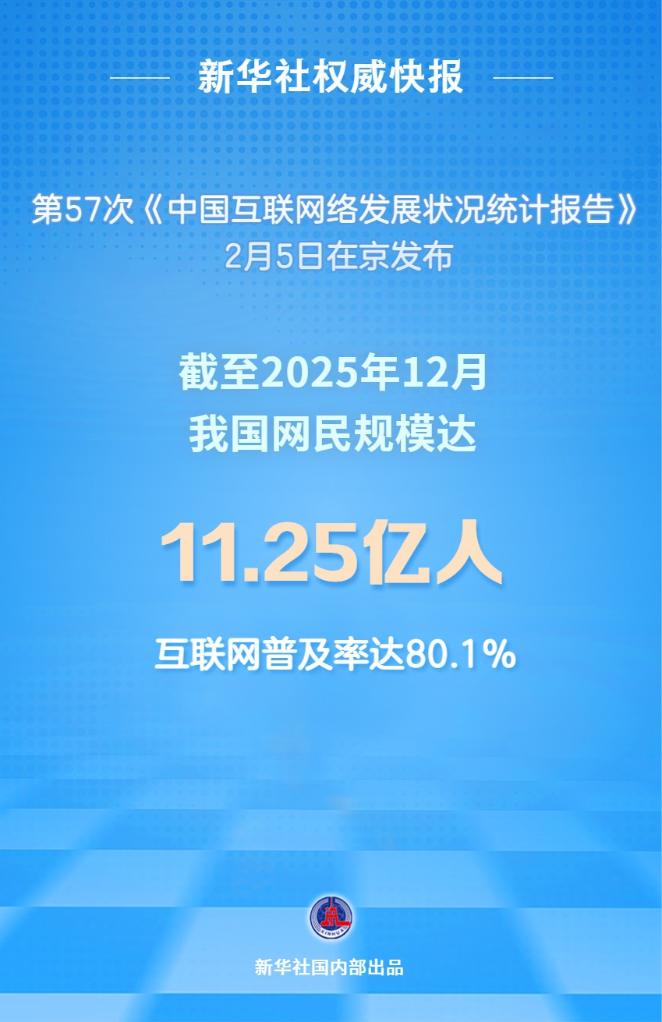
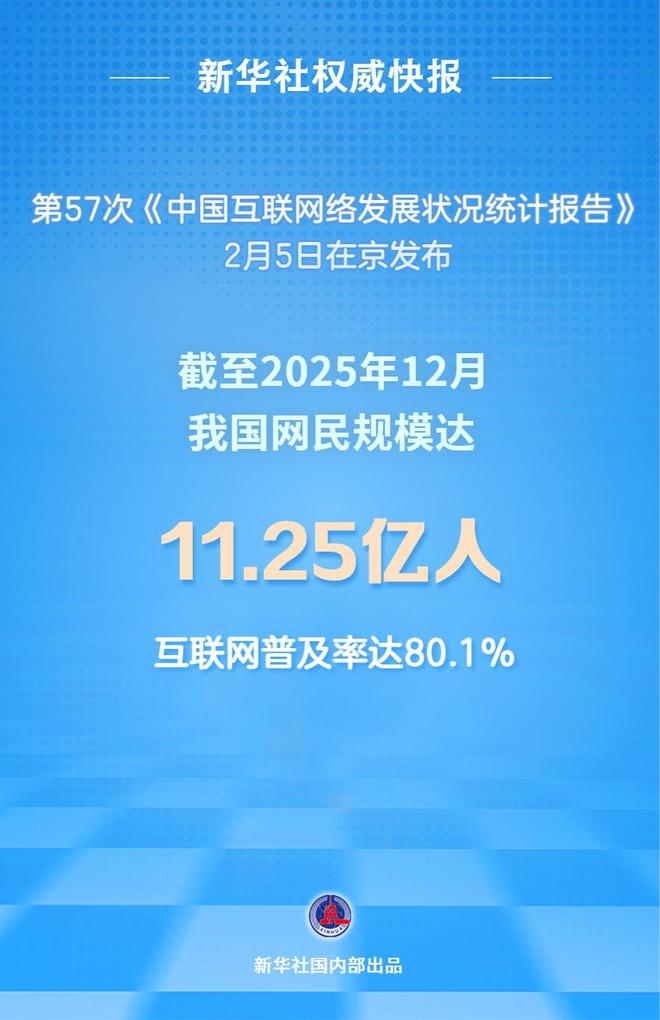
互联网普及率超80% 数智生活向新向好
Xin Hua She· 2026-02-06 01:24
Core Insights - The report indicates that by December 2025, China's internet user base is projected to reach 1.125 billion, with an internet penetration rate of 80.1% [3][5] - The user base for generative artificial intelligence is expected to reach 602 million, reflecting a growth of 141.7% compared to the end of 2024 [6] Group 1: Internet Infrastructure Development - China has established the world's largest and technologically advanced information and communication network, enhancing the connectivity for economic and social development [5] - As of December 2025, the internet penetration rate has increased by 9.7 percentage points since the beginning of the 14th Five-Year Plan, with rural internet penetration at 69.5% and internet usage among individuals aged 60 and above at 53.7% [5] Group 2: Artificial Intelligence Integration - AI applications are becoming increasingly prevalent across various sectors, including steel, electricity, and telecommunications, enhancing product development, quality inspection, and customer service [7] - The integration of AI into daily life and production is seen as a key driver for the digital and intelligent transformation of society [6] Group 3: Digital Services and Quality of Life - By December 2025, the number of online government service users is expected to reach 940 million, providing efficient services throughout the lifecycle of enterprises and individuals [8] - The online healthcare user base is projected to be 411 million, with over 200 inter-recognition projects for medical examination results across all provinces [8] - Online education users are expected to reach 327 million, with an increasing number of digital educational resources available on the national smart education public service platform [8]

数智生活向“新”向“好”
Xin Lang Cai Jing· 2026-02-05 18:10
Group 1: Internet Development - As of December 2025, the number of internet users in China is projected to reach 1.125 billion, with an internet penetration rate of 80.1%, reflecting a 9.7 percentage point increase since the beginning of the 14th Five-Year Plan [2][5] - The construction of a leading global information and communication network has been completed, with 4.838 million 5G base stations built, covering over 330 cities, significantly enhancing network service penetration [2][3] Group 2: AI Application Growth - The user base for generative artificial intelligence is expected to reach 602 million by December 2025, representing a 141.7% increase from the end of 2024 [4] - AI applications are increasingly integrated into key industries such as steel, electricity, and telecommunications, enhancing product development, quality inspection, and customer service [4][3] Group 3: Digital Inclusion and Quality of Life - Online government service users are projected to reach 940 million, providing efficient services that cover the entire lifecycle of businesses and individuals [5] - The online healthcare user base is expected to reach 411 million, with over 200 projects for mutual recognition of medical examination results among local medical institutions implemented across all provinces [5] - Online education users are anticipated to reach 327 million, with a growing number of digital educational resources available on the national smart education public service platform [5]
互联网普及率超80%!数智生活向“新”向“好”
Xin Hua She· 2026-02-05 14:07
Group 1: Internet Development in China - As of December 2025, the number of internet users in China is projected to reach 1.125 billion, with an internet penetration rate of 80.1% [1][3] - The internet penetration rate has increased by 9.7 percentage points since the beginning of the 14th Five-Year Plan, with rural internet penetration at 69.5% and internet usage among individuals aged 60 and above at 53.7% [5] Group 2: 5G Infrastructure and Network Services - China has built 4.838 million 5G base stations, covering over 330 cities, significantly enhancing the penetration of various network services [5] - Two-thirds of prefecture-level cities have achieved gigabit city standards, and pilot projects for 10-gigabit optical networks have been initiated in some cities [5] Group 3: Artificial Intelligence Adoption - The user base for generative artificial intelligence in China is expected to reach 602 million by December 2025, representing a growth of 141.7% compared to the end of 2024 [7] - AI applications are increasingly penetrating key industries such as steel, electricity, and telecommunications, impacting product development, quality inspection, and customer service [7][6] Group 4: Digital Services and Quality of Life - The number of online government service users is projected to reach 940 million, providing efficient services that cover the entire lifecycle of businesses and individuals [8] - Online healthcare users are expected to reach 411 million, with over 200 projects for mutual recognition of inspection results among medical institutions across all provinces [8] - The online education user base is anticipated to reach 327 million, with more digital educational resources available on the national smart education public service platform [8]
新华鲜报 | 互联网普及率超80%!数智生活向“新”向“好”
Xin Hua She· 2026-02-05 13:53
Group 1: Internet Penetration and Infrastructure - As of December 2025, the number of internet users in China is projected to reach 1.125 billion, with an internet penetration rate of 80.1%, an increase of 9.7 percentage points since the beginning of the 14th Five-Year Plan [2][5] - China has built a leading global information and communication network with 4.838 million 5G base stations, covering over 330 cities, significantly enhancing network service penetration [2][3] - The rural internet penetration rate is 69.5%, and the internet usage rate among individuals aged 60 and above is 53.7%, indicating broader access to digital services [2] Group 2: AI Application and Growth - The user base for generative artificial intelligence is expected to reach 602 million by December 2025, representing a growth of 141.7% compared to the end of 2024 [4] - AI applications are increasingly integrated into key industries such as steel, electricity, and telecommunications, enhancing product development, quality inspection, and customer service [4][3] - AI is becoming a crucial driver for the digital and intelligent transformation of society, with applications ranging from personalized travel planning to agricultural robotics [3] Group 3: Digital Inclusion and Quality of Life - The number of users for online government services is projected to reach 940 million by December 2025, providing efficient services that cover the entire lifecycle of businesses and individuals [5] - Online healthcare services are expected to have 411 million users, with over 200 projects for mutual recognition of medical examination results across cities [5] - The online education user base is anticipated to reach 327 million, with more digital educational resources becoming available through the national smart education public service platform [5]
新华鲜报丨互联网普及率超80%!数智生活向“新”向“好”
Xin Hua She· 2026-02-05 12:56
Core Insights - As of December 2025, the number of internet users in China is projected to reach 1.125 billion, with an internet penetration rate of 80.1% [1][3] - The user base for generative artificial intelligence is expected to grow to 602 million, representing a 141.7% increase from the end of 2024 [7] Group 1: Internet Development - China has established the world's largest and technologically advanced information and communication network, facilitating economic and social development [5] - The country has built 4.838 million 5G base stations, covering over 330 cities, which supports the penetration of various network services [5] - By December 2025, the internet penetration rate is expected to increase by 9.7 percentage points from the beginning of the 14th Five-Year Plan, with rural internet penetration at 69.5% and 53.7% of internet users aged 60 and above [5] Group 2: Artificial Intelligence Integration - AI applications are rapidly integrating into daily life and production, serving as a key driver for digital and intelligent transformation [6] - Generative AI is being applied across key industries such as steel, electricity, and telecommunications, enhancing product development, quality inspection, and customer service [7] Group 3: Digital Inclusion and Quality of Life - The online government service user base is expected to reach 940 million, providing efficient services throughout the lifecycle of enterprises and individuals [8] - Online healthcare users are projected to reach 411 million, with over 200 projects for mutual recognition of inspection results among medical institutions across all provinces [8] - The online education user base is anticipated to grow to 327 million, with more digital educational resources becoming available on the national smart education public service platform [8]
新华鲜报|互联网普及率超80%!数智生活向“新”向“好”
Xin Hua She· 2026-02-05 12:41
Group 1: Internet Development in China - As of December 2025, the number of internet users in China is projected to reach 1.125 billion, with an internet penetration rate of 80.1% [1][3] - The internet penetration rate has increased by 9.7 percentage points since the beginning of the 14th Five-Year Plan, with rural internet penetration at 69.5% and internet usage among individuals aged 60 and above at 53.7% [5] Group 2: AI Adoption and Growth - The user base for generative artificial intelligence in China is expected to reach 602 million by December 2025, representing a growth of 141.7% compared to the end of 2024 [7] - AI applications are increasingly integrated into key industries such as steel, electricity, and telecommunications, enhancing product development, quality inspection, and customer service [7] Group 3: Digital Services and Quality of Life - The number of users for online government services is projected to reach 940 million, providing efficient services that cover the entire lifecycle of businesses and individuals [8] - Online healthcare services are expected to have 411 million users, with over 200 projects for mutual recognition of inspection results among medical institutions across all provinces [8] - The online education user base is anticipated to reach 327 million, with more digital educational resources becoming available on the national smart education public service platform [8]
构筑清朗空间:网络生态治理的原则、价值与路径
Xin Lang Cai Jing· 2026-01-23 22:57
Core Viewpoint - The governance of the online ecosystem is a crucial task for building a strong digital nation, impacting national development, security, and the interests of the people [1] Group 1: Basic Principles of Online Ecosystem Governance - The governance must unify the leadership of the Party and a people-centered approach, ensuring that governance work is politically stable and responsive to the needs of internet users [1] - Governance should combine rule of law and technological empowerment, enhancing the legal framework while utilizing advanced technologies like big data and AI for effective governance [2] - A systematic approach is necessary, coordinating various relationships and implementing precise strategies for different types of online behaviors [2] Group 2: Core Values of Online Ecosystem Governance - Security value is fundamental, focusing on political, ideological, data, and social security to create a safe online environment [3] - Order value aims to establish a clear and orderly digital space, addressing misinformation and ensuring fair competition [4] - Vitality value emphasizes the need for innovation and cultural prosperity, allowing for the growth of new technologies and cultural products [5] - Justice value seeks to promote digital inclusivity and protect rights, ensuring equitable access to digital resources and legal protections for users [5] Group 3: Practical Paths for Online Ecosystem Governance - Strengthening the legal system is essential, with a focus on refining laws related to cybersecurity, data protection, and personal information [6] - Enhancing technological governance involves building monitoring platforms and developing advanced tools for risk detection and management [6] - Platforms must be held accountable, ensuring they have clear rules and adequate resources for content management and user protection [6] - International cooperation is vital for establishing global governance frameworks and enhancing collaboration in combating cybercrime [7] - Promoting online civility and consensus through education and cultural initiatives is necessary to foster a positive online environment [7]
激活区域发展新动能 张店农商银行做实普惠金融大文章
Jin Rong Shi Bao· 2025-12-25 04:18
Core Viewpoint - Shandong Zhangdian Rural Commercial Bank emphasizes the political and people-oriented nature of financial work, focusing on enhancing inclusive finance to support the real economy and high-quality development through four main paths: party building, technological empowerment, service penetration, and scenario expansion [1]. Group 1: Party Building - The bank constructs a "government-bank-enterprise" inclusive ecosystem, collaborating with local government and community organizations to enhance financial service delivery [2]. - Zhangdian Rural Commercial Bank has signed 31 strategic cooperation framework agreements with various local organizations since 2024, establishing 77 community projects to deepen financial services [3]. - The bank has built 22 financial service stations covering 55 administrative villages and communities, creating a good ecosystem for inclusive finance [3]. Group 2: Technological Empowerment - The bank utilizes digital marketing and data analysis to identify customer needs, successfully providing 4 million yuan in credit to a high-tech enterprise in need of funds [4]. - A digital marketing team has processed data from 94,000 customers, identifying 4,650 potential clients for targeted services, significantly improving service efficiency [5]. - The bank has achieved a 99.45% visit rate for targeted clients, providing a total of 267 million yuan in credit support [5]. Group 3: Service Penetration - Zhangdian Rural Commercial Bank has implemented a "small and micro enterprise financing coordination mechanism," enabling rapid loan disbursement, such as an 8 million yuan loan to a company facing funding challenges [7]. - The bank has established a daily loan review mechanism to enhance the efficiency of inclusive loan disbursement, issuing 1.16 billion yuan in loans to 171 small enterprises this year [8]. Group 4: Scenario Expansion - The bank collaborates with the Baoshan Ecological Technology Park to create a financial service center, providing comprehensive services to resident enterprises, including specialized products like intellectual property pledge loans [9]. - The bank has engaged with 14 local business associations, visiting 810 enterprises and facilitating loans totaling 148 million yuan [10]. - The bank promotes a "financing + intelligence + technology" ecosystem, integrating financial services with consumer scenarios to enhance the overall service offering [10].
长三角议事厅·周报|沪苏同城化:硬联通之后,还需算四本账
Xin Lang Cai Jing· 2025-12-22 07:57
Core Insights - The integration of Shanghai and Suzhou has reached a significant milestone with improved transportation links, but the next phase focuses on smoother operational integration rather than just speed [1][2][3] - The recent proposal by the Jiangsu Provincial Party Committee emphasizes the need for Suzhou to transition from merely learning from Shanghai to fully integrating with it, highlighting the importance of addressing discrepancies in standards, interests, and assessments [1][2] Group 1: Hard Connectivity Achievements - The Shanghai Metro Line 11 has been extended to Kunshan, and high-speed rail travel between Suzhou North Station and Shanghai Hongqiao has been reduced to approximately 23 minutes [1] - The combined GDP of Shanghai and Suzhou is projected to exceed 8 trillion yuan in 2024, with Shanghai at 5.39 trillion yuan and Suzhou at 2.67 trillion yuan [1] Group 2: Soft Frictions in Integration - The main challenges in the integration process are categorized into three types of "soft frictions": differences in standards and processes, difficulties in benefit distribution, and structural constraints from assessment and competition logic [2][3] - The fragmentation in standards and processes leads to increased hidden costs for businesses operating across cities, as multiple recognitions and submissions are required [2] Group 3: Institutional Tools for Collaboration - Effective solutions to the identified soft frictions involve creating executable, assessable, and replicable institutional tools rather than merely increasing coordination meetings [4][5] - The Long Triangle Ecological Green Integration Development Demonstration Zone has successfully transformed cross-provincial collaboration from project-based to rule-based, addressing common bottlenecks with a practical "toolbox" approach [4] Group 4: Focus on Public Welfare - The integration's success is also measured by its impact on public welfare, with initiatives to streamline cross-city services such as social security transfers and public housing loans, aiming for completion within three working days [5] - The establishment of a unified social security card system aims to enhance daily experiences of integration by covering various services like transportation and library access [5] Group 5: Expanding Institutional Frameworks - The current focus should be on expanding successful practices from pilot projects into a broader institutional product library, allowing for systematic operation rather than isolated breakthroughs [6] - The goal is to align evaluation standards and regulatory measures across regions, facilitating smoother project approvals and enhancing the overall experience of integration for residents and businesses [6] Group 6: National Demonstration Significance - The Shanghai-Suzhou integration serves as a national model for cross-provincial collaboration, emphasizing the need for both speed and clarity in operational processes [7] - The ongoing investment in infrastructure, such as the 600 billion yuan allocated for railway construction in the Yangtze River Delta during the 14th Five-Year Plan, supports this integration effort [7]